
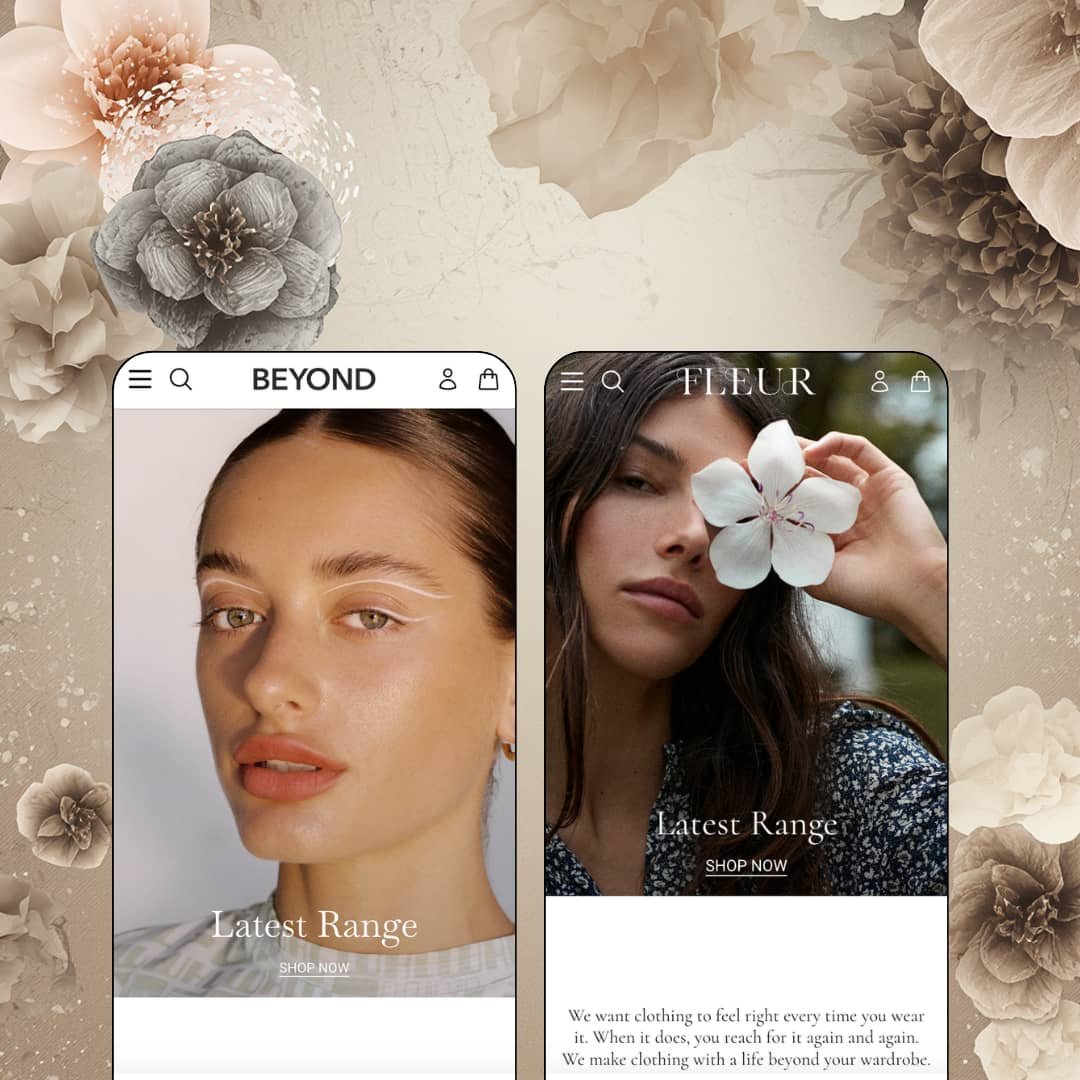
Halfway down the first demo's homepage, I realized I hadn't passed a single product grid yet. That's deliberate: Troop Themes built Beyond, an Online Store 2.0 theme first released in 2021 and carried to version 7.2.0 in June 2026, around the bet that some brands sell more by reading well. Its two presets, Beyond and Fleur, stage jewelry and slow fashion as long-form brand narratives, leading with manifesto-scale typography instead of product carousels. At $420, the open question is whether a storefront this committed to storytelling also closes carts.
Filter groups that speak the catalog's language
Filtering here goes metafield-deep. The collection template layers merchant-defined attribute groups on top of the basics: the demo splits two hundred-odd pieces by birthstone month, star sign, and metal alongside availability, a min-to-max price field, and a name search inside the filter panel itself. That converts attribute-heavy browsing into guided discovery rather than pagination endurance, because shoppers arrive at gift purchases with an attribute in mind, not a product name. For jewelry and accessories brands holding 100 to 500 SKUs organized around occasions, this is the difference between a catalog and a maze.
A variant flow built for expensive decisions
Twenty-six combinations, zero dropdown fatigue. The ring template renders thirteen sizes and two metals as tappable button groups, and once you scroll past the fold, a sticky add-to-bag bar carries the exact selection along with a one-tap Change link, so a $1,612 configuration never silently resets or slips out of view. High-consideration purchases die on variant confusion, and this flow keeps the chosen spec visible through the entire persuasion scroll from gallery to care instructions. Luxury-tier sellers courting considered-purchase buyers will feel that in completed checkouts, not just in polish.
Merchandising slots inside the browsing surfaces
Where does promotion live in a theme this averse to banner noise? Inside the surfaces shoppers already use. The collection grid seats a designed callout card, in the demo a Best Sellers tile with its own copy and link, directly among the product cards, and the navigation reserves labeled promo positions for individual products a merchant wants pushed. Placement is the pitch here: offers meet people mid-browse instead of shouting from a rotating hero. Restock-driven stores with cross-shop-heavy buyers get promotional reach without surrendering the calm that justifies the whole design.
One path from impulse to checkout
Quick add sits on product cards throughout both demos, feeding a slide-out bag that greets each addition with a free-shipping progress line and an order-note field. Momentum never leaves the page. A shopper who taps a $98 pair of hoops sees exactly how far they are from the shipping threshold while the catalog is still open behind the drawer, which is precisely when a second item gets added. For evergreen single-brand stores whose average order hovers near a free-shipping cutoff, that progress nudge is a quiet basket-builder running at zero ongoing cost.
The preset family is two deep
Two presets. That's the entire family. Beyond ships jewelry and womenswear as starting points and nothing else, which sits thin at the very top of Shopify's theme pricing, where a single license is often the anchor of a larger launch plan. The section library is versatile enough to be re-staged for other verticals, but every one of those moves starts from a blank calendar rather than a prepared demo. Multi-brand operators and agencies planning seasonal relaunches across distinct verticals should budget genuine re-staging work into each additional storefront.
The design demands a content operation
Every strength above assumes you can feed it. Manifesto statements, three-part brand-story blocks, per-product narratives, and journal tie-ins all render as empty stages until a merchant supplies serious copy and photography, and both demos set that bar with professional imagery borrowed from working brands. There's no halfway version. A store that fills these sections with thin placeholder text will look worse than one running a simpler theme honestly, because the layouts frame every word like it matters. Merchants running impulse-buy assortments at budget price points won't recoup the production effort, since their buyers never read this far down a page.
A 2021 foundation at a 2026 price
Beyond runs the same Online Store 2.0 generation as Dawn, Shopify's free default, so the $420 buys design language and section craft rather than a newer technical base. The foundation is proven. It just isn't new. Blocks nest to the OS 2.0 ceiling rather than the deeper nesting the Theme Blocks generation allows, which limits how far sections can be restructured in the editor without touching code. That matters most for agencies assembling campaign landing pages on tight seasonal cycles, and far less for a single-brand store that adopts the shipped layouts largely as they are.
What it takes to launch
Expect a multi-day pass rewriting manifesto and brand-story sections in your own voice, re-staging the navigation's product and promo slots for your catalog, populating the metafields that power filtering, linking the size-guide and variant-information helper pages, and verifying the five bundled European translations against your final copy.
-
What works in this preset
The homepage walks you through a brand argument before it asks for money. A full-bleed Latest Range hero gives way to two manifesto statements set in heading-size type, then a text-only list of collection links, then a spotlight on a single Signature Pendant with paired calls to action, one into the product and one into a journal post about it. Only after Mission, Production, and Impact each get their own alternating image-and-text block does the page hand you trust tiles and a newsletter form. It's patient. For a fine-jewelry pitch built on provenance and craft, that pacing does genuine persuasion work across nearly a dozen sections without ever raising its voice.
I spent time in the Shop dropdown because it behaves like a small storefront of its own. Four collection columns each list four named products beneath their category, so a shopper can jump straight from the menu to a specific tennis bracelet or birthstone necklace without touching a collection page. The Best sellers entry goes further and renders full product tiles with prices inside the navigation panel itself. Depth like this changes what the header is for. Navigation stops being a routing layer and starts acting as a first browsing surface.
An engagement ring is a four-week promise here, and the template treats it that way. The Round Moissanite page opens on an eleven-image gallery, states the made-to-order lead time before anything else, then unrolls spec bullets, a materials accordion, customer-voice quotes, and separate story, craft, and care blocks as you scroll. Short version: every product gets a landing page. The Pairs well with row keeps a cross-sell present without interrupting the narrative that follows it.
-
What works in this preset
It takes one scroll to see who Fleur is for. The preset restages the theme as a womenswear boutique: hero, a single-sentence clothing philosophy, a text list of collections, then a Xena Knit Top spotlight whose secondary link points into a journal feature on that exact garment. Shoppable image tiles for the Stella Skirt and Bellini Dress connect campaign photography straight to their product pages. It's a small catalog told well, and the storytelling arc that carried gemstones translates to linen without any visible strain.
Product pages here argue for the purchase at the moment it happens. Breadcrumbs, strike-through sale pricing, and accordions for materials, shipping, and care sit above a production-story trio, Quality check, End to end production, and Shipped direct, which moves the About page's whole case onto the buying surface. That's smart placement. A shopper deciding on a $169 linen dress reads the reassurance exactly where the decision gets made, instead of two clicks away on a policy page nobody opens.
The navigation is staged boutique-lean on purpose, two top-level items with collection dropdowns underneath, which keeps attention on imagery rather than menu merchandising. One entry stands out: Voyage Collection points not at a collection page but at a journal feature, folding lookbook-style editorial directly into the shopping path. For a tight apparel line built around seasonal capsules, that restraint mirrors how the clothes themselves are pitched.
Where it stumbles
One thing kept bugging me as I moved through the catalog. Fleur's copy is committed keep-forever slow fashion, restraint over excess, pieces made to outlast seasons, yet the demo merchandising runs deep strike-through discounts, with featured tops cut from $166 to $93 and a vest from $119 to $56. Nothing is broken. But a preset positioned as considered luxury reads oddly when half its showcase is marked down by roughly half, and merchants who borrow this staging wholesale will import the same mixed signal into their own brand.
Reading and shopping share every surface
Across both presets, the theme refuses to keep content and commerce in separate rooms: menu entries open into journal features, every product spotlight pairs a buy link with a story link, and brand arguments sit on the product template itself rather than being exiled to an About page. That dual-path pattern repeats consistently enough to count as the theme's actual thesis. Merchants who invest in editorial material see it working at the point of sale, not just in a blog that nobody visits.
Five years old, still current
Launched in 2021 and updated to 7.2.0 in June 2026, Beyond has been maintained through half a decade of platform churn without its design dating. Both demos read like sites built this year. The maturity shows in small decisions, restrained type scales, consistent spacing, footers treated as brand real estate with narrative blocks and imagery, and it lowers the risk of buying into a product its developer has quietly walked away from.
One blueprint wearing two outfits
Read back to back, the presets are the same skeleton restyled: hero, manifesto, collection list, product spotlight, three-part brand story, trust tiles, in the same order both times. The purchase delivers one storytelling formula with two photography directions, not two distinct design explorations. Buyers hoping the second preset reveals hidden range will find the range lives almost entirely in imagery, and imagery is the part every merchant replaces anyway.
Calm is also a ceiling
The type scale, pacing, and whitespace are tuned for patience on every template in both demos. The conversion toolset is there to run harder promotions, but deploying aggressive urgency inside this measured design would fight the theme's own voice, and neither demo ever shows what that compromise looks like in practice. Merchants whose economics depend on tempo should treat the serenity as a commitment they're signing up for, not a setting they can flip later.
★ 7.6/10
Rating
-
Attribute-driven filtering, in-surface promo placements, and a complete card-to-drawer purchase path cover the core merchandising work end to end; the OS 2.0 nesting ceiling is the main functional boundary.
8
-
Section editing is straightforward, but the templates only look right once substantial copy, photography, and metafield data are in place, so the real learning curve is content, not settings.
7
-
The mobile menu's back-button stacking pattern keeps even the deep product-level navigation usable on small screens, and buy controls stay reachable while long product narratives scroll.
8
-
Pages stay disciplined about weight, with responsively sized imagery throughout and homepages that lean on typography as much as media, reasonable restraint for a theme this visual.
8
-
A capable section library with strong typographic control, but everything bends toward one calm voice; stores wanting loud, dense, or playful layouts will be fighting the defaults.
7
Frequently Asked Questions
-
Not for five European markets: the theme's interface strings ship pre-translated in English, French, Italian, German, and Spanish, with a language selector staged in the demo header.
-
Yes. On apparel product pages, a Size chart link opens beside the size selector, so fit guidance lives at the exact moment of choice rather than on a separate page.
-
The demo catalog paginates across eleven pages and adds a recently-viewed row, so returning shoppers can re-find pieces without retracing the whole catalog.
-
The official feature list includes combined listings, flagged specifically for Shopify Plus stores, worth confirming with Troop Themes if that structure is central to your catalog.
-
Troop Themes maintains public documentation at support.troopthemes.com, and recent Theme Store feedback repeatedly credits the team's responsiveness on customization questions.
-
Version 7.2.0 shipped on June 26, 2026, continuing an update cadence that has run steadily since the theme's 2021 launch.
This review is based on hands-on testing of the publicly available preset demos of the Beyond Shopify theme as of August 2026. Theme features, preset availability, and performance can change with subsequent updates from the theme developer.