
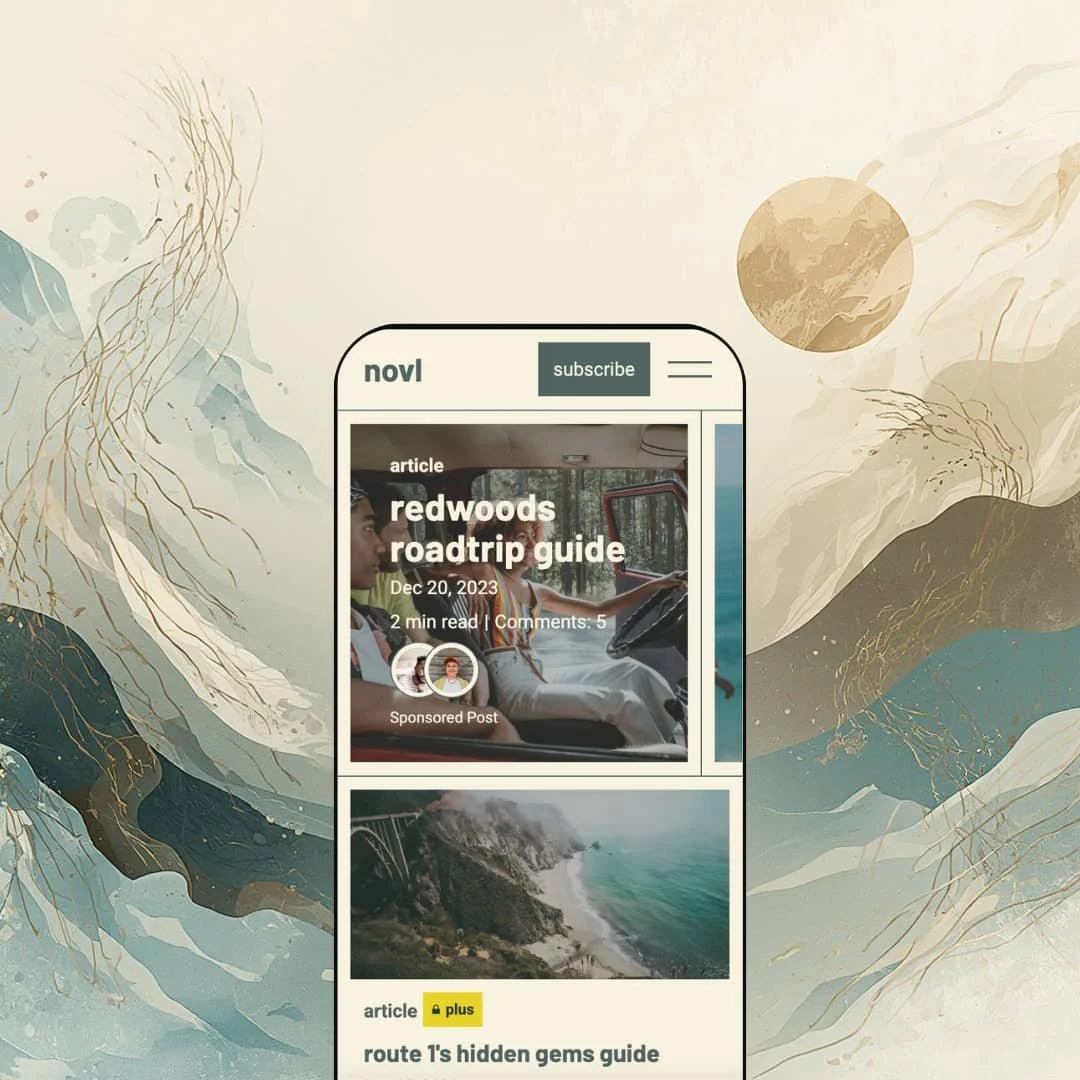
Most Shopify themes treat the blog as an afterthought. Zora builds the entire store around it. NOVL's $300 Online Store 2.0 theme positions itself as an all-in-one membership platform, putting gated articles, podcasts, and video interviews in front while a small merch shop runs behind them. If you sell content first and products second, this is one of the few themes built for exactly that; if it's the reverse, read the Cons before anything else.
Membership gating is built into the theme itself
Zora ships a four-tier membership panel, with Standard, Premium, and Plus tiers laddering storewide product discounts at 10%, 20%, and 30% while unlocking progressively deeper pools of article, audio, and video content. No plugin sits behind it. For subscription-driven creators and educators selling a compact merch line under 30 SKUs, this consolidates what would otherwise be a memberships app, a discount app, and the integration work between them.
Articles, podcasts, and video are all first-class formats
What does a blog post look like when it's the product? Here it carries a format label, a read time, a comment count, and a tier badge, while the episodes row embeds playable audio directly on the homepage instead of routing listeners off to a third-party platform. Video interviews get the same treatment. Podcast networks and travel publishers coordinating multi-host production schedules will feel that difference daily.
Contributor attribution runs through the whole system
Every article card on the demo carries avatar bylines tagged by role, and each writer, host, and videographer gets a dedicated profile page linked from both the content feed and the footer navigation. Sponsored posts render as their own labeled card type, with a Sponsors page alongside. That's a revenue surface, not decoration. Multi-contributor publications funding themselves through sponsorship deals get attribution and disclosure machinery without a custom build.
The mega menu turns blog tags into magazine navigation
I clicked into the Destinations menu expecting a flat tag list and found a three-level tree instead: four US regions expanding into roughly forty state-level links, plus a separate Topics column spanning food, music, camping, and gift guides. Archives stay browsable at scale. For destination publishers and local-content brands sitting on a hundred-plus articles, this is the difference between a magazine and a scroll-forever blog.
Product-first merchants are working against the grain
Every surface routes attention toward subscription: the header leads with a Subscribe trigger, the homepage opens on a featured article rather than a featured collection, and the cart toolkit amounts to notes, in-store pickup, and a sticky cart. Commerce here is a sidecar. If products are your business, this is the wrong tool. Apparel or electronics merchants running evergreen, product-led catalogs of 100+ SKUs should look elsewhere.
One preset means one staged answer at a premium price
That's a thin evaluation surface for $300. The roadtrip-magazine demo is the only staged reference point, so a fitness educator or a music label planning the same membership model has to mentally re-skin every section before knowing whether the theme fits their world. At this price, the burden of imagination sits entirely with the buyer.
The track record is one review deep
Zora launched in March 2024 and has collected exactly one Theme Store review since. That review is positive, and the version history shows live maintenance with 2.0.2 shipping in January 2026, but a sample of one says almost nothing about how support holds up under pressure or how updates land across real stores. For single-operator creators betting an entire content business on one theme from one small developer, that's a genuine diligence item.
What it takes to launch
Expect a multi-day structural pass before launch: multi-format content production across articles, audio, and video, contributor profile pages, the tag-naming convention that powers the destination navigation, membership tier configuration, menu re-staging, and a full copy and imagery replacement.
-
What works in this preset
Landing on the homepage feels like opening a travel magazine, not a store. A featured article hero leads, followed by a mixed feed where every card declares its format as Article, Audio, or Video, alongside read times and comment counts that run as high as fourteen on the Oklahoma literary piece. Commerce waits its turn. Products don't appear until well down the page.
Tier badges do quiet persuasive work throughout the feed. The Route 1 hidden gems guide carries a plus badge, the Alabama interview video is marked premium, and locked media swaps its player for a log-in-or-subscribe prompt rather than hiding the card entirely, so visitors can see precisely what they're not getting. I scrolled the feed twice before noticing how deliberately locked and unlocked items are interleaved. That's clever funnel staging for a content business.
The gear shop is deliberately small. Six monochrome merch items fill the collection, the trucker hat wears a 14% sale badge, and the collection page pairs a filter rail covering price, availability, and collection facets with an infinite-scroll loader instead of numbered pagination. It reads as a magazine's merch shelf, which is exactly what the vertical calls for.
Where it stumbles
The commerce half rides on the spec sheet. I went looking for the before/after slider, product tabs, and product videos that the feature list promises, and the demo's product pages never stage any of them; the t-shirt page runs a thumbnail gallery, a quantity stepper, a share row, and a lone Default variant. Buyers evaluating the merchandising toolkit get a list of claims, not a demonstration.
Zora is less a storefront with a blog than a publishing operation with a checkout attached.
Its defining trait is single-mindedness: the membership pitch follows you from the navigation to the article feed to the price line on the demo merch, all pulling toward one recurring-revenue funnel. That coherence is rare on the Theme Store, and it's also the ceiling, because nothing in the design hedges toward conventional retail.
Treat the purchase as a business-model commitment rather than a visual choice, and it earns its place; treat it as a regular theme and it will fight you.
Rating
★ 6.8/10
-
Tiered content gating, inline media playback, and contributor profiles cover territory few themes attempt; the commerce layer is serviceable rather than deep.
8
-
The tag convention behind the destination menu and the tier configuration mean real setup work before the theme performs as demonstrated.
6
-
The card-based feed and embedded players translate naturally to small screens; the three-level destination menu asks for patient tapping on a phone.
7
-
Content pages carry heavy media loads of audio, video, and large editorial imagery, while product and collection pages run noticeably leaner.
7
-
One preset and one editorial aesthetic: strong inside the magazine lane, narrow the moment you step outside it.
6
Frequently Asked Questions
-
Yes. A Free tier sits ahead of the $5, $8, and $12 paid tiers in the subscribe panel, so a list-building entry point exists before anyone pays.
-
Theme UI strings come pre-translated in five EU languages (English, French, Italian, German, Spanish). Translating your own articles and products is separate, platform-level work.
-
Version 2.0.2 shipped on January 5, 2026. NOVL, based in Austin, hosts its documentation and a support request form on its own site.
-
Yes, and engagement is surfaced: the redwoods guide shows five comments directly on its card, so active discussion becomes visible merchandising for the content itself.
-
The footer signup pairs the email field with interest checkboxes for camping, RVing, food, art, and music, so subscriber lists arrive pre-segmented.
-
The toolkit includes filtering, sorting, breadcrumbs, and infinite scroll, but the demo tests them against only six products, so large-catalog behavior is unproven on what's publicly staged.
This review is based on hands-on testing of the publicly available preset demo of the Zora Shopify theme as of June 2026. Theme features, preset availability, and performance can change with subsequent updates from the theme developer.