
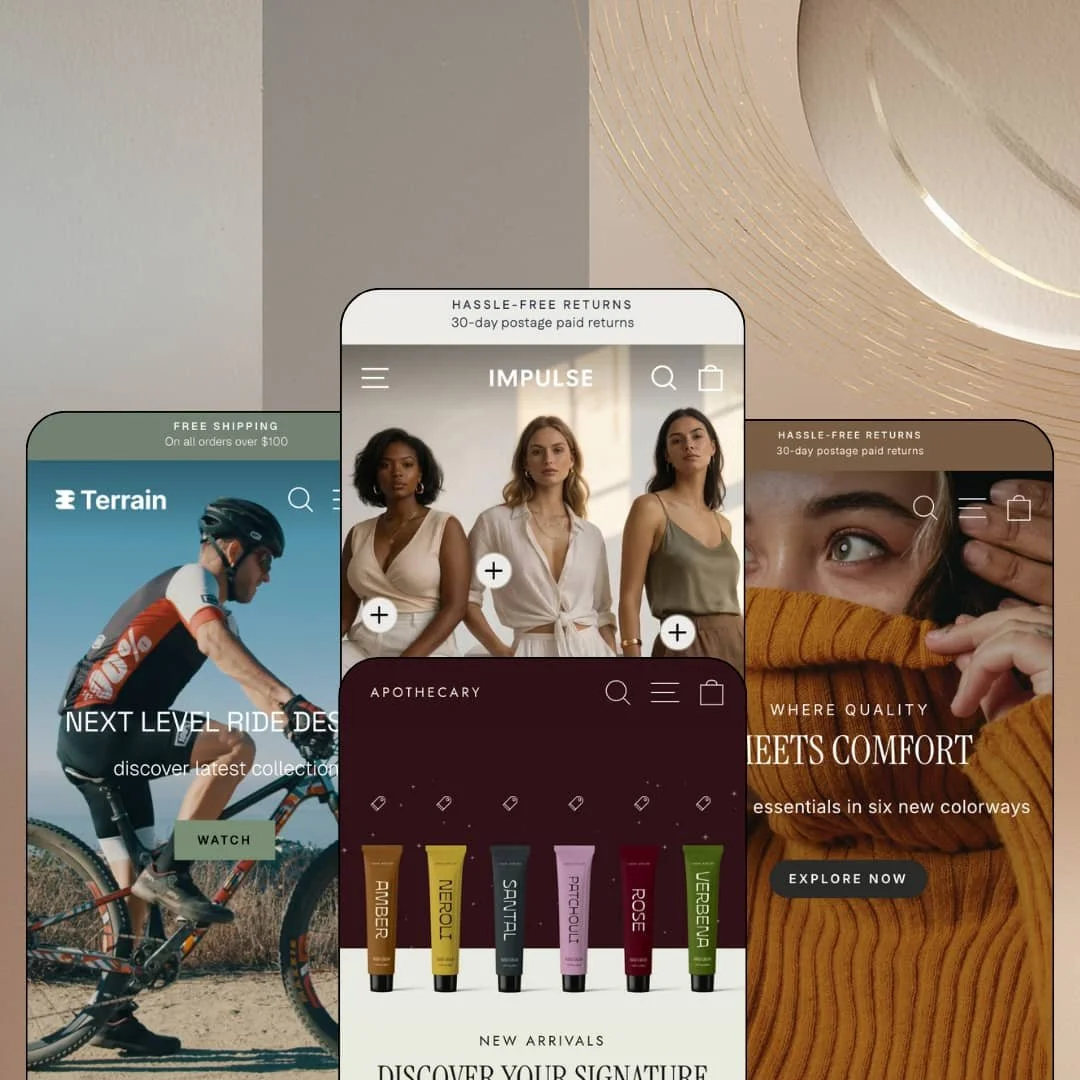
The demo store parked at Impulse's jewelry URL sells hand soap. That mismatch tells you how long this theme has been in circulation: Archetype Themes launched Impulse in August 2018 and has re-staged its demos so many times since that the addresses no longer match the storefronts. Today it runs on Online Store 2.0 architecture, sits at version 9.2.0 as of July 2026, and ships four presets: Impulse, Dune, Terrain, and Apothecary. At $500 it is one of the most expensive listings in the Theme Store, and that is the bar this review holds it to.
A promotions kit that actually coordinates
Terrain's announcement bar rotates a free-shipping message and a product-launch teaser, each with its own link, while sale cards compute and print the exact markdown ("Save 21%") instead of a bare sale flag; countdown sections, promo tiles, banners and popups fill out the rest of one coordinated promotions kit. Nothing here needs an app. For drop- and sale-driven apparel and sports merchants running 50 to 500 SKUs on a recurring campaign calendar, this set is the core purchase argument.
How much selling can a dropdown do?
Across the preset demos, every mega menu panel pairs up to three levels of links with an image-and-caption promo block, so the navigation itself becomes campaign real estate that changes with the season rather than sitting there as a static sitemap. Menus rarely work this hard. Multi-category and multi-brand retailers with 100-plus SKUs and a promotion to push every month will touch these panels weekly.
Quick-buy that reads the product first
The card-level buy control checks each product's option structure before deciding what to be: single-variant items get a straight Add to Cart, configurable products swap the same slot for a quick-view trigger that the sports demo labels "Customize", and colorway siblings surface as swatch links right on the card. No dead-end add-to-cart misfires. That serves impulse-led beauty and CPG stores under 100 SKUs just as well as configurable big-ticket gear where blind one-click buying would break.
The physical shop is part of the storefront
Impulse treats brick-and-mortar as a first-class surface. In-store pickup is supported natively, the header carries a slot for the shop's street address, and the product template can close with a store section holding a map link and full opening hours, which quietly turns every product page into an invitation to walk in. Single-location boutiques and brick-and-click retailers with local, repeat-visit customer bases get that layer with zero custom work.
You are not paying for the architecture
The architecture is not the product here. At $500 it can't be. Impulse runs the same Online Store 2.0 generation that Dawn, Shopify's free default, has shipped since 2021, so the entire premium rests on the section library, the promotions tooling and eight years of refinement rather than on anything generational. First-store merchants on starter budgets with catalogs under 50 SKUs will struggle to justify the gap on those grounds alone.
The default voice is discount-first
A dropdown in the apparel demo ships with a "25% off all Flannel" caption baked into the menu itself, entry popups open with signup discounts, and the sum is a theme whose path of least resistance is a store that permanently looks on sale. This kept bugging me on the calmer demos too. Full-price luxury brands, from fine jewelry to considered-purchase furniture, will spend real hours stripping that register out before launch.
The storytelling layer is hand-fed
Component breakdowns, testimonial quotes, size tables and trust rows all live as content blocks the merchant writes and maintains page by page, and I went looking for any sign of a product-data-driven alternative in the demos without finding one. Every spec is a copy-paste job. Spec-heavy bike or electronics retailers with 200-plus SKUs and seasonal catalog turnover should price that maintenance into the decision.
What it takes to launch
Expect a multi-day pass across promotional copy and scheduling, mega-menu promo imagery, product-template tab content, and a review of the five pre-translated language files before launch.
-
What works in this preset
Arrive on the flagship demo and the hero image is already selling: products are pinned directly onto the lifestyle photo, shoppable the moment the page loads. Archetype leads its own Theme Store pitch with exactly this mechanic. It earns the billing.
This is the preset that carries the theme's name, and it behaves accordingly: a bold campaign hero, sale banners and testimonial blocks stack into a homepage that reads like a conversion sequence instead of a lookbook, tuned for fashion catalogs that live on seasonal pushes. Nothing about it is subtle.
-
What works in this preset
Open the navigation and this store organizes itself around brands before categories. A Shop-by-Brand panel lists five labels, Muttonhead through Beside, each wired to its own vendor collection so a shopper can follow a label loyalty rather than a product type. Five labels, one panel.
"Made to go together," says the shop-the-look section, and it proves the point by pinning a $6 stationery card and a $270 velvet blazer onto the same lifestyle image, each with its own view-product callout, a price spread that shows the hotspot mechanic handling accessories and hero pieces in a single frame. Small detail, real range.
The slideshow rotates three campaign slides with independent copy and calls to action, and the rest of the homepage alternates category tiles with brand-story panels for the denim line. It never sits still.
Where it stumbles
Brands are staged as plain vendor collections, which means the storefront's multi-brand ambition stops at the menu: I found no dedicated brand-index or brand-profile template in evidence, so a retailer carrying twenty labels would be building brand pages by hand. For a demo that leads with Shop by Brand, that ceiling is worth knowing before purchase.
-
What works in this preset
A $5,999 trail bike is not an impulse purchase, and this preset's navigation respects that: the Bikes menu drills past collections down to individual builds, Carbine Factory, Tracer Elite and the rest, so a rider who already knows the model reaches it in one click. That is unusual menu discipline.
Scroll a product page and the buy box is only the opening act. The Carbine Expert template rolls into component breakdowns for frame, wheels, chain and cassette, a ten-year-guarantee panel, shipping-and-assembly feature rows and an embedded ride video, which adds up to long-form persuasion built for a considered purchase.
Where it stumbles
Then the same storefront pivots to outlet mode. Save-up-to-70% messaging threads through the homepage and the menu's own promo panel, and against four-figure flagship builds that register reads like a clearance rack parked inside a showroom, a tension merchants selling premium sports equipment will need to stage their way out of.
-
What works in this preset
The hero here doesn't point at products, it is the products: six hand creams pinned across one flat-lay image, each hotspot opening straight to a price and product page. I clicked through every one of them. The staging makes a small catalog feel like a counter display.
"Botanical Formulations · Single Scent Philosophy" scrolls past in a ticker, value-proposition rows preach personalization and longevity, and a sustainability statement anchors the footer, a register so calm it is hard to believe this shares a section library with the bike shop. The contrast is the argument.
Product-family merchandising carries the Tonka launch: a limited-edition banner introduces the new scent, then a full row stages the candle, conditioner, oil, cream and soap as one coordinated line. Nine scent collections, Neroli to Oud, handle the rest of the wayfinding.
One grammar, four registers
Read the four demos back to back and the same section vocabulary produces a loud outdoor storefront, a casual multi-brand shop and a hushed apothecary without changing its skeleton, spanning low-ticket body care to four-figure sports equipment on one design system. Few pre-purchase questions matter as much as whether a theme can hold your register. Impulse demonstrably holds several at once.
Longevity you can verify
Eight years separate the August 2018 launch from the 9.2.0 release of July 2026, and the demos themselves show ongoing re-staging rather than abandonment. For a one-time license meant to run for years, a developer still actively shipping updates to a 2018 product is evidence, not marketing copy.
Campaign-asset hunger
Everything that makes Impulse distinctive is a surface someone has to keep fed. Menu promo blocks, hero rotations, hotspot imagery and ticker copy all assume a steady supply of photography and offers, and a store without a real campaign calendar leaves the theme's best real estate sitting blank.
Listed verticals without a preset
The Theme Store files Impulse under jewelry & accessories and food & drink, yet none of the four demos stages either vertical. Buyers in exactly those categories have to imagine their store into a preset row that never shows it, which is a strange gap for a preset family this mature.
★ 8.0/10
Rating
-
The promotions set, adaptive quick-buy, pre-order handling and age verification add up to an unusually complete conversion toolkit inside one license.
8
-
Section staging is legible across all four demos, but the sheer volume of promo surfaces means the first setup week goes to scheduling and re-dating rather than design.
8
-
Slide-out navigation, a drawer cart and touch-sized hotspot callouts keep the promo-dense layouts workable on small screens.
8
-
The demos run image-led but disciplined, with lazy-loaded media and homepages that stop at a sane section count despite the promotional density.
8
-
Apothecary calm and outlet-loud Terrain coming from one theme is the flexibility argument made visually; typography and color range across the demos back it up.
8
Frequently Asked Questions
-
Theme UI strings come in English, French, Italian, German and Spanish; product content still needs its own translation workflow.
-
Yes. Each demo maintains a dedicated pre-order product page, with the button states handled by the theme itself.
-
A built-in age verifier is part of the feature set, relevant for alcohol, supplements and other 18-plus product lines.
-
Yes, flagged as a Shopify Plus feature on the listing, which matters for merchants consolidating colorways into a single product page.
-
9.2.0, released July 6, 2026.
-
Yes, it ships in the merchandising set, so skincare, detailing and restoration stores get their proof format without an extra install.
This review is based on hands-on testing of the publicly available preset demos of the Impulse Shopify theme as of August 2026. Theme features, preset availability, and performance can change with subsequent updates from the theme developer.