
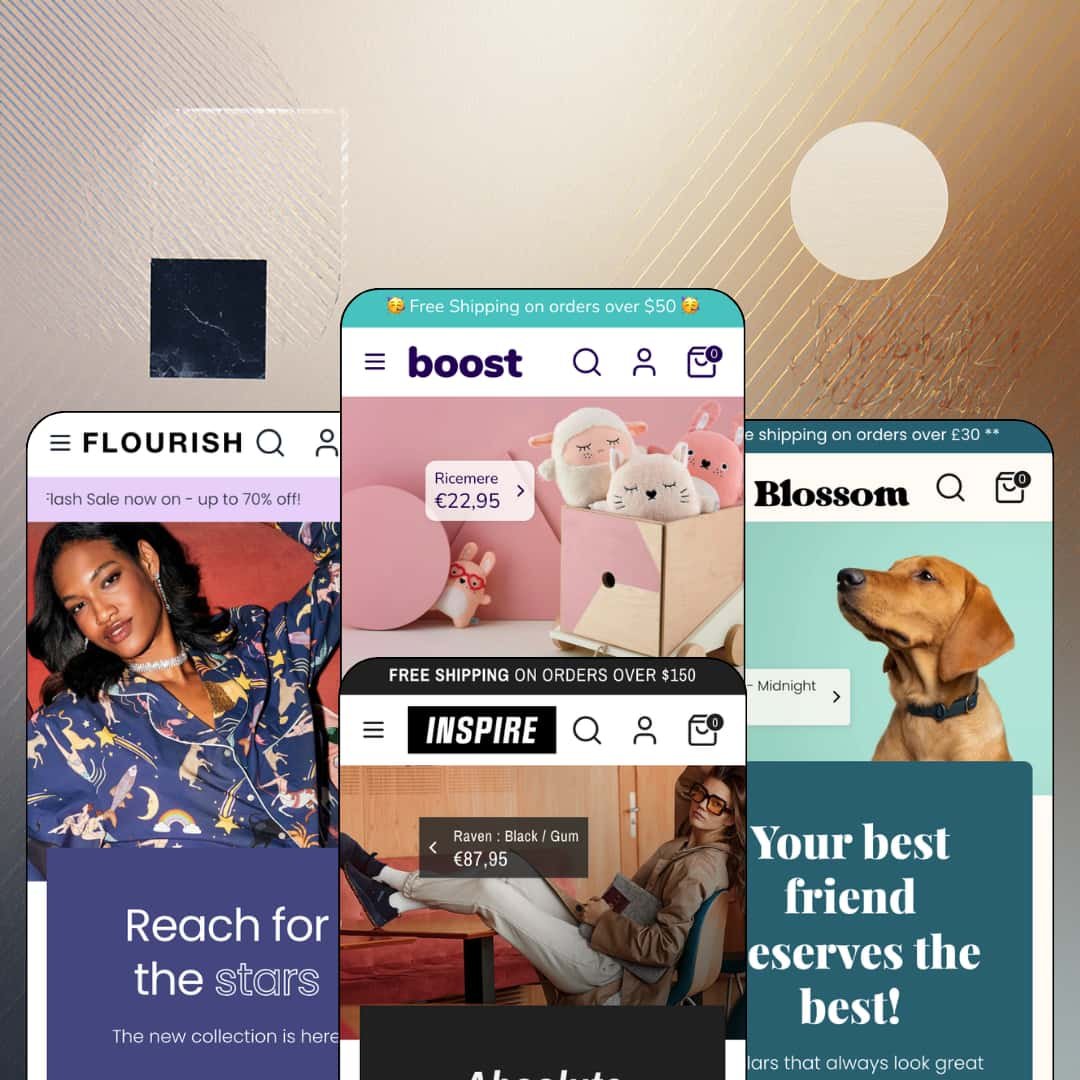
Eight years is a long shelf life for a Shopify theme. Boost has been selling since October 2018, and Clean Canvas has carried it through the Online Store 2.0 transition all the way to a March 2026 update without softening its pitch: a loud, promotion-forward storefront for playful brands. Four preset demos (Boost, Flourish, Blossom, Inspire) cover toys, print-led accessories, pet gear, and sneakers at a $380 price. I spent time in all four to see whether the age shows.
Shoppable imagery runs through the whole theme
Hero slideshow slides carry tappable product tags with live prices and compare-at strikethroughs, and a dedicated hotspot section pins up to six products onto one lifestyle image. The photo becomes the shelf. For impulse-led catalogs under 100 SKUs, toy brands and pet accessory lines especially, where photography does most of the selling, this is the theme's strongest single argument.
How loudly do you want to sell?
Boost treats promotion as a layered system: an announcement bar up top, promo tiles mid-page, a looping flash-sale ticker between sections, and a promotional slot inside the mega menu itself, staged in the Inspire demo as a save-up-to-50% tile beside the navigation columns. Merchants can dial the volume from one quiet strip to a storefront that shouts on every scroll. The whole kit ships native. For discount-driven, flash-sale-pattern stores in mid-market apparel and footwear, that volume knob is the value.
Collection pages merchandise, they don't just list
The Toys collection in the Boost demo runs a filter set with live result counts covering availability, a min-to-max price range, product type, and thirteen separate color values, next to an eight-option sort menu. A spotlight card promotes one sale item inside the grid itself. That's merchandising, not plumbing. For stores at the upper end of the theme's 11-to-100-plus catalog positioning, in color-led categories like footwear or toys, the filter depth arrives pre-configured rather than as an afterthought.
The buy box carries real operational information
On Inspire's Raven product page, the stock line reads out exact units (24 in stock, ready to ship), the color option renders as a photo-thumbnail swatch, and a store-pickup block shows the flagship location with a usually-ready-in-four-hours window plus a directions link. Shoppers get answers, not vibes. For merchants running a physical shop alongside the webstore and selling considered purchases in the $99-to-190 range, the buy box does genuine operational work instead of decorating the add-to-cart button.
There's no cart drawer, and buyers have noticed
I went looking for a slide-out cart and found a full page redirect instead; the header cart icon in all four demos routes straight to the cart page. A merchant review from February 2026 flags the missing drawer option outright, and Clean Canvas's reply promises major updates over the coming months, which means the gap is acknowledged but not yet closed. That's a hole in a conversion-first pitch. For impulse-buy, cross-sell-heavy stores, flash-drop toy or sneaker merchants moving low-ticket items, the page detour adds friction exactly where this theme promises to remove it.
Design freedom has ceilings, especially in type
An August 2025 merchant review criticizes the limited freedom in fonts and titles relative to what the buyer expected, and nothing in the current demos contradicts it, since heading treatments repeat in fixed patterns across all four presets. The system look is cohesive. It's also confining. For design-led, single-brand stores at the luxury end that live or die on typography, $380 buys a strong house style rather than an open canvas.
A 2018 architecture at a 2026 price
Boost sits on the Online Store 2.0 generation while Shopify's free Dawn covers the same sections-everywhere editing baseline at zero cost, so the $380 has to be justified entirely by the promotion and merchandising layer stacked on top. The newer Theme Blocks generation supports blocks nested up to eight levels; Boost predates it. That runway isn't there. For single-brand merchants making a considered, multi-year platform decision, the architecture's age belongs in the calculation alongside the feature list.
What it takes to launch
Expect a one-to-two-day pass covering copy and imagery replacement across four storytelling-heavy homepages, mega menu re-staging (the demo menus link to individual demo products), and promotion configuration spanning the ticker, tiles, banners and popups before launch.
-
What works in this preset
The homepage opens mid-story rather than mid-pitch. Illustrated Noodoll characters front the hero, and the demo commits fully to the fiction: a Ricetown world with a farm, weather monsters, and a resident rockstar plush whose product blurb reports he just played his best gig in London. It's silly. It's also exactly how a toy brand earns attention, and the theme's storytelling sections give the bit room to breathe instead of squeezing it into a banner.
Navigation is built for gift shoppers, not SKU managers. The Shop menu splits three ways, by category, by character personality (Shy, Happy, Funny, Naughty, Adventurous) and by gift intent (kids, babies, creatives, last chance), with an image promo card riding alongside the columns. That taxonomy sells the browsing itself, and it maps neatly onto how people actually buy presents for children they only half-know.
Scroll far enough and the blog earns its slot. Posts carry named authors, dates and a shop-the-story tie-in that routes readers back to the products each article features, while a press wall stacks Vogue, Wired and Women's Health logos directly above the reviews block for borrowed credibility.
-
What works in this preset
A founder biography does the heavy lifting here. The demo introduces a designer who established her label in 2013 after London's Royal College of Art and built it on illustrative silk scarves, and that narrative anchors the page before any grid of products gets a word in. Fashion buyers shop the person as much as the product. Flourish is staged around that truth.
You also see how Boost handles a brand that refuses one lane. I noticed the staged testimonials span a silk scarf, a swimsuit and cat-print cushions, which quietly demonstrates a print-led label selling across apparel, swim and homeware inside a single storefront, while the value row (free shipping over $100, a 14-day contact window, ethical production) holds the mixed catalog together. The mix reads deliberate.
-
What works in this preset
Twelve products, give or take. That's the whole store: a collar, a leash and a poop-bag holder in three colorways each, plus a walk set and eco bags, priced in pounds. Blossom is the honest small-merchant demo of the family, and the homepage still fills out completely, which is the real proof for a two-person pet brand wondering whether a $380 theme is overkill for a tiny catalog.
You get the values pitch with real structure behind it. Alternating image-and-text blocks walk through the materials story, a one-percent-per-sale shelter donation and the brand promise, and a get-the-look block ties lifestyle photography to a purchasable product row, so a mission-led brand can argue its case in between the buy buttons.
Where it stumbles
The navigation doubles as the product list. With a catalog this small, the mega menu links to every individual product by name, and that browsing model quietly stops scaling the moment the range grows beyond what a menu can hold; merchants who expand will be re-staging the navigation from scratch.model quietly stops scaling the moment the range grows beyond what a menu can hold; merchants who expand will be re-staging the navigation from scratch.e exuberant palette can skew juvenile if you sell premium or clinical goods. Re-skinning colors and toning down highlights is often required to match a sober identity.
Because the palette is opinionated, introducing monochrome or muted branding takes deliberate adjustments to backgrounds, buttons, and accents. Without that, visuals may clash.
-
What works in this preset
How do you navigate a sneaker line where every colorway is its own product? Inspire's answer is a three-column mega menu that splits the flagship Raven silhouette into men's, women's and mini editions and links named colorways like Ash Rose / White and Halogen Blue / White directly, so the menu itself becomes a colorway index that mirrors how sneakerheads think.
The demo also sells the offline half of the business. A flagship-store block lists the address and opening hours with a Google-directions link, and the journal reads like genuine sneaker editorial, introducing a sole unit developed over an eighteen-month period rather than filler posts. Retail plus content, one storefront.
Where it stumbles
Color discovery lives entirely in that menu. Because each colorway ships as a separate product, the demo stages sibling-color browsing in the navigation rather than on the product cards, and wiring those relationships together is merchant-side catalog work; stores with deep colorway matrices should budget setup time before this pattern pays off.
Real brands make the demos honest
All four demos run licensed real-world catalogs, from Noodoll plush through Arkk Copenhagen sneakers to Westley pet gear, complete with genuine price ladders, sold-out states and colorway sprawl. What you evaluate is much closer to a live store than a staged mood board, and that honesty makes the pre-purchase trial unusually informative.
A consistent personality that survives four verticals
Toys, prints, pets and sneakers all speak in the same upbeat register, from emoji-framed announcement bars to a testimonials block cheerfully titled Testi-bone-ials in the pet demo. The voice never collapses into chaos. A theme with an actual personality is a genuine differentiator, provided the merchant's brand wants that energy.
Sized truthfully for small catalogs
The presets stage between roughly a dozen and a few dozen products each, which matches the Theme Store's stated 11-to-100-plus catalog positioning instead of overselling it. Navigation depth, menu design and homepage grammar all assume a store an owner can hand-curate, and the demos prove the layouts hold at that scale.
Four skins, one skeleton
Read back-to-back, all four homepages follow the same running order: hero, collections, ticker, story blocks, featured product, press wall, testimonials, blog, icon row, newsletter. Differentiation comes from palette and photography rather than sequence. Two Boost stores in the same niche will need deliberate re-arranging to avoid resembling each other.
The layouts assume an asset library you may not have
Every preset leans on professional lifestyle photography, press logos and video to carry its sections. With stock imagery and no coverage to show, the same storytelling blocks thin out fast, and what reads as immersive in the demos can read as empty in a bootstrapped launch.
★ 7.4/10
Rating
-
Promotion, hotspot and filtering tooling runs deep for the tier; the cart experience and app-dependent review layer hold it back from top marks.
8
-
Presets arrive as complete working stores with menus, pages and promos pre-staged, so most launch work is swapping content rather than building sections.
8
-
Navigation collapses into a stacked accordion menu and imagery ships in responsive sizes; nothing in the layouts depends on desktop-only patterns.
7
-
Homepages run long, with slideshows, video, tickers and a dozen-plus sections; images lazy-load, but the default staging is content-heavy and rewards pruning.
7
-
Color and layout options cover the expected range, but type control is the documented sore spot and the preset family shares one page grammar.
7
Frequently Asked Questions
-
Version 8.1.0 landed on March 26, 2026 and added support for Shopify's new account login, continuing an update record that now stretches more than seven years past the 2018 launch.
-
No. The ratings under demo product titles are rendered by a review app; the theme supplies the placement hooks, and the review engine is a separate install.
-
The theme's interface strings come in English, French, Italian, German and Spanish out of the box, while translating your actual product content still runs through Shopify's own localization workflow.
-
Yes. The Boost demo's Toys collection runs a full hotspot storytelling section beneath the paginated grid, so category pages can merchandise like landing pages instead of ending at the last product card.
-
Product cards across all four demos carry a quick-buy trigger, and the theme lists a separate quick view, so shoppers can act on a product without committing to a full page load.
-
Clean Canvas, a developer with a multi-theme catalog in the Theme Store; documentation lives at cleancanvas.co.uk/support/boost and support requests run through the developer's own portal.
This review is based on hands-on testing of the publicly available preset demos of the Boost Shopify theme as of August 12 2026. Theme features, preset availability, and performance can change with subsequent updates from the theme developer.