
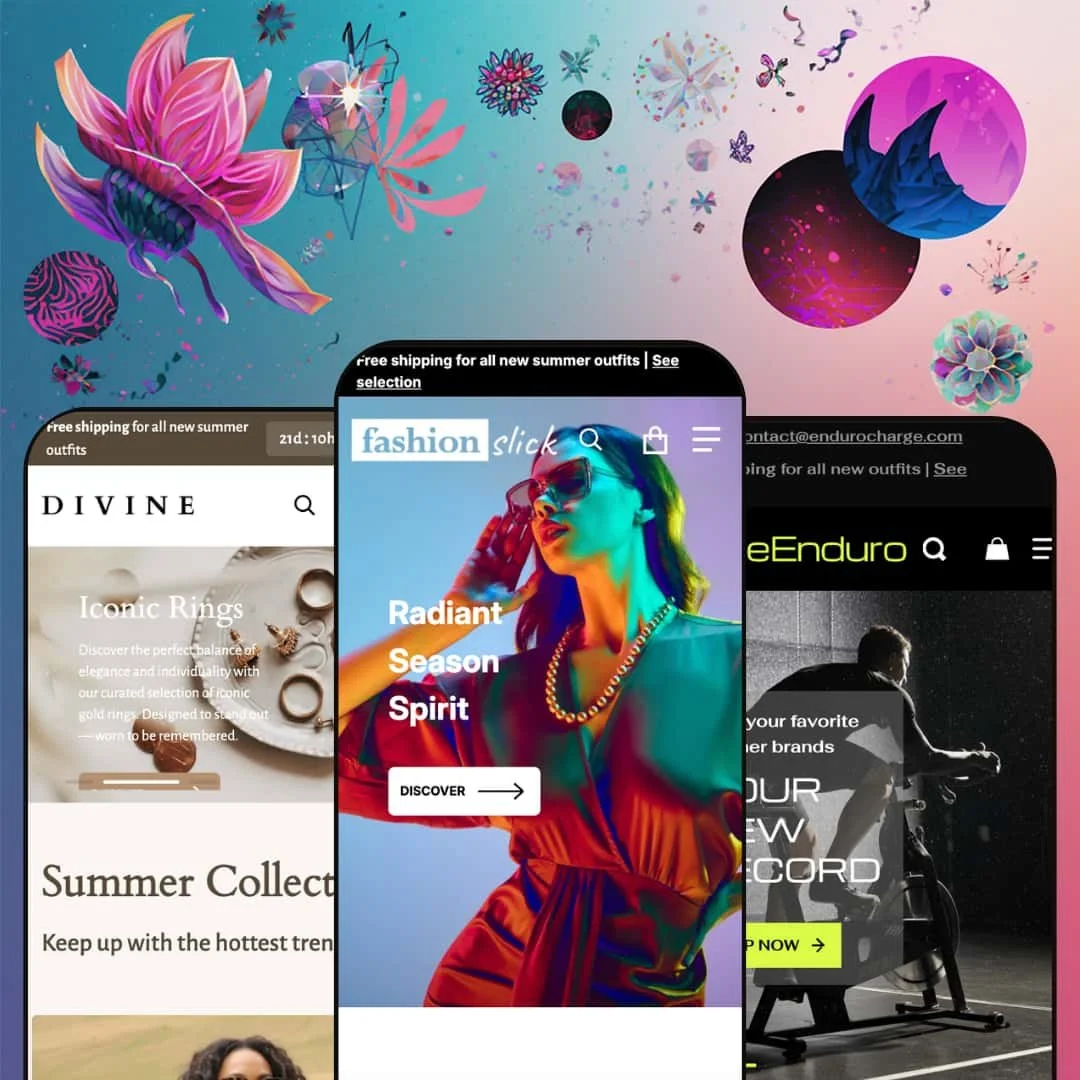
Most $120 Shopify themes ship one preset and call it a season. Divine ships three, and they're three different businesses, not three palettes of the same one. The Divine preset stages a women's summer fashion store, Oldmoney runs a luxury jewelry catalog with CHF 5,999 statement necklaces, and Enduro builds out a fully-stocked fitness equipment store. Whether the architecture and section library hold up against that ambition at the budget price point is the question this review answers.
Three legitimate verticals from a $120 license
Divine packages three full presets under one $120 license: Divine for women's summer fashion, Oldmoney for luxury jewelry pricing up to CHF 5,999, and Enduro for fitness equipment with an 11-collection catalog. These aren't color variants of the same demo. They're three distinct brand identities with distinct hero compositions, distinct mega menu treatments, and distinct section ordering. For multi-brand operators running two or three Shopify stores at the budget tier, where a single Premium-tier license can cost three times what Divine asks, three viable starting points from one purchase change the math. For solo merchants likely to pivot brand direction within the first year, having three preset templates pre-built into the same license cuts the cost of an experiment.
Section-library depth at a sub-$150 price point
For apparel, jewelry, and equipment merchants planning content-rich PDPs and conversion-led homepages at a budget license cost, Divine ships an unusually deep section library. The roster reads long. Image hotspot sections, before-after image sliders, product video grids with .mp4 hover previews, lookbook sections, featured single-product blocks, marquee text strips, and image-banner pairs all appear across the preset demos. At $120, that's section breadth that opens content-heavy PDPs and long-scroll homepages without bolting on third-party page-builder apps. For DTC brands with 50–200 SKUs that want to merchandise via long-scroll homepages and content-heavy product pages, the section breadth lifts what's possible at this license level.
Conversion-feature bundle pre-wired across all three presets
The conversion stack arrives assembled. Countdown timer in the announcement bar (Oldmoney) plus a Flash Sale countdown on collection pages (Enduro), stock counter on PDPs ("In stock 1 left", "In stock 3 left"), product badges with sale percentages, three-up trust badge rows above the fold, in-menu image promo tiles, cross-sell and "Pair well with" strips on PDPs, plus newsletter-with-discount as the email-capture default (Oldmoney leads with "Sign up & save 15%"). For DTC merchants with 50–200 SKU catalogs running flash drops, seasonal promotions, or scarcity-led merchandising, this is a coordinated conversion mechanism wired in at install. Building this stack from scratch through app subscriptions runs into real recurring cost, even before the integration work.
Multi-content mega menu architecture varies per preset
Each preset uses a different mega menu pattern, all built from the same theme primitives. Oldmoney runs three-tier deep nesting (Jewelry to Woman to Rings, Earrings, Necklaces, Diamonds) plus featured-product tiles inside the Best Sellers panel and a black-and-white image promo column. Enduro uses visual category tiles where every Cardio sub-category gets a thumbnail photograph (Cycling, Treadmills, Stair Climbers, Ellipticals, Exercise Bikes) alongside two in-menu image promo blocks. Divine keeps text columns plus in-menu product tiles. Three menu patterns, one theme. For catalog-heavy merchants with 50+ SKUs distributed across multiple category branches who depend on navigation as a primary discovery surface, the per-preset variation gives a real choice of structural patterns rather than a single one-size-fits-all menu.
Online Store 2.0 architecture at the launch boundary of the Theme Blocks era
Divine launched in October 2024, which puts it on the Online Store 2.0 baseline rather than the Theme Blocks generation introduced in mid-2025. No AI-block generation surface, no deep-nested blocks beyond roughly two levels, no Web Components in the markup. At $120 the architectural lag isn't damning. But for merchants with internal development teams planning multi-year customization roadmaps, or stores with 200+ SKU catalogs depending on deep block-level merchandising, the generation gap matters: it means Liquid customization rather than block composition for anything past the standard editor surface.
Three presets, three narrow verticals
The three preset choices (women's summer fashion, luxury jewelry, fitness equipment) are wildly different from each other but also wildly specific. For merchants selling in verticals outside these brackets (home goods, food and beverage, electronics, B2B wholesale, professional services, hospitality), the demo replacement work runs heavier than the headline preset count suggests. Each preset's section composition is shaped to its vertical. Oldmoney's product video grid stages jewelry, Enduro's collection-page filter rail is wired for fitness equipment specifications, and Divine's lookbook section assumes model photography. A home-goods brand starting from Enduro and a hospitality brand starting from Divine both rebuild more than just copy and imagery.
Customer trust depends on demo testimonials, not wired-in review-app surfacing
Each preset's Customer Reviews section is a static testimonial block: image, quote, customer name, location. The product page exposes a basic star-rating and review distribution widget. The Cairie Radiance Necklace PDP shows "Based on 1 review" with a distribution chart, which suggests integration hooks for a review app rather than a wired-in app at install. That's a Day-One install task. For established brands needing UGC, verified-buyer badges, and per-product review counts visible on collection pages and search results, particularly in considered-purchase categories like luxury jewelry pricing into four CHF figures, this means installing and configuring a review app (Judge.me, Loox, Yotpo, Stamped) as a pre-launch task rather than a post-launch enhancement.
What it takes to launch
Single-preset launches stay at the Medium end: plan a one-to-two-day pass across hero captions, mega-menu promo copy, product descriptions, and metafield population for filter facets and FAQ blocks. Multi-preset deployments stretch longer: each preset ships its own placeholder brand identity, distinct announcement-bar copy, distinct social-handle stub, and distinct metafield architecture, which means brand-naming and template-data work running across all three. If you're importing an existing catalog, add metafield normalization for product filter axes (Material, Size, Availability) before opening the collection page to shoppers.
-
What works in this preset
Women's summer fashion sets the frame for the Divine preset. A three-slide hero with separate mobile-specific banner assets carries the season-led messaging, while the mega menu opens "Woman" into a three-column layout (Summer 2024, Sale, Accessories with sub-collections under each) plus two image promo tiles ("Elegance", "ChicClicks") inside the same panel. The Man mega menu surfaces featured products with quick-view tiles directly inside the navigation, which is theme-layer territory most budget themes don't bother with. Built on Online Store 2.0, the architecture handles section variety without strain.
Section variety pulls weight. I scrolled past the trust badge row and a Featured Collections grid into a Trending Now product carousel that mixes Add-To-Cart and Quick-View treatments. A lookbook section runs ten model photographs against an "#ElevateYourStyle" marquee strip. The before-after image slider gets repurposed as a fashion comparison block called "Get the right color for you", and the "Out Long Sleeve Shirt" gets a featured-product placement directly on the homepage with Color and Size variants, sold-out states rendered distinctly per individual size-color combination.
The footer leans dense. Five columns sit on a decorative background image: logo with social row, About, Collections, Customer Service, General Info, and Newsletter. The columns are constrained to menu blocks and text blocks rather than full section-group integration, which limits how merchants can use the footer as a secondary conversion zone with featured products or shoppable image tiles.
-
What works in this preset
I clicked into Oldmoney expecting the cheapest part of the demo. It's the most polished. The hero runs three slides on the jewelry vertical (Iconic Rings, Effortless Sparkle, Grace Around Every Curve), and the mega menu carries three-tier deep nesting under Jewelry (Woman branching into Earrings, Rings, Necklaces, Diamonds; Man branching into Watches, Cross necklaces, Tie Clips, Bracelets, Rings) plus a black-and-white image promo column. The Best Sellers menu integrates four featured-product tiles with prices and quick-view inside the navigation panel itself.
The product video grid section stages five product cards with hover-video previews, each pairing a 1080p .mp4 with the product image, name, and CHF price. Pearl chokers, gold rings, diamond earrings, and rhinestone bracelets land across the row at CHF 115 through CHF 2,500. That's serious merchandising.
Variant-priced products work cleanly. The Cairie Radiance Necklace shows CHF 5,999 for the 16-inch chain and CHF 6,199 for the 18-inch, with the variant selector flipping price on size change rather than holding a flat price across variants. The product page also runs Description / Reviews / Frequently Asked Questions accordion tabs with a "Pair well with" cross-sell strip and a marquee promo code band ("#UseCodeDIVINE15").
-
What works in this preset
Of the three demos, Enduro is the most fully built out. It runs eleven collections (Cardio, Cycling, Treadmills, Stair Climbers, Ellipticals Trainers, Exercise Bikes, Functional, Dumbbells, Kettlebells, Weight plates, Barbells, Machines), and the mega menu uses visual category tiles with small thumbnail photographs for each Cardio sub-category, with every sub-category getting its own tile rather than just a text link. Two in-menu image promo tiles ("New Special" and "Trains hard") sit alongside the category columns.
I went looking for the collection page filters. The Dumbbells collection surfaces a multi-axis filter rail: Material (Iron 1, Metal 1, Plastic 1, Rubber 3, Stainless steel 3, with counts per option), Size (1 kg through 50 kg with 14 buckets), Price (numeric From/To range with the highest price labeled), and Availability (In stock / Out of stock with counts). Nine sort modes plus a grid-or-list view toggle. That's filter depth most $120 themes don't bother with.
The featured product is Salut Bike Classic Fitness at CHF 699, with a long single-paragraph description plus a bullet-spec block (frame, drive system, resistance, display, seat adjustment, weight capacity, dimensions). The product video grid below the PDP runs five cards: Salut Bike Elle, Braided Battle Ropes, Geloton Original Series Tread, Selectable Adjustable Dumbbells, Toast Rack & Bumper Plate. Each pairs a 1080p .mp4 with product imagery and CHF price. The footer adds a vector tagline graphic.
Where it stumbles
Gear-comparison is the dominant buyer behavior in fitness equipment above the CHF 500 mark. Enduro doesn't ship a native comparison-table or specification-matrix section to support it. The Salut Bike Classic Fitness PDP leans on a long-form description with bullet specs, but a buyer cross-shopping the Salut Bike against the Geloton Tread or comparing the four exercise-bike variants in the catalog can't put them side-by-side without leaving the store. That's a real gap for the vertical.
Section-pattern consistency across all three presets
The same advanced section types appear in every preset: image hotspot, before-after image slider, product video grid with .mp4 hover previews, featured single-product block, marquee text strip, image-banner pairs. It's not a fashion-only flourish or a luxury-only flourish. The section library doesn't shrink whichever preset you start from. That's the consistency choice. It only becomes visible after staging all three demos side by side.
Mobile asset discipline runs through every preset
Mobile-specific banner files ship with the Divine preset (separate slider-mobile-new-2 and slider-mobile-new-3 assets), the Oldmoney product video grid uses mobile-friendly cards that hold preview thumbnails rather than autoplay, and the Enduro collection page handles narrow viewports with a collapse-to-button filter rail. Mobile work shows up as a baked-in habit. It's not a single preset's polish. For merchants where mobile traffic dominates desktop, this matters.
Architecture-generation lag affects every preset equally
Online Store 2.0 sits under all three demos. There's no way to pick a Theme-Blocks-architecture variant from inside the Divine theme; the architectural floor is the same regardless of which preset you choose. For merchants treating preset choice as their primary architectural decision, this is the constraint that's invisible from any single preset and only surfaces after weighing all three against newer Theme Blocks themes at adjacent price points.
Demo data is brand-specific per preset and resists mix-and-match
You don't get reuse. Switching from Divine to Enduro mid-project means starting brand identity work from scratch. The presets are built as completed stores, not as remix kits. Fashion Slick Ltd. doesn't share copy, imagery, or section ordering with Divine Oldmoney or Divine Enduro. Merchants planning to evolve a single store across multiple visual directions over time get less reuse benefit from owning a multi-preset theme than the preset count alone suggests.
★ 7.6/10
Rating
-
Section library covers image hotspots, before-after sliders, product-video grids, and marquee strips across all three presets, plus a multi-axis collection-page filter (Material, Size, Price, Availability) and a conversion stack of countdown timer, stock counter, promo tiles, and cross-sell.
8
-
Standard Shopify editor experience with three preset starting points, though each preset ships dense demo content that needs replacement before launch, and single-preset launches stay friendlier than multi-preset deployments.
7
-
Mobile-specific slider assets and banner files ship with the Divine preset, the mega menu collapses cleanly for narrow viewports, and the cart sits in a slide-out drawer with thumb-reach checkout positioning.
8
-
The homepage runs lean for the section count, image lazy-loading is present, the section variety doesn't bloat into heavy DOM weight, and the product video grid uses preview thumbnails rather than autoplay.
7
-
Three distinct preset starting points span fashion, luxury jewelry, and fitness equipment, the section library supports content-heavy staging, but the Online Store 2.0 architecture caps deep block-level customization at roughly two levels of nesting.
8
Frequently Asked Questions
-
Three: Divine for women's summer fashion, Oldmoney for luxury jewelry priced up to CHF 5,999, and Enduro for fitness equipment with an 11-collection catalog. Each demo runs a distinct brand identity (Fashion Slick Ltd., Divine Oldmoney, Divine Enduro) and distinct hero composition.
-
Yes. The Divine preset's "Out Long Sleeve Shirt" demonstrates Color × Size (Turquoise / Multicolor × L / M / S / XS), with sold-out variant states rendered distinctly per combination. Variant-specific pricing also works: Oldmoney's Cairie Radiance Necklace shows CHF 5,999 for the 16-inch chain and CHF 6,199 for the 18-inch.
-
The Enduro Dumbbells collection page surfaces filter-by Material, Size, Price range (with numeric From/To inputs), and Availability, with counts per filter option. Nine sort modes are available, plus a grid-or-list view toggle.
-
Yes, via a product video grid section that appears in both the Oldmoney and Enduro presets. Each card pairs a thumbnail-preview .mp4 file with the product image, name, and price, with five product cards fitting the row.
-
Each preset ships a slightly different announcement-bar treatment. Oldmoney pairs the free-shipping message with an inline countdown timer (days, hours, minutes, seconds). Divine runs a free-shipping message with a "See selection" deep link. Enduro keeps the bar message-only.
-
Not as configured. The three presets all stage B2C consumer-facing demos with standard cart, drawer checkout, and DTC merchandising, with no demo-visible quantity-break pricing, customer-group pricing, or net-terms display. B2B-specific merchandising would need Shopify Plus features layered separately.
-
Yes. All three presets use a before-after image slider section. Divine stages it for fashion comparison ("Get the right color for you"), Oldmoney for diamond ring variations (Lara Diamond Ring vs. Kira Diamond Ring), and Enduro for treadmill comparison.
This review is based on hands-on testing of the publicly available preset demos of the Divine Shopify theme as of May 2026. Theme features, preset availability, and performance can change with subsequent updates from the theme developer.