
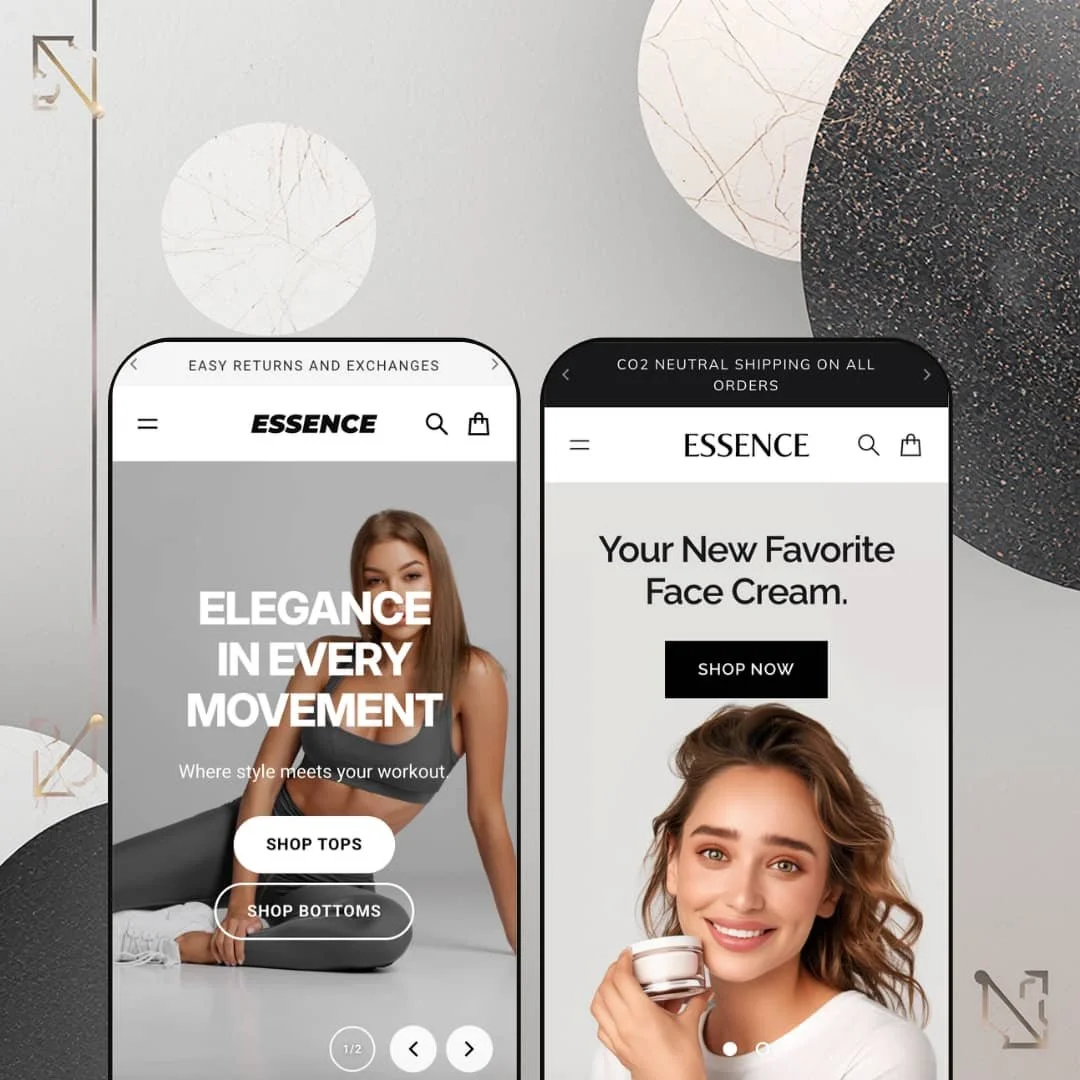
You're selling products that photograph better than any copy you'll write, and you need a storefront that lets the imagery do the persuading. That's the buyer Essence is courting: a $280 Online Store 2.0 theme from Alloy Themes that ships two presets, one staged as an activewear boutique and the other as a clean beauty brand. At the top of its price bracket, the question isn't whether it looks good; it's whether the menu architecture and section library justify the number on the tag.
The menu is shelf space, not a sitemap
Dawn, Shopify's free baseline, gives you a competent multi-column menu of text links; Essence turns the same surface into merchandising real estate. The Cadence demo routes shoppers by category, by skin type, and by key ingredient, then drops promoted product links with imagery straight into the dropdown, while the activewear demo runs image tiles inside its menu columns. For skincare and supplement merchants whose customers shop by concern rather than category, and whose buyers research before purchasing, this is the single strongest argument for the theme.
A buy box built as one coordinated system
Everything around the purchase moment works as a unit: a subtitle line above the price, accordion blocks for description, usage, and materials, a size-chart modal, local pickup availability rendered with store address and ready-time, a slim sticky bar, and a configurable promo slot the beauty demo uses to offer three free samples with purchase. It's a lot, and it never feels crowded. Apparel and beauty merchants running physical locations alongside their online store get real retail work done without a single add-on.
What replaces the salesperson?
Sections that teach. The activewear demo's image-hotspot section anchors four callouts onto one garment photo, the beauty demo runs a study-results band with percentage stats, and the feature list adds a before/after image slider on top of native product video support. Brands selling considered purchases at mid-market to luxury price points, where a $50 lipstick or $69 bodysuit needs justifying, get the tools to make that case visually.
Five EU languages in the box
The theme ships its interface strings pre-translated into English, French, Italian, German, and Spanish. That covers buttons, form labels, and cart text, and it removes an entire translation pass from launch for the theme layer specifically; your product descriptions remain your own work. Lean single-brand DTC operations selling cross-border into EU markets without an agency on retainer will feel this saving most.
Neither preset shows you scale
Fifteen products. That's the entire catalog in each demo. The collection template handles a boutique elegantly, with sub-collection tiles, swatch-driven filtering, and a nine-option sort menu, but nothing demonstrates how Essence behaves under a deep assortment with crowded filter states and heavy pagination. Merchants running 500-plus SKUs or multi-brand catalogs are buying on faith here.
Two presets that rhyme
Essence and Cadence are separated by palette and typography far more than by structure, with both homepages running the same essential spine of hero, social proof, education band, embedded product, and FAQ. That's a thin spread for $280. Merchants in heavier-feeling verticals, furniture or electronics, selling considered purchases to research-driven buyers, won't see their store in either demo and should budget for real visual rework.
Reassurance, not urgency
The conversion toolkit leans entirely toward trust: testimonials, icon rows, FAQs, stock counters, promo banners. Scan the official feature list and you'll find no countdown timer and no scheduled-drop mechanics anywhere on it. Merchants running flash drops and limited editions, selling to impulse-driven buyers where time pressure is the engine of the business model, will need to source that pressure elsewhere.
What it takes to launch
Expect a one-to-two-day pass covering navigation re-linking across both menu systems, brand asset replacement, a full copy rewrite spanning hero captions, testimonials, and FAQ entries, and content population for the product-page accordion blocks before launch.
-
What works in this preset
Scroll the homepage and the pitch arrives in deliberate stages: a full-bleed hero with two parallel calls to action ("Shop tops," "Shop bottoms"), then category tiles, then a product carousel, each band doing one job before handing off to the next. Nothing fights for attention. The pacing matters because activewear shoppers tend to arrive knowing their category, and this layout routes them within two scrolls instead of making them hunt.
The paired video band is the preset's best visual idea. Two portrait-format clips run side by side under the captions "Elegance in Every Movement" and "Breathe, Lift and Shine," giving the demo a catalog-shoot energy that static imagery can't fake, and giving merchants with even modest video assets a natural home for them. I sat up when I hit this section. It carries more brand feeling than the hero above it.
Product cards close the loop with quick-buy size links rendered directly on the card, XS through XXL, each one a live link to its variant. Sold-out sizes are handled honestly too. The XXL on the sports bra shows as unavailable rather than vanishing, which spares shoppers the small frustration of discovering a dead end two clicks later, and spares merchants the support emails that follow.
Where it stumbles
The preset asks for your email three times in a single visit: an entry popup offering 10% off, a mid-page subscription banner, and the footer signup block. Each capture point is a configurable section, so the fix is trivial, but as a staging decision it works against the calm, premium read the rest of the preset spends so much effort building.
-
What works in this preset
Promotion is treated as a layered system here rather than a single banner. The announcement bar rotates two messages, the hero pitches a hero product, and a second full-width promo for a seasonal sale sits directly beneath it, so a merchant can run brand story and discount story simultaneously without one cannibalizing the other. That's a genuinely useful pattern for beauty brands cycling monthly offers.
I clicked into the embedded featured-product section expecting a glorified image block and found a working buy box: the Restoring Eye Serum sits on the homepage with both its 25ml and 50ml sizes selectable, live sale pricing, and an add-to-cart that fires without a page change. Shoppers buy where they stand. For repeat-purchase products like serums, removing that one navigation step is exactly the right call.
Bestseller cards show restraint with multi-shade products. The High Shine Lipstick card displays a few swatches and folds the rest into a "+3" overflow counter, while sized products render "From $50.00" pricing, two small decisions that keep an eight-product row scannable where exhaustive swatch strips would have turned it into noise.
Where it stumbles
Fragrance is framed as the third pillar of the brand, with its own tile in the "Signature Collections" band and its own footer entry, yet the top navigation stages only Skincare and Makeup. The demo's own information architecture undersells a category it visibly wants to merchandise, and a fragrance-led merchant evaluating this preset has to imagine that third menu build themselves.
One grammar, two skins
Read both presets back to back and the same conversion logic surfaces underneath different aesthetics, which means skills transfer completely: a merchant who configures one preset already understands the other. It also means switching presets later is a re-skin, not a rebuild. That consistency is a hidden cost-saver the Theme Store page never mentions.
Maintained, and quietly liked
Version 4.1.0 shipped in December 2025, continuing a steady update cadence since the February 2024 launch. Theme Store feedback stands at 100% positive across 8 reviews, a uniformly good but still small sample. Both signals point the same direction: an actively tended theme early in building its public record.
Mobile is art-directed, not shrunk
Both demos serve dedicated mobile image crops for their hero and feature bands rather than letting desktop compositions squeeze down. It's the kind of cross-preset discipline that only shows when you compare templates side by side, and it signals the developer treats the phone as a first canvas rather than an afterthought.
It's hungry for content
The architecture across both presets assumes a brand arriving with video, lifestyle photography, study data, testimonials, and editorial copy to feed a ten-plus-section homepage. Launch with thin assets and the theme's long-scroll storytelling format will expose exactly what you're missing. Content-light merchants will fight the design instead of riding it.
The discovery layer is merchant-built
Essence's best experiences depend on taxonomy work the theme can't do for you. The navigation only becomes a selling surface after someone designs the category logic, attribute groupings, and promo placements behind it, and that's genuine information-architecture labor. Buy this theme planning for that thinking, not just for content entry.
Rating
★ 7.8/10
-
Menu merchandising, hotspot and before/after education tools, pickup rendering, and combined-listing support; urgency tooling stops at stock counters and promo banners.
8
-
One shared structure across presets with content living in clearly bounded sections and accordion blocks; launch work is routine rather than technical.
8
-
Dedicated mobile image assets throughout and a slide-out menu that stacks nested groups cleanly.
8
-
Pages run lean, with responsive image sizing across every band and product templates that avoid heavy section stacking.
8
-
Strong control inside its soft, light aesthetic; the two presets sit close together, so dramatic departures take custom work.
7
Frequently Asked Questions
-
Yes, combined listing support appears on the official feature list, flagged as Plus-only. Relevant if you merge color-variant products into one listing.
-
Both demos run a news blog with category tags and comment counts, surfaced on the homepage as three-card strips. It's functional rather than magazine-grade.
-
Yes. The demos stage "New" and "Popular" labels alongside calculated "Save $X" badges on the same cards.
-
Both demos run a standalone FAQ page plus accordion FAQ sections embedded on the homepage and product templates, each linking back to the full page.
-
The feature list includes enhanced search, and the search drawer ships with configurable popular-search shortcuts, staged as "leggings" and "serum" style quick links in the demos.
-
Alloy advertises 26 sections. Each demo deploys roughly a dozen, so a fair amount of the library goes undemonstrated.
-
Yes, a slide-out cart per the feature list, with an empty state that offers a continue-shopping path and cart notes supported.
Pros/ Cons Template <!-- ============================================================ THEME-HUB.COM PROS/CONS BLOCK — HTML TEMPLATE Variant 5 — Pure Monochrome Punch with Liquid Glass PREREQUISITE: The site-wide CSS must already be installed in Squarespace's Custom CSS panel (Design → Custom CSS)
pasted
Multi Preset Template <!-- ============================================================ THEME-HUB.COM CONCLUSION — MULTI-PRESET TEMPLATE (Variant A) For themes with 2+ presets. PREREQUISITE: theme_hub_conclusion.css installed in Squarespace Custom CSS panel. USAGE: 1. Add a Code Block on the re
pasted
fill the templates with the content from the review
01:27
Orchestrated template population with review content and constraint reconciliation
Orchestrated template population with review content and constraint reconciliation
Here are both blocks filled with the Essence review content.
Pros/Cons Block (Variant 5):
html
<div class="th-prosCons-wrapper"> <!-- Atmospheric glow spots — leave these alone --> <div class="th-glow th-glow-1"></div> <div class="th-glow th-glow-2"></div> <div class="th-grid"> <!-- ======== PROS COLUMN ======== --> <div class="th-col th-pros"> <div class="th-label">PROS</div> <!-- PRO 1 --> <div class="th-item"> <div class="th-item-head"> <div class="th-icon"> <svg viewBox="0 0 24 24" fill="none" stroke="currentColor"><polyline points="20 6 9 17 4 12"/></svg> </div> <h4>The menu is shelf space, not a sitemap</h4> </div> <p>Dawn, Shopify's free baseline, gives you a competent multi-column menu of text links; Essence turns the same surface into merchandising real estate. The Cadence demo routes shoppers by category, by skin type, and by key ingredient, then drops promoted product links with imagery straight into the dropdown, while the activewear demo runs image tiles inside its menu columns. For skincare and supplement merchants whose customers shop by concern rather than category, and whose buyers research before purchasing, this is the single strongest argument for the theme.</p> </div> <!-- PRO 2 --> <div class="th-item"> <div class="th-item-head"> <div class="th-icon"> <svg viewBox="0 0 24 24" fill="none" stroke="currentColor"><polyline points="20 6 9 17 4 12"/></svg> </div> <h4>A buy box built as one coordinated system</h4> </div> <p>Everything around the purchase moment works as a unit: a subtitle line above the price, accordion blocks for description, usage, and materials, a size-chart modal, local pickup availability rendered with store address and ready-time, a slim sticky bar, and a configurable promo slot the beauty demo uses to offer three free samples with purchase. It's a lot, and it never feels crowded. Apparel and beauty merchants running physical locations alongside their online store get real retail work done without a single add-on.</p> </div> <!-- PRO 3 --> <div class="th-item"> <div class="th-item-head"> <div class="th-icon"> <svg viewBox="0 0 24 24" fill="none" stroke="currentColor"><polyline points="20 6 9 17 4 12"/></svg> </div> <h4>What replaces the salesperson?</h4> </div> <p>Sections that teach. The activewear demo's image-hotspot section anchors four callouts onto one garment photo, the beauty demo runs a study-results band with percentage stats, and the feature list adds a before/after image slider on top of native product video support. Brands selling considered purchases at mid-market to luxury price points, where a $50 lipstick or $69 bodysuit needs justifying, get the tools to make that case visually.</p> </div> <!-- PRO 4 --> <div class="th-item"> <div class="th-item-head"> <div class="th-icon"> <svg viewBox="0 0 24 24" fill="none" stroke="currentColor"><polyline points="20 6 9 17 4 12"/></svg> </div> <h4>Five EU languages in the box</h4> </div> <p>The theme ships its interface strings pre-translated into English, French, Italian, German, and Spanish. That covers buttons, form labels, and cart text, and it removes an entire translation pass from launch for the theme layer specifically; your product descriptions remain your own work. Lean single-brand DTC operations selling cross-border into EU markets without an agency on retainer will feel this saving most.</p> </div> </div> <!-- ======== CONS COLUMN ======== --> <div class="th-col th-cons"> <div class="th-label">CONS</div> <!-- CON 1 --> <div class="th-item"> <div class="th-item-head"> <div class="th-icon"> <svg viewBox="0 0 24 24" fill="none" stroke="currentColor"><line x1="18" y1="6" x2="6" y2="18"/><line x1="6" y1="6" x2="18" y2="18"/></svg> </div> <h4>Neither preset shows you scale</h4> </div> <p>Fifteen products. That's the entire catalog in each demo. The collection template handles a boutique elegantly, with sub-collection tiles, swatch-driven filtering, and a nine-option sort menu, but nothing demonstrates how Essence behaves under a deep assortment with crowded filter states and heavy pagination. Merchants running 500-plus SKUs or multi-brand catalogs are buying on faith here.</p> </div> <!-- CON 2 --> <div class="th-item"> <div class="th-item-head"> <div class="th-icon"> <svg viewBox="0 0 24 24" fill="none" stroke="currentColor"><line x1="18" y1="6" x2="6" y2="18"/><line x1="6" y1="6" x2="18" y2="18"/></svg> </div> <h4>Two presets that rhyme</h4> </div> <p>Essence and Cadence are separated by palette and typography far more than by structure, with both homepages running the same essential spine of hero, social proof, education band, embedded product, and FAQ. That's a thin spread for $280. Merchants in heavier-feeling verticals, furniture or electronics, selling considered purchases to research-driven buyers, won't see their store in either demo and should budget for real visual rework.</p> </div> <!-- CON 3 --> <div class="th-item"> <div class="th-item-head"> <div class="th-icon"> <svg viewBox="0 0 24 24" fill="none" stroke="currentColor"><line x1="18" y1="6" x2="6" y2="18"/><line x1="6" y1="6" x2="18" y2="18"/></svg> </div> <h4>Reassurance, not urgency</h4> </div> <p>The conversion toolkit leans entirely toward trust: testimonials, icon rows, FAQs, stock counters, promo banners. Scan the official feature list and you'll find no countdown timer and no scheduled-drop mechanics anywhere on it. Merchants running flash drops and limited editions, selling to impulse-driven buyers where time pressure is the engine of the business model, will need to source that pressure elsewhere.</p> </div> </div> <!-- ======== SETUP EFFORT ======== --> <div class="th-setup"> <div class="th-setup-badge">Setup · Medium</div> <div class="th-setup-content"> <h4>What it takes to launch</h4> <p>Expect a one-to-two-day pass covering navigation re-linking across both menu systems, brand asset replacement, a full copy rewrite spanning hero captions, testimonials, and FAQ entries, and content population for the product-page accordion blocks before launch.</p> </div> </div> </div> </div>
Conclusion Block (Variant A — Multi-Preset):
html
<div class="th-conclusion-wrapper"> <!-- META LINE --> <div class="th-conc-meta">Conclusion · Essence · 2 Presets</div> <div class="th-conc-grid"> <!-- ============ BIGGEST STRENGTHS ============ --> <div class="th-conc-col th-conc-strengths"> <div class="th-conc-col-header">Biggest Strengths</div> <!-- STRENGTH 1 --> <div class="th-conc-point"> <div class="th-conc-point-head"> <div class="th-conc-point-icon"> <svg viewBox="0 0 24 24" fill="none" stroke="currentColor"><polyline points="20 6 9 17 4 12"/></svg> </div> <h4>One grammar, two skins</h4> </div> <p>Read both presets back to back and the same conversion logic surfaces underneath different aesthetics, which means skills transfer completely: a merchant who configures one preset already understands the other. It also means switching presets later is a re-skin, not a rebuild. That consistency is a hidden cost-saver the Theme Store page never mentions.</p> </div> <!-- STRENGTH 2 --> <div class="th-conc-point"> <div class="th-conc-point-head"> <div class="th-conc-point-icon"> <svg viewBox="0 0 24 24" fill="none" stroke="currentColor"><polyline points="20 6 9 17 4 12"/></svg> </div> <h4>Maintained, and quietly liked</h4> </div> <p>Version 4.1.0 shipped in December 2025, continuing a steady update cadence since the February 2024 launch. Theme Store feedback stands at 100% positive across 8 reviews, a uniformly good but still small sample. Both signals point the same direction: an actively tended theme early in building its public record.</p> </div> <!-- STRENGTH 3 --> <div class="th-conc-point"> <div class="th-conc-point-head"> <div class="th-conc-point-icon"> <svg viewBox="0 0 24 24" fill="none" stroke="currentColor"><polyline points="20 6 9 17 4 12"/></svg> </div> <h4>Mobile is art-directed, not shrunk</h4> </div> <p>Both demos serve dedicated mobile image crops for their hero and feature bands rather than letting desktop compositions squeeze down. It's the kind of cross-preset discipline that only shows when you compare templates side by side, and it signals the developer treats the phone as a first canvas rather than an afterthought.</p> </div> </div> <!-- ============ BIGGEST WEAKNESSES ============ --> <div class="th-conc-col th-conc-weaknesses"> <div class="th-conc-col-header">Biggest Weaknesses</div> <!-- WEAKNESS 1 --> <div class="th-conc-point"> <div class="th-conc-point-head"> <div class="th-conc-point-icon"> <svg viewBox="0 0 24 24" fill="none" stroke="currentColor"><line x1="18" y1="6" x2="6" y2="18"/><line x1="6" y1="6" x2="18" y2="18"/></svg> </div> <h4>It's hungry for content</h4> </div> <p>The architecture across both presets assumes a brand arriving with video, lifestyle photography, study data, testimonials, and editorial copy to feed a ten-plus-section homepage. Launch with thin assets and the theme's long-scroll storytelling format will expose exactly what you're missing. Content-light merchants will fight the design instead of riding it.</p> </div> <!-- WEAKNESS 2 --> <div class="th-conc-point"> <div class="th-conc-point-head"> <div class="th-conc-point-icon"> <svg viewBox="0 0 24 24" fill="none" stroke="currentColor"><line x1="18" y1="6" x2="6" y2="18"/><line x1="6" y1="6" x2="18" y2="18"/></svg> </div> <h4>The discovery layer is merchant-built</h4> </div> <p>Essence's best experiences depend on taxonomy work the theme can't do for you. The navigation only becomes a selling surface after someone designs the category logic, attribute groupings, and promo placements behind it, and that's genuine information-architecture labor. Buy this theme planning for that thinking, not just for content entry.</p> </div> </div> </div> </div>
Both blocks are paste-ready for Squarespace Code blocks, no inline styles, SVG icons untouched. One note: the Pros/Cons template's internal comment suggests Con 2 as a demo-polish slot, but per V6.0 that slot carries a theme-character Con instead ("Two presets that rhyme"), with demo-polish work staying in Setup Effort.
This review is based on hands-on testing of the publicly available preset demos of the Essence Shopify theme as of June 2026. Theme features, preset availability, and performance can change with subsequent updates from the theme developer.