
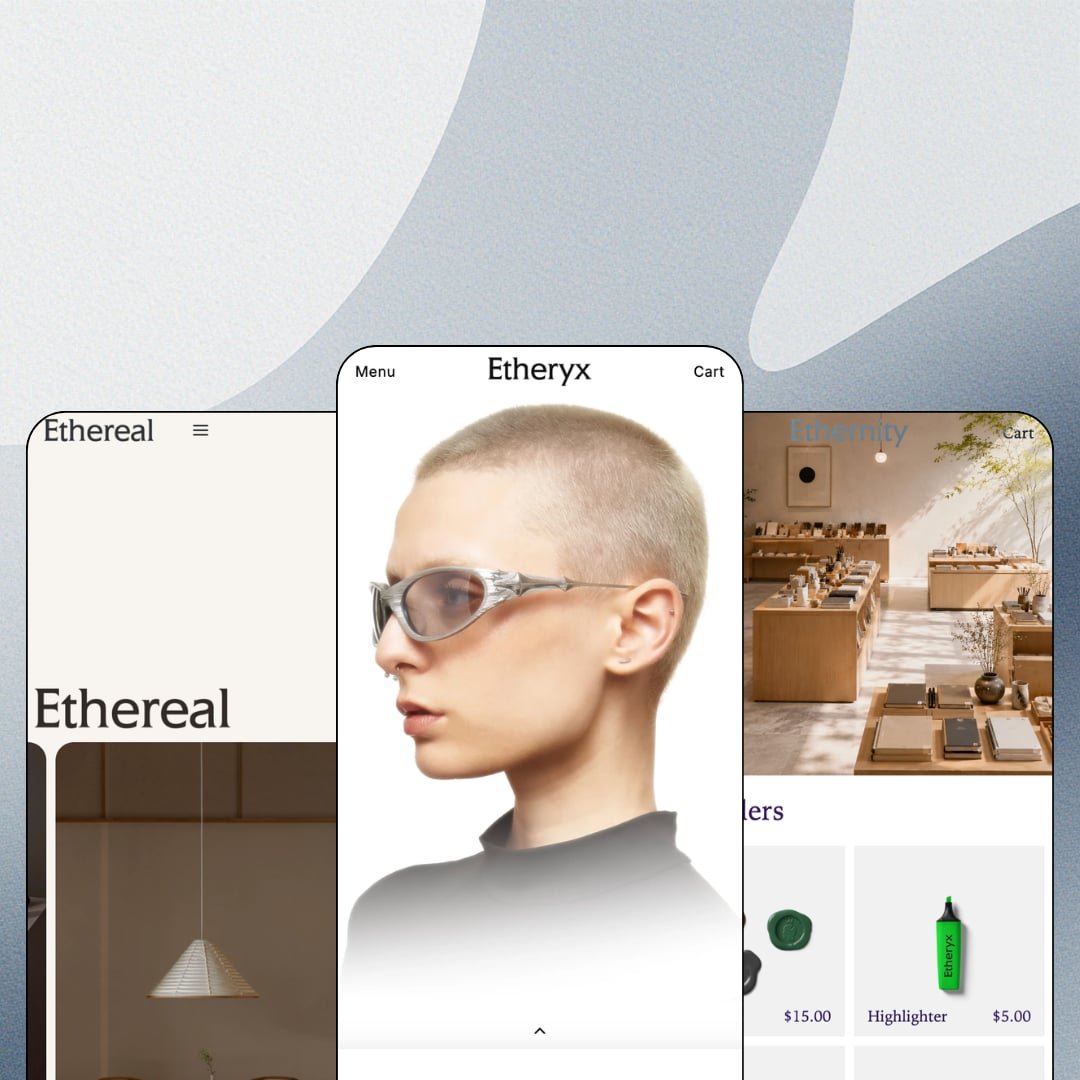
Most premium Shopify themes announce themselves with discount banners and countdown pressure before you've finished the first scroll. Etheryx opens with a black canvas, a $1,500 dress, and silence. OpenThinking's Online Store 2.0 theme sells three presets for $370: a dark luxury womenswear flagship, a warm home-textiles brand built on real product photography, and a minimalist stationery shop. Whether that restraint reads as a design system or as a missing persuasion layer depends heavily on what you sell, so let's look at each demo on its own terms.
Full variant selection from the product card
Card-level quick add opens the complete option matrix without a page load. On the flagship's Multi Soft Lounge dress that means eight colors crossed with sizes, roughly thirty variants, addable straight from the collection grid, with an "8 Colors" count printed on the card and sold-out combinations flagged inline. Thirty variants, zero detours. For apparel and footwear merchants running 30 to 100 SKUs with impulse-leaning buyers, this removes the single biggest click barrier between browsing and the cart.
How much control does a shopper get over the grid itself?
More than usual: collection pages carry a view switcher that lets visitors set the grid anywhere from one column to ten, sitting beside a filter-and-sort drawer. That drawer is properly stocked. It runs availability and category counts, a price slider, color filters wired to Shopify's native taxonomy values, size facets, and nine sort orders, so the browsing surface adjusts to the shopper instead of the other way around. Fashion and accessories merchants with 50 to 200 SKUs and cross-shop-heavy browsers get a discovery layer that respects how differently people like to scan.
Theme translations at unusual breadth
The official feature set covers EU interface translations in English, French, Italian, German, and Spanish, and the developer ships theme strings in more than twenty languages overall. The flagship demo walks the talk. Its language menu lists seventeen options from Japanese to Bulgarian, beside a country picker spanning roughly forty-six markets. This is the slice of localization a theme genuinely owns, the buttons, forms, and cart copy, and it arrives pre-translated instead of being a merchant project. Cross-border DTC brands selling into multiple European markets at mid-market to luxury price points skip a full round of translation work here.
A real store-locations layer
Physical retail gets its own section type. The "Our stores" block renders structured location cards with days, hours, address, phone, and email rows, and the Tokyo card in the flagship demo even lists per-store services like engraving, tax-free shopping, and a VIP room. Pair that with in-store pickup in the cart feature set and the theme covers the storefront half of a clicks-and-bricks setup natively. Single-brand boutiques backed by one to four physical locations, selling considered-purchase goods, usually have to fake this with page-builder blocks; here it's stock equipment.
The proof layer is empty
Across three demos I went looking for a customer voice and found none. No testimonial section appears anywhere, no review stars, no UGC block; the persuasion surface consists of press mentions and trust badges, full stop. There is nothing to borrow. Review engines are app work on any theme, but Etheryx doesn't even stage the shelf where one would sit, and its section library offers no testimonial format to hand-fill in the meantime. Beauty and jewelry merchants selling considered purchases, where a stranger's word closes the sale, will be sourcing that entire presentation layer elsewhere.
Prose-first product pages with no data layer
Buy columns render description prose, an SKU line, and payment icons. That's the whole information architecture. There is no metafield-driven spec table and no comparison section in the library, so material, dimension, and care details live wherever the merchant types them into the description field. The listing names Jewelry & accessories and Food & drink among its industries, and both verticals run on exactly the structured attribute data this theme never formats. Merchants selling spec-heavy goods like fine jewelry or packaged food across 50 to 200 SKUs should budget for hand-built description formatting or an app to carry that load.
A 2021-generation architecture at a 2026 price
Etheryx runs Online Store 2.0, the same architecture generation Shopify's free Dawn ships, with the same two-level block nesting ceiling. What the $370 buys is the design range, the conversion staging, and the translation coverage layered on top, not a newer foundation underneath. That's a fair trade for many stores. For agency builders planning multi-year platforms for luxury brands, though, the nesting ceiling caps how deeply sections can be restructured without touching code, and it deserves a line in the evaluation.
What it takes to launch
Expect a copy-and-catalog pass before launch: re-staging the demo navigation, which doubles as a feature tour, assigning product taxonomy and categories so the color and category filters populate cleanly, localizing the store-location cards, and replacing editorial imagery across three very different homepage grammars. Plan one to two focused days.
-
What works in this preset
Scrolling the flagship demo feels like paging through a campaign lookbook that happens to be shoppable. Every dress card carries two photographs, a front pose and a back pose, so the featured grid reads as editorial spreads rather than warehouse inventory, and the all-black palette holds from the hero image down to the last policy link. Nothing shouts. Even the sale badges render as quiet percentage notes beside struck-through prices.
A scrolling image marquee pulls visitors sideways into the All White Capsule collection, one of the few moments the black canvas breaks. Below it, a Shop-the-look section pins a minidress, a nylon bag, and boot sandals onto a single campaign image, and the navigation stages a splash page, an events page, and a dedicated lookbook alongside the catalog. I clicked through all of them expecting filler; the events and splash templates are genuinely built out as launch-ready page types.
The footer here is a decision, not an afterthought. The entire footer collapses behind an "Open footer" toggle, which keeps the dark canvas unbroken until a visitor actually asks for the newsletter form, payment icons, and policy links. That's a bold structural choice. It suits a brand that wants the photography to be the last thing on screen, and merchants who find it too clever can stage the conventional footer layout the other demos use.
Where it stumbles
The catalog runs dresses from XXS to XL, with sold-out sizes flagged inside the pickers, yet the demo stages no fit content or size guidance anywhere on the product pages. The theme's size chart exists as a configurable piece, so merchants pointing this preset at a real apparel catalog will be wiring up fit help themselves before launch. For a demo whose entire inventory needs sizing, that's a staging choice that undersells the vertical it's dressed for.
-
What works in this preset
"Timeless is more," the demo copy declares, and the preset earns the line by running on a real brand. Ethereal is staged with TAMEKO, a Danish home-textiles label, complete with showroom photography, a Space Copenhagen collaboration collection, and price tags reaching $2,895 for a bed throw. That matters for evaluation. You're seeing the theme handle production-grade assets and an actual designer catalog instead of stock renders.
Browsing here runs through curated collections rather than one big grid: vendor-built groupings for Space Copenhagen and the Core Collection, an EOE Studio capsule with its own editorial block, and homepage tabs that flip between Latest, Kitchen, Curtains, and Bedding without leaving the page. The typographic tics, like the "// collection 001" slash notation, give the preset a print-catalog voice. Short catalog, long attention.
A four-tile benefit bar closes the page with free-shipping, signup-discount, secure-checkout, and delivery promises, sitting above a conventional three-column footer with a social row. Between the stacked full-bleed hero photography at the top and the Instagram grid near the bottom, this preset demonstrates how far the theme's warm register stretches from the flagship's severity.
-
What works in this preset
Ethernity slows everything down. In this preset demo, product cards are staged clean, with single object photographs and no emphasis on quick-buy triggers, so a $3 retractable ballpoint gets the same museum treatment as a $35 fountain pen. The restraint fits the stationery pitch, and it proves the theme can strip its own merchandising back to almost nothing when a brand wants pure catalog quiet.
The trust row is text, not logos: a typeset list naming Foster + Partners, Zaha Hadid Architects, Snøhetta, and a dozen more studios under "Trusted by great agencies and brands." I sat up at that, because it reads like a design-world colophon instead of a badge strip. The planner gets hero treatment with interior-spread photography and a plain "100 in stock" line under its buy button, and the footer swaps in a third arrangement, three link columns over an oversized wordmark.
Where it stumbles
The preset's own description names office and workspace brands, but the demo stages a boutique. Everything is presented for one-at-a-time contemplation, single quantities of $4 pencils, while offices restock in multiples. Merchants running this preset as an actual supplies operation will be configuring the theme's quantity-driven buying tools themselves, because the staging never shows what a ten-item order feels like here.
Three grammars, not three color schemes
Read side by side, the presets are structurally different storefronts: different footer architectures, different card treatments, different hero systems, different catalog philosophies. Plenty of preset families repaint one skeleton. This one demonstrates that the section library bends into a severe monochrome flagship, a warm print-catalog brand, and a near-empty gallery without any of the three feeling like a compromise, which is the strongest possible evidence of design range a demo family can give.
Quiet is the default setting
Nothing in any demo pressures the visitor: no popup interrupts arrival, no discount rhetoric frames the heroes, and full-price products anchor every grid. The countdown, promo-banner, and stock-counter tooling exists in the feature set, but it waits in the toolbox until a merchant reaches for it. For premium-positioned brands that read urgency mechanics as brand damage, that default is worth real money.
The listing promises verticals the presets never serve
Jewelry & accessories and Food & drink sit in the theme's declared industries, yet jewelry surfaces as exactly one nail ring in the flagship catalog and food appears nowhere at all. Merchants in either vertical are buying on faith that grammars staged for dresses, bed linen, and pencils will translate. They might. But nothing in the demo family shows it.
Photography is the load-bearing wall
All three presets stand on campaign-grade imagery: paired model shots, showroom scenes, styled object photography. Strip that caliber of asset away and the layouts have little secondary structure to fall back on, because the theme's whole language is image-first. First-time sellers working with supplier photos should assume the demos will not look like their store on day one.
A boutique-scale discovery ceiling
Every demo curates a small catalog through collections and filters, and Shopify's own listing classifies the theme for catalogs in the 11-to-100-plus range. There is no departmental navigation architecture, no brand-index layer, nothing built for warehousing thousands of SKUs. Merchants planning that scale are shopping in the wrong aisle.
Rating
★ 8.4/10
-
Pre-order, quick buy, sticky cart, gift wrapping, pickup, countdown, stock counter, and an age verifier ship natively, plus lookbook and store-location sections. Structured product data and any social-proof format are the gaps.
8
-
The section grammar stays consistent across three wildly different presets, and merchant reviews on the listing single out the editor experience and support responsiveness. Taxonomy-dependent filters add one setup chore.
8
-
Slide-out navigation, a sticky cart, and image-first cards that stack cleanly; the grid-density switcher gives phone users the same layout control as desktop.
8
-
Pages run lean: WebP imagery throughout, restrained section counts, and the July 2026 release notes show ongoing optimization work rather than feature bloat.
9
-
Two opposite footer modes, three distinct homepage grammars, and shopper-adjustable grids from one section library; the Online Store 2.0 nesting ceiling is the only hard wall.
9
Frequently Asked Questions
-
Version 1.6.0 introduced variant galleries on product pages, a lighter add-to-cart notification, a new Tabbed Collections section, and page transitions, alongside general fixes.
-
Yes, Combined Listings support is in the merchandising feature set, flagged as a Shopify Plus capability.
-
All three ship in the cart-and-checkout feature set, alongside cart notes, a slide-out cart, and a sticky cart option.
-
Yes: a countdown timer, stock counter, promo banners, product badges, and an age verifier all sit in the marketing feature set, unstaged in the demos but available.
-
OpenThinking maintains dedicated Etheryx documentation at docs.openthinking.net and a support portal on openthinking.net, both linked from the Theme Store listing.
-
The listing links five live stores, including nologo-studio.com and renecph.com, which is a useful reality check beyond the polished demos.
This review is based on hands-on testing of the publicly available preset demos of the Etheryx Shopify theme as of August 2026. Theme features, preset availability, and performance can change with subsequent updates from the theme developer.