
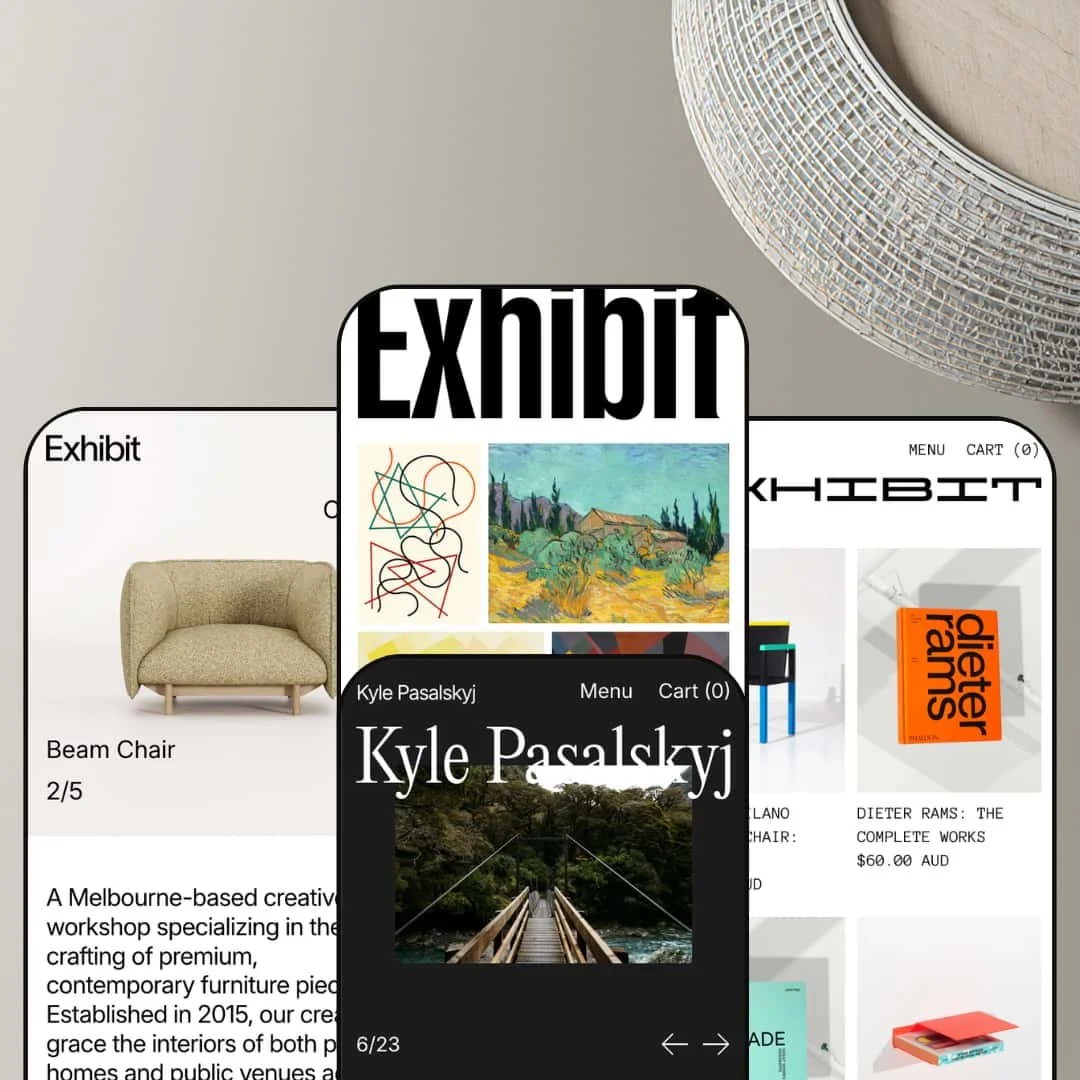
Most premium Shopify themes compete on how much they can do. Exhibit competes on how little it puts between a buyer and an image. Switch built this $350 Online Store 2.0 theme for visual-first sellers, and its four presets cast it as an art gallery, a photographer's print shop, a design retailer, and a furniture workshop. Whether that restraint justifies premium money depends almost entirely on what your products look like at full width.
The image wall is a genuine selling machine
Every one of the four demos opens on products before prose. The product is the interface. Grids, slideshows, carousels, and scrolling marquees all serve one job: staging imagery at maximum size with minimum chrome, so the catalog does the persuading that sales copy would otherwise attempt. For independent artists and photographers with sub-50-piece catalogs, selling high-ticket originals to considered buyers, that presentation discipline is the entire purchase argument.
Product pages engineered for the print trade
Two variant axes, rendered as tidy button groups. Both the art and photography demos run a Size-by-Frame matrix of twelve combinations, paired with mockup galleries that show each piece hanging framed in a real room, so a buyer resolves size anxiety and frame choice without ever leaving the page. Poster and print sellers running two-axis variant grids at gallery-level pricing, where buyers deliberate before spending, get purpose-built machinery here.
Collection browsing dressed for collectors
Filtering is baseline Shopify; how it's dressed is not. The gallery demo's collection page presents Style and Nationality facets as a calm sidebar checklist with price-range fields and eight sort orders, styled to recede into the page rather than dominate it, so browsing 87 artworks feels closer to flipping through a catalogue raisonné than operating a database. For curated stores in the 50-to-100 SKU range whose collectors cross-shop by attribute, the discovery layer arrives already civilized.
What happens between "I like this" and checkout?
Exhibit answers with a coordinated quick-commerce kit: quick view, quick buy, a slide-out cart, and a sticky header keep the entire purchase loop inside the browsing context, so a buyer never loses their place in the grid while completing an order. Momentum stays intact. For sellers of lower-ticket prints and design objects, where buyers lean impulsive and carts stay small, that closed loop quietly protects conversion.
The marketing column is four lines long
I went looking for the promotional toolkit. There's barely any. On the theme's own feature sheet, the marketing-and-conversion column runs exactly four items (FAQ page, quick view, recommended products, stock counter), and none of the four demos stages urgency, discount theater, or countdown pressure of any kind. For discount-driven apparel or gadget stores running flash-drop calendars at impulse price points, Exhibit was not built for that playbook.
Your photography carries everything
Bad photos get framed here too. The design language provides no decorative cover: no dense grids, gradient overlays, or busy promotional furniture to hide behind, which means supplier-grade imagery gets exhibited at two-thousand-pixel width exactly as it is. Dropship operations and multi-brand resellers working from manufacturer-supplied photos will find the theme amplifies their weakest asset instead of concealing it.
Density was never the plan
Every layout decision favors space over throughput. Oversized image cells, editorial spacing, and a low products-per-screen count make the browsing math comfortable at 87 products and increasingly expensive as a catalog grows toward several hundred SKUs spread over many categories. Multi-category stores with cross-shop-heavy buyers will feel the drag long before anything technically breaks.
What it takes to launch
Expect a one-to-two-day pass covering homepage and About copy, blog placeholders, imagery sourcing at gallery scale, metafield population to power the specification rows and filter facets, and currency plus market configuration for your region.
-
What works in this preset
Landing on this demo feels like walking into a gallery rather than opening a store. The homepage begins with a wall of more than twenty paintings, uninterrupted by headlines, badges, or promotional copy, and the effect is that the inventory itself becomes the hero section. It works. An "Art en masse" marquee scrolls past further down, adding motion to the page without adding noise.
Artist, Nationality, Year, Style: the product page renders provenance as clean specification rows above the buy button. I clicked into Starry Night Over The Rhone and found a six-image gallery cycling the artwork through framed room mockups, which is exactly the visual reassurance a buyer spending four figures on wall art wants before committing. Small detail, big trust dividend.
Nothing on this homepage asks for the sale twice. Between the image wall and the newsletter box sit four short editorial blocks about exhibitions, acquisition logistics, and emerging artists, plus a Publications blog that treats content as part of the storefront rather than an afterthought. For a gallery whose credibility is the product, that pacing is the pitch.
-
What works in this preset
Can a store be a résumé? This preset says yes: the homepage carries the photographer's office address, professional profile, press features, and contact details as native sections, so the shop and the portfolio become one page instead of two separate sites. A working photographer could hand out this URL as both.
I scrolled a long way before hitting a single price. The opening wall gives you New Zealand landscape photographs and nothing else; commercial detail waits until you commit to one. That sequencing mirrors how prints actually get bought, image first and logistics later, and the preset stages it with real conviction.
Scaling down suits the theme. Four navigation links, a field-notes blog, and a compact Latest Prints carousel are the entire commercial apparatus here, and the preset demonstrates that Exhibit doesn't need catalog volume or section density to fill a storefront convincingly.
-
What works in this preset
This is the preset where the header grows up. The logo sits above a motto ("Good design is as little design as possible") and an exposed sub-collection tree covering Books, Objects, Rent, Rugs, Seating, Storage, and Tables, so discovery starts before a single click happens. Seven doors, zero hunting.
One storefront, three business models. Retail design objects share the page with rental listings and a 1,500-square-foot studio-hire section that closes on an Enquire button, and the preset makes that mix read as intentional rather than improvised. Lamp listings run From-pricing wherever variants exist.
Product cards each carry a second image for the rollover swap the theme advertises, so the grid previews alternate angles without a click. Combined with a Dieter Rams principles passage staged as homepage prose, the preset argues that a design store's philosophy and its merchandising can share one page without either feeling bolted on.
Where it stumbles
The rental half of the positioning ends at an inquiry. Rentals are distinguished by product titling and resolved through the contact page, with no dates, deposits, or term handling anywhere in the theme itself, so a props business serving repeat production clients would run the actual rental workflow entirely off-page.
-
What works in this preset
Whitespace earns real money here. Beds priced from $3,950 upward get single-piece slideshow staging, Sale and Sold Out badges, and From-pricing, and the preset proves the gallery treatment transfers cleanly from wall art to considered furniture purchases without losing commercial seriousness.
A self-hosted workshop film runs as its own homepage section, with no third-party player frame around it. Video support is on the feature sheet, and this demo actually uses it. Further down, an oversized brand-logo section closes the page, the "feature logo" treatment Switch advertises, turning the wordmark itself into a design element.
Four collection doors carry the whole catalog: Beds, Seating, Storage, Tables. For a made-to-order workshop with a tight product family, that shallowness works in its favor, keeping every path from homepage to product under two clicks.
One skeleton, four believable identities
All four presets run the same compositional rhythm: imagery first, a prose interlude, collection doors, product carousels, a blog strip, a newsletter close. Yet they read as an institution, a person, a studio, and a workshop. Identity travels through typography, header treatment, and photography rather than layout novelty, which makes preset choice low-stakes and later re-staging cheap.
Restraint held without exception
Read together, the demos reveal a theme that never once breaks its own rule. No preset sneaks in a pop-up, a hard-sell block, or a pressure tactic; the bet that considered purchases close on confidence and space is carried consistently from a sixty-dollar design book to five-figure furniture. That coherence is the actual premium being sold.
Business-model range inside one vertical
The preset family quietly spans originals, editioned prints, retail with rentals, and made-to-order manufacture. Four transaction rhythms, one section library. For this theme's audience that range matters more than vertical breadth, because visual-first sellers rarely change what they look like but often change how they sell.
Depth in one aesthetic, not breadth across markets
Every preset is a shade of the same art-adjacent world. At $350, the purchase buys refinement of a single idea rather than a multi-vertical toolkit, and merchants outside visual-first categories would spend their customization budget fighting the theme's instincts instead of extending them.
Sameness is one photography budget away
Because the compositional skeleton repeats across presets, differentiation lands entirely on the merchant's imagery and typography choices. Two Exhibit stores in the same niche, both using decent but unremarkable photography, will produce handsome pages that look like each other. The theme hands you a beautiful frame and no way to be memorable without filling it well.
A 2021 foundation, kept current
Exhibit is Online Store 2.0 architecture from mid-2021, actively maintained into 2026 but a generation behind the nested-block editing model of newer Theme Blocks-era themes. Nothing here reads abandoned. Merchants planning heavy block-level customization should simply know which era they're buying into.
★ 7.4/10
Rating
-
A deliberately short feature set, executed well: variant matrices, specification rows, video sections, and quick-commerce tools cover the niche, while promotional tooling is absent by design.
7
-
Shallow page structures and a compact section library make staging fast; the main time cost is metafield setup for spec rows and facets.
8
-
The slide-out menu, sticky header, and single-column collapse of the image walls carry the gallery concept to small screens without layout compromise.
8
-
Scripting stays restrained and section counts are low, but image-wall homepages front-load twenty-plus full-width photos, so real-world speed rides on merchant image discipline.
7
-
Wide identity range within a minimalist register, as the four presets prove; dense, promotional, or maximalist layouts sit outside its vocabulary.
7
Frequently Asked Questions
-
Styling and staging, not capability. They're four arrangements of one section library, so pick whichever demo sits closest to your catalog and restyle from there.
-
The storefront side, yes: one demo pairs retail with a studio-hire inquiry flow. Scheduling, deposits, and terms would live in your own process or an app.
-
Yes. Product videos are supported, and the furniture demo runs a brand film as a standalone homepage section rather than an embedded third-party player.
-
Version 2.2.0 shipped on January 30, 2026, and the theme has received steady releases since its 2021 launch.
-
With Switch directly: the developer runs its own help center with Exhibit-specific setup documentation, separate from the Theme Store listing.
-
In-store pickup is part of the feature set, a practical fit for galleries and workshops that sell locally as well as online.
This review is based on hands-on testing of the publicly available preset demos of the Exhibit Shopify theme as of July 2026. Theme features, preset availability, and performance can change with subsequent updates from the theme developer.