
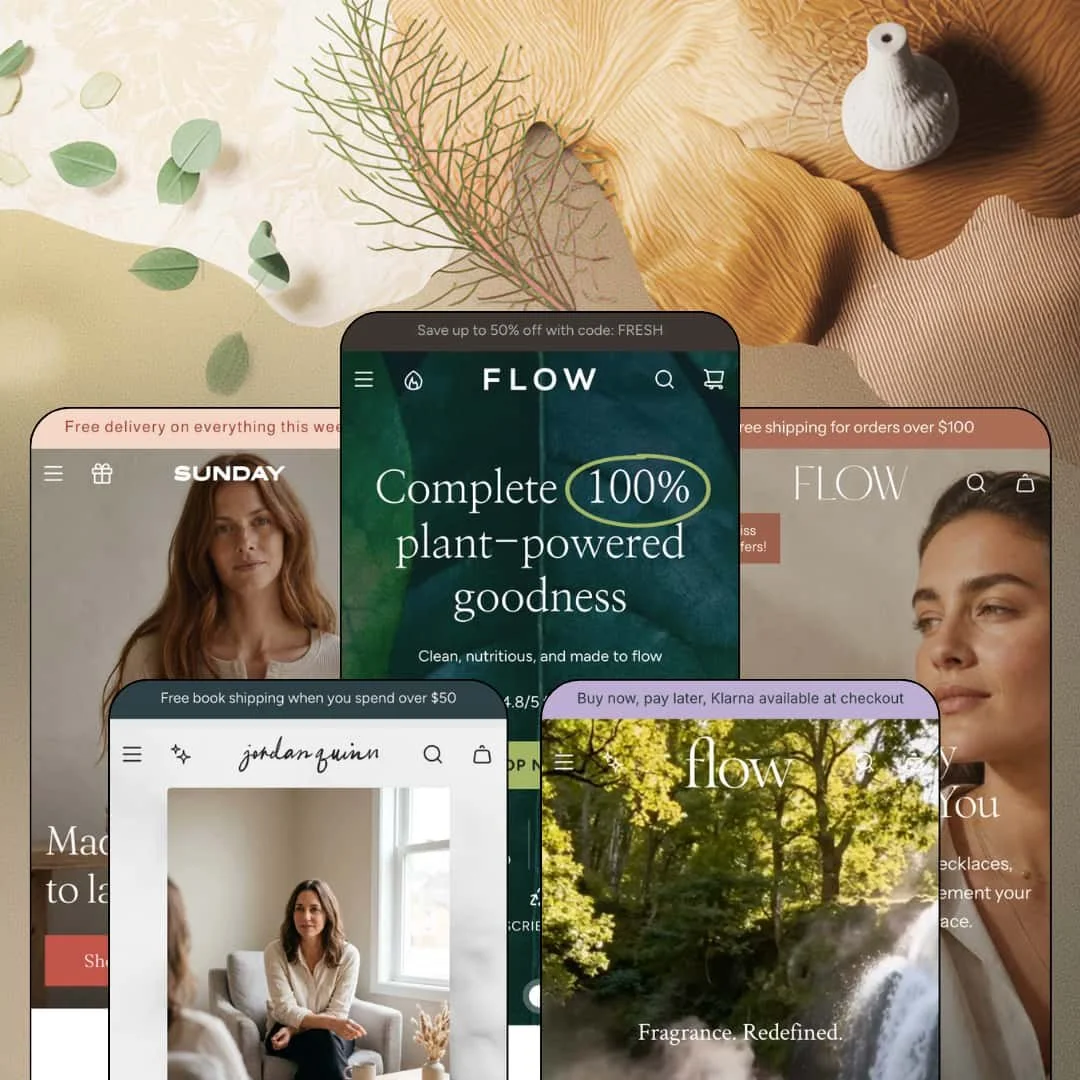
A theme that first shipped in December 2016 shouldn't feel this current. Flow, Eight Themes' $420 build for wellness, skincare and food brands, went through a full conversion-focused relaunch in July 2026, and that version 42 refresh is visible on every one of the five preset demos: Flow, Grain, Timeless, Nectar and Sanctuary. It's an Online Store 2.0 theme, which matters at this price, and I spent time in all five demos to see whether a nine-year-old product still earns a spot on a 2026 shortlist.
An offers drawer that gives promotions a permanent address
Flow mounts a dedicated offers control in the header that opens a drawer stacking discount codes, per-offer countdowns and buyable product cards in a single panel. Promotions stop being a one-line announcement and become a destination shoppers can reopen at any point in the session. That changes discount behavior. For drop-driven food and beverage brands running weekly codes across an 11-to-100-SKU catalog, this replaces a patchwork of banner sections with one managed surface.
Nutrition and spec tables that run on metafields
The July 2026 release added product data sections fed directly from metafields. They're not decorative. A filled nutrition panel renders side-by-side per-100ml and per-serving columns with reference-intake percentages, while the jewelry staging turns the same idea into material, sizing and packaging rows. For food and supplement brands with labeling duties, and for considered-purchase shoppers who read the back of the pack before paying, this section becomes the purchase argument itself.
How many taps sit between your homepage and a full cart?
Flow's answer is one. A set-builder section stages several products together, each slot with its own live variant picker, and a single button adds the whole set to the cart, while a companion buy module sells an individual product from the homepage with size selection in place. For impulse-leaning shoppers and evergreen small-catalog brands whose whole range fits above the fold, that's a shorter funnel than any product-page journey.
Native gifting inputs on the product page
Personalization is handled as a line item, not an app hook. The jewelry staging shows an optional engraving field capped at a few words plus a gift-wrap toggle, both flowing through standard checkout as order properties the merchant receives with the order. Simple customization stops being a build project. For handmade jewelry sellers and single-brand gift makers serving considered-purchase buyers, this covers the most common personalization case out of the box.
Star ratings without a review engine
Product cards and pages across the demos render star scores and review counts, and the testimonial sections beneath them are hand-typed quotes with first names. I went looking for anything that collects a review and found nothing; the display layer is real, the feedback loop isn't. Those stars are paint. For conversion-focused beauty and food brands that live on repeat-buyer trust, a review app plus integration time belongs in the launch budget.
A replenishment pitch without replenishment mechanics
Flow's own tagline courts wellness, skincare and food, and the smoothie demo's hero even rotates a subscribe-and-save claim. The theme ships nothing behind that claim. Recurring orders, subscription pricing and customer portals all mean adding an app and wiring it into the product page and cart, which is real project work on top of the license. Subscription-driven CPG brands with evergreen, repeat-order catalogs should price that in before comparing themes on sticker cost.
Online Store 2.0 foundations at a $420 list price
Flow sits on the same architectural generation as Dawn, Shopify's free default: JSON templates, sections everywhere, block nesting that stops around two levels. That's a fair trade for many stores. The $420 buys the section library, the promo systems and five staged presets, not a newer architecture, so mid-market single-brand merchants stepping up from a free theme should be clear they're paying for design depth and merchandising tooling on a shared foundation rather than for the newest generation of theme engineering.
What it takes to launch
Expect a multi-day pass before launch: storefront copy across whichever preset you adopt, metafield population for the data-driven product sections, promo-system configuration covering offers, codes and countdown windows, mega menu restaging around your real catalog, and a sweep for demonstration copy left in section defaults.
-
What works in this preset
You land on a bottle and a promise. The hero pins a tappable price tag directly onto the lifestyle image, so the first product sits one tap away before any scrolling happens, and a marquee of trust claims runs underneath like a shop-window sticker strip. Right below, a quiz teaser offers to match visitors to the right smoothie in three questions. It's a wellness pitch with a checkout reflex.
The mega menu behaves like a second storefront. Each category column lists individual smoothies by name, promotional tiles push a limited-time sale and a gift card, and the About column carries story and recipe entries instead of bare page links. A wholesale enquiries entry even sits in there, a quiet nod to B2B leads.
I kept scrolling into video. Recipe-style clips carry small product cards with live prices, so watching becomes shopping without a page change, and the blog feeds smoothie recipes back into the same loop. For a food brand, that's the content-to-cart bridge done properly.
-
What works in this preset
This one isn't a shop. It's a funnel. The homepage walks the classic direct-response ladder: a named problem, a reframe in three illustrated points, a statistics band claiming outcomes in percentages, and a lead magnet trading a free starter kit for an email address. Selling a $199 course needs different furniture from selling a $19 candle, and this preset ships that furniture.
The buy box speaks digital natively. Instead of shipping notes, it stages a what's-included checklist, delivery-format chips and a money-back line, which is exactly the reassurance stack an information product needs at the moment of decision. No shipping tables, no size pickers, no noise.
Press does the heavy lifting further down. A marquee pairs pull-quotes with publication logos, the author bio reads like a back-cover flap, and long-form sections under the buy box argue outcomes the way a sales page would. I sat up at how coherent the persuasion layer is.
Where it stumbles
The storefront sells the promise; everything after purchase lives elsewhere. Courses, a podcast and 1-on-1 coaching sessions are staged as ordinary add-to-cart products, and once the order lands, content delivery, memberships and calendar booking all depend on outside tooling. Buyers of this preset should budget for that stack on day one.
-
What works in this preset
Three levels down, the menu still offered me choices. Navigation runs from category to sub-category to individual pieces, with collection image panels riding alongside, and a dedicated image tile funnels shoppers straight into gold. For a jewelry catalog, that depth separates browsing from hunting.
The product page acts like a service counter. A pickup module lists physical stores with addresses and ready-in times behind an availability check, a product FAQ accordion answers care and returns questions in place, and a complete-the-look row cross-sells matching pieces. Nothing forces a support email.
Cards get an editorial voice. Bestseller tiles carry short staff notes explaining why a piece earns its spot, a press logo strip loops beneath the fold, and shop-the-look imagery drops product pins onto styled photography. Small touches, but they compound.
-
What works in this preset
Perfume is a considered purchase, and this demo treats it that way. The storefront leads with education: guidance on layering scents, an explainer on how concentration types differ, and a note on why a fragrance seems to fade to its own wearer, each sitting alongside named customer voices. That's the right register for a category where buyers hesitate.
Skincare and fragrance merchants start here. The Theme Store frames Nectar as adaptive layouts built to inspire premium purchasing, and its beauty positioning rounds out the family's fifth vertical alongside food, digital goods, jewelry and apparel.
-
What works in this preset
Nothing here shouts. Full-screen imagery, headlines of five or six words, and a numbered three-part brand story replace the discount grammar the other demos run, which proves the same section library can hold its breath when a brand needs quiet. The announcement bar carries one line, not three.
The lookbook earns its keep. An outfit image invites clicking on individual pieces, revealing product cards with prices in place, so styling content converts without a collection detour. I noticed the intimates capsule gets its own calm four-card row, staged like a magazine spread.
The footer behaves like a boutique's back page. It carries a visit-us address block, journal entries written like short columns on fabric care and warm neutrals, and a restrained newsletter promise of no spam, ever.
Where it stumbles
The catalog map reads like a mood board. Loungewear, intimates, rugs and framed prints share one navigation, and the offers drawer discounts floor rugs while the homepage sells robes, so the preset demonstrates range where a merchant needs a category system. Plan on restaging the menu around your actual assortment before launch.
Five registers from one grammar
Read the demos back to back and the range is the story. The identical section library plays juice-bar loud, sales-letter direct, boutique quiet, fragrance-hushed and gallery calm, and none of the five feels like a reskin of the others in tone. If your brand voice is still forming, that flexibility is worth more than any single feature.
A 2016 theme on a 2026 release footing
Flow launched in December 2016 and reached version 42 with a genuine relaunch this July, colour system and product page included. That cadence matters: a theme is a multi-year dependency, and the maintenance signal here is as concrete as they come.
Physical, digital and service commerce in one family
Across the presets, Flow sells bottles, PDFs, courses, coaching hours, jewelry and robes without changing its underlying template logic. Very few merchants need all of that at once. Agencies and operators who standardize on one theme across very different client stores will notice the breadth immediately.
One skeleton under five skins
Squint past the styling and every homepage runs a familiar sequence: hero, marquee, featured products, editorial rows, countdown, testimonials, blog. The presets differentiate through colour, type and photography rather than through structural rearrangement, so merchants wanting a genuinely unconventional page flow will be building it themselves in the editor.
A content appetite the license fee doesn't cover
Every demo runs on dense lifestyle photography, video assets and long, hand-written storytelling. The theme provides the frames; filling them is an ongoing production commitment, and solo founders without a content pipeline will feel the gap between the demo and their own launch day within the first week.
★ 8.2/10
Rating
-
Promo, merchandising, personalization and data-section tooling is deep and coherent; the absent review mechanics are the visible gap.
9
-
The best sections are data-hungry: metafields, promo windows and menu staging all need deliberate setup before the theme looks like its demos.
7
-
Slide-out navigation, drawer-based cart and offers, and stacked card layouts translate the desktop grammar cleanly to small screens.
8
-
Pages run lean, with lazy-loaded imagery and restrained section weight even on the media-heavy demo homepages.
8
-
The version 42 colour scheme system plus five tonal registers from one library give real stylistic range; structure stays consistent while styling moves.
9
Frequently Asked Questions
-
Flow for drinks and CPG food, Grain for courses and coaching, Timeless for jewelry and giftable accessories, Nectar for fragrance and beauty, Sanctuary for loungewear and soft goods. Switching later means restaging content, not repurchasing.
-
Per the release notes: a new colour scheme system, a full-screen product hero, and a refreshed product page and cart. It landed on July 16, 2026, so the demos already reflect it.
-
Theme interface strings come pre-translated in English, French, Italian, German and Spanish. Translating your own product content remains separate work.
-
An age verifier is part of the feature set, which pairs naturally with the food-and-drink positioning for alcohol-adjacent catalogs.
-
Shopify files it under the "Some (11–100+)" catalog band, and the discovery tooling matches that: curated menus and filtered collections rather than warehouse-scale browsing.
-
Yes, within limits: single-variant items add straight from collection cards, while multi-variant items route through an options view first.
This review is based on hands-on testing of the publicly available preset demos of the Flow Shopify theme as of August 2026. Theme features, preset availability, and performance can change with subsequent updates from the theme developer.