
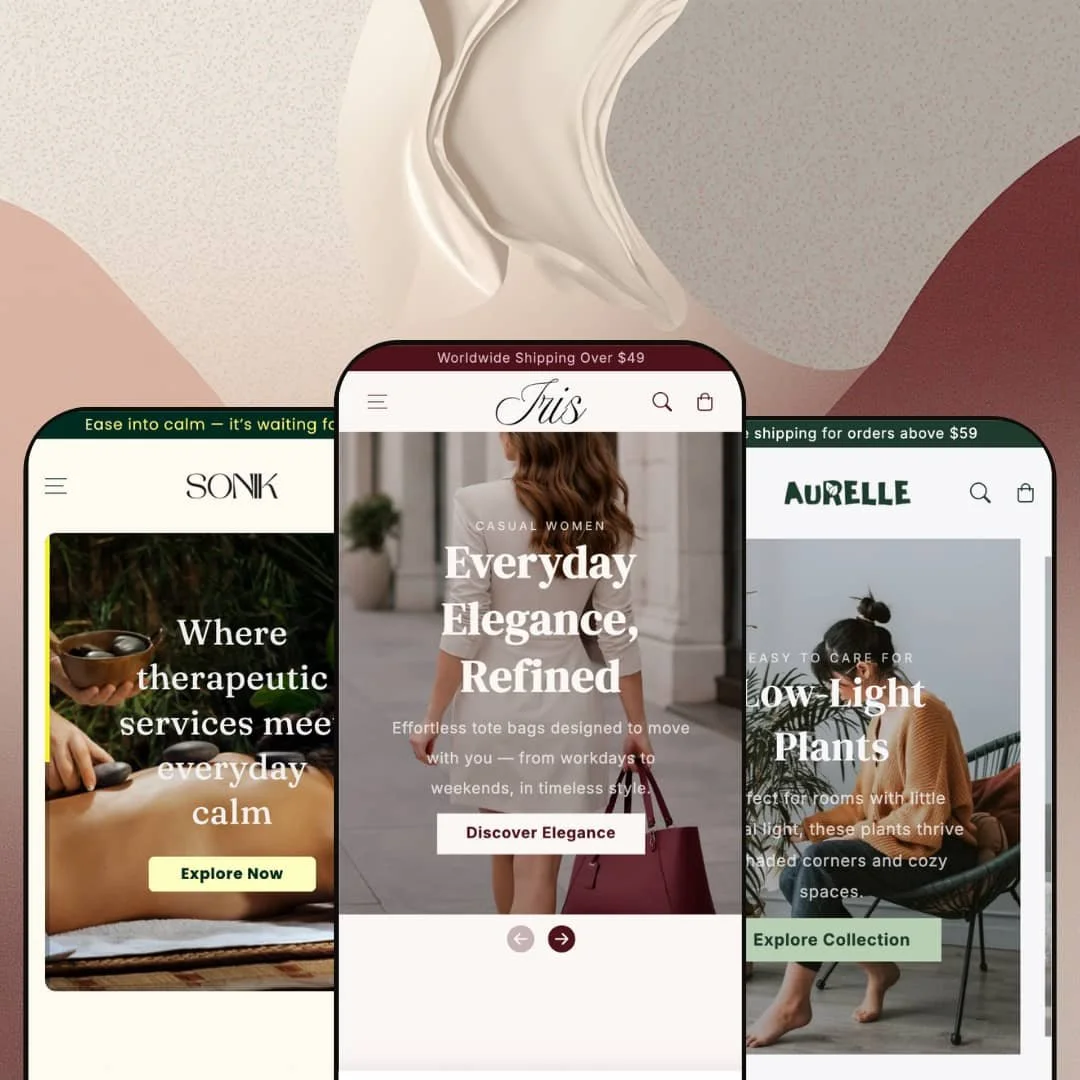
Most premium Shopify themes pick a vertical and commit. Iris, Mana Themes' Online Store 2.0 theme at $270, refuses to: its three presets stage a handbag label, a houseplant shop, and a day spa from one shared section library. That range is the sales pitch, and it's also the claim a buyer most needs to pressure-test before spending. I spent time in all three demos to see where the system genuinely flexes and where it just changes clothes.
Navigation doubles as a promo channel
Iris treats the mega menu as merchandising space, not a sitemap. Dropdown columns run image tiles with badge labels, a 35% Sale flag on a Find your Plant tile here, a New badge on Business Bags there, and a Product Spotlight block can park a single hero item like the TerraTone Classic Tote inside the menu itself. Shoppers see offers before reaching any page. For sale-driven stores with 50 to 200 SKUs spread across many sub-categories, where the menu is the most-touched surface on the site, that placement does campaign work for free.
Purchase-state signals, everywhere they matter
How close is this item to gone? Iris answers directly on the buy box: a live stock counter reads 100 in stock, the quantity stepper reports how many units already sit in your cart, a sticky add-to-cart block follows the scroll, and a back-in-stock waiting list takes over once inventory hits zero. It's one coherent availability mechanism. Restock-driven shops and impulse-buy catalogs under 100 SKUs, where urgency and scarcity carry the close, get the full instrument panel without stacking integrations on day one.
Three verticals from one license
The preset family covers physical goods, living goods, and services in a single purchase. That's real range. A bag boutique, a plant shop, and a spa sit about as far apart as Shopify use cases get, yet the same 30-plus-section library carries all three demos without any preset feeling like a stretch. For agencies and multi-brand operators building everything from sub-50-SKU service menus to mid-sized retail catalogs, one $270 license that restages this widely beats buying a niche theme per project.
The cart drawer closes deals, not just lists them
Iris's slide-out cart carries a discount-code field with its own apply action plus an order-instructions box, directly in the drawer. That placement matters. Customers arriving with a newsletter code can validate it before committing to checkout, which removes the single most hesitation-prone moment in a coupon-led purchase, instead of forcing them to trust that a field will eventually appear. For mid-market brands running email-coupon funnels and first-order discount campaigns, the drawer quietly protects conversion at its weakest point.
A services preset with no concept of time
Sonik dresses Iris up as a spa, but the checkout still thinks it's selling totes. Treatments move through quantity steppers and a cart like physical goods because Shopify's core product model has no time-slot logic and Iris adds none on top of it. The storefront sells the calm. The calendar is your problem. Appointment-driven businesses, single-location spas, salons, and studios booking staff against hours, should budget for a scheduling app and its integration work before treating this preset as turnkey.
Discovery tops out at the menu
The heavy lifting in product discovery happens inside the mega menu, and the trail thins once you leave it. Collection pages run a hero image, a filter drawer, a sort dropdown, and a grid. That's it. The demos stage 12 to 30 products per collection and never show how the collection template would keep a 500-plus-SKU, multi-brand catalog navigable past the second click; every staged collection is shallow enough that the question simply never comes up.
One product-page anatomy, two outfits
Iris ships two product layouts, and they're siblings. Both run the same skeleton of gallery, buy box, and accordion content, differing mainly in thumbnail treatment, and while editorial sections can stack beneath that unit, the Aurelle demo proves it, the core anatomy itself offers little structural variation. Luxury-tier sellers of considered purchases, where a product page should read like a story before it reads like a spec sheet, will feel that ceiling first.
What it takes to launch
Expect a one-to-two-day pass covering hero and banner copy across your chosen preset, mega-menu image tiles and their link targets, metafield values behind the filter drawer, and configuration of waiting-list, promo, and translation strings before launch.
-
What works in this preset
Landing on the homepage, you get sorted fast. The hero rotates three audience-targeted slides, Casual Women, Men's Collection, and Business Women, each pushing its own collection CTA, so the first scroll already routes shoppers by identity instead of dropping everyone onto the same generic banner. It's a small staging decision that does real segmentation work.
Product cards earn their keep. Each one carries a second image that swaps on hover, a computed percentage badge like the -29% on the Minimal Structured Shoulder Bag, plus quick-view and add-to-cart triggers, which adds up to a dense little conversion surface on what otherwise reads as a minimal storefront.
I clicked into the Women collection and found a Bag/Case material filter running on real metafield values, Faux leather and Synthetic, alongside availability, price, and brand. That's vertical-aware staging. It shows merchants what the filter drawer looks like populated rather than merely promised.
Where it stumbles
The visual register says quiet luxury; the staging says weekend sale. Percentage flags sit on nearly every menu tile and a discount code rides the announcement bar, so a brand selling €219 totes on considered-purchase energy would spend its first session stripping promotional chrome rather than adding any.
-
What works in this preset
Plant retail is a use-case business, and this preset gets that. Collections are organized by problem, Low-Light Plants, Pet-Safe Picks, Air-Purifying Greens, Drought-Tolerant Plants, rather than by botanical taxonomy, which mirrors how plant buyers actually shop: by room, pet, and personal neglect level. The category banners reinforce it with benefit-led copy.
The product page treats aftercare as merchandising. Beneath the description sit icon badges and accordion blocks for shipping and returns, and further down an Expert Help section pairs a care-tips blog link with a Plant Stylist contact CTA, turning support content into a retention surface for a category where a dead plant means a dead repeat customer.
A tabbed Best Sellers grid splits the catalog into Indoor, Low-Light, and Pet-Safe views with live product counts. Fourteen items in one tab, four in the others. The tabs make a modest catalog feel curated instead of thin.
Where it stumbles
One omission kept bugging me: live-goods logistics. Every plant is staged as a flat, single-variant product, with no pot-size or height options demonstrated anywhere, and for a vertical where a 12cm and a 21cm pot are genuinely different purchases, the demo never shows how the theme's variant tooling would carry that load.
-
What works in this preset
The "Rooted in trust" testimonial block does something smart. Each quote carries the reviewer's photo plus a linked card for the exact treatment being praised, so applause for the Hot Stone Massage lands one click away from putting it in the cart. It's a direct wire from social proof to revenue.
Service length runs as a variant axis. The alternative product layout stages a Herbal Head & Scalp Therapy with 30- and 45-minute options rendered as a button-group picker, which is exactly the right mental model for selling time-based treatments through a product catalog.
A numbered Discover the Ritual section ranks three treatments with category labels and prices, an editorial top-three framing that suits a services menu well, and the marquee text strips and icon benefit rows spaced between sections keep an unusually long homepage moving.
Where it stumbles
The Packages menu over-promises. Its dropdown tiles read like bundled offerings, Massage Therapy, Energy Healing, Gift Cards, but every tile resolves to a plain category collection, and the catalog stages no actual multi-treatment package, so the preset names a merchandising idea it never demonstrates.
A consistent editorial rhythm across wildly different stores
Read back-to-back, the three demos share a pacing discipline: full-bleed hero, curated grid, image banner, social proof, newsletter, location-anchored footer. The rhythm holds whether the content is ferns or facials. That cadence, rather than any single section, is the quiet reason the multi-vertical pitch works; merchants inherit an editorial tempo, not just a parts bin.
Footers that end the page with a brand, not a link dump
Every preset closes the same way: a logo-led mission statement, a store-location block with photography and address, newsletter, socials. It reads as a final brand impression rather than housekeeping. The footer is the one page element treated as storytelling space in all three demos without exception, and it signals where the developer's design priorities sit.
Preset variety is content-deep, not structure-deep
The three storefronts differ enormously in subject and barely at all in skeleton. Announcement bar, hero carousel, grid, editorial band, testimonial, footer recur in the same order with new photography, so a merchant buying presets expecting three structurally distinct layout philosophies is really buying three art directions of one. Strong art directions, admittedly. But one.
Design investment fades with click depth
Homepages got the love, and product pages got most of the remainder. The interior tier of collection templates, FAQ, contact, and standard pages is staged plainly across all three presets, and the distance between a homepage's choreography and a collection page's hero-filter-grid utility is wide enough that shoppers will feel the register change mid-journey.
★ 7.6/10
Rating
-
The conversion kit runs deep for $270: in-menu promos, waiting lists, stock counters, gift wrapping, five-language theme strings. Time-based selling is the one notable hole.
8
-
Presets arrive content-complete with navigation, pages, and two product layouts pre-staged; merchant work concentrates in metafields, menu tiles, and block configuration.
8
-
The mobile menu stacks columns into an accordion drawer and collections get a dedicated filter-and-sort sheet; image-heavy homepages put the burden on disciplined asset sizing.
7
-
Pages pair lazy-loaded imagery with a restrained script footprint relative to how much sits on screen; the longest homepages still carry substantial media weight.
7
-
A 30-plus-section library restages convincingly from handbags to massage menus; the product page's core anatomy is the one place the system stays rigid.
8
Frequently Asked Questions
-
Theme interface strings come pre-translated in English, French, Italian, German, and Spanish. The demos run live switchers in subsets of those five; translating product content itself remains the merchant's job.
-
Yes, on two levels: gift wrapping at the cart level and a dedicated gift-card product layout. The Sonik demo goes furthest, staging four named gift experiences in their own navigation menu.
-
Every preset ships About, Events, Lookbook, FAQ, and Contact pages, and two of the three demos add a News blog. The Events page is an unusual inclusion that suits brands running launches or workshops.
-
A Recently Viewed section labeled "Pick up where you left off" sits on product pages and rebuilds the visitor's browsing trail without any extra configuration.
-
Three tiers: top-level items, column headings, and links beneath them, with image columns able to sit alongside the text columns inside any dropdown.
This review is based on hands-on testing of the publicly available preset demos of the Iris Shopify theme as of June 2026. Theme features, preset availability, and performance can change with subsequent updates from the theme developer.