
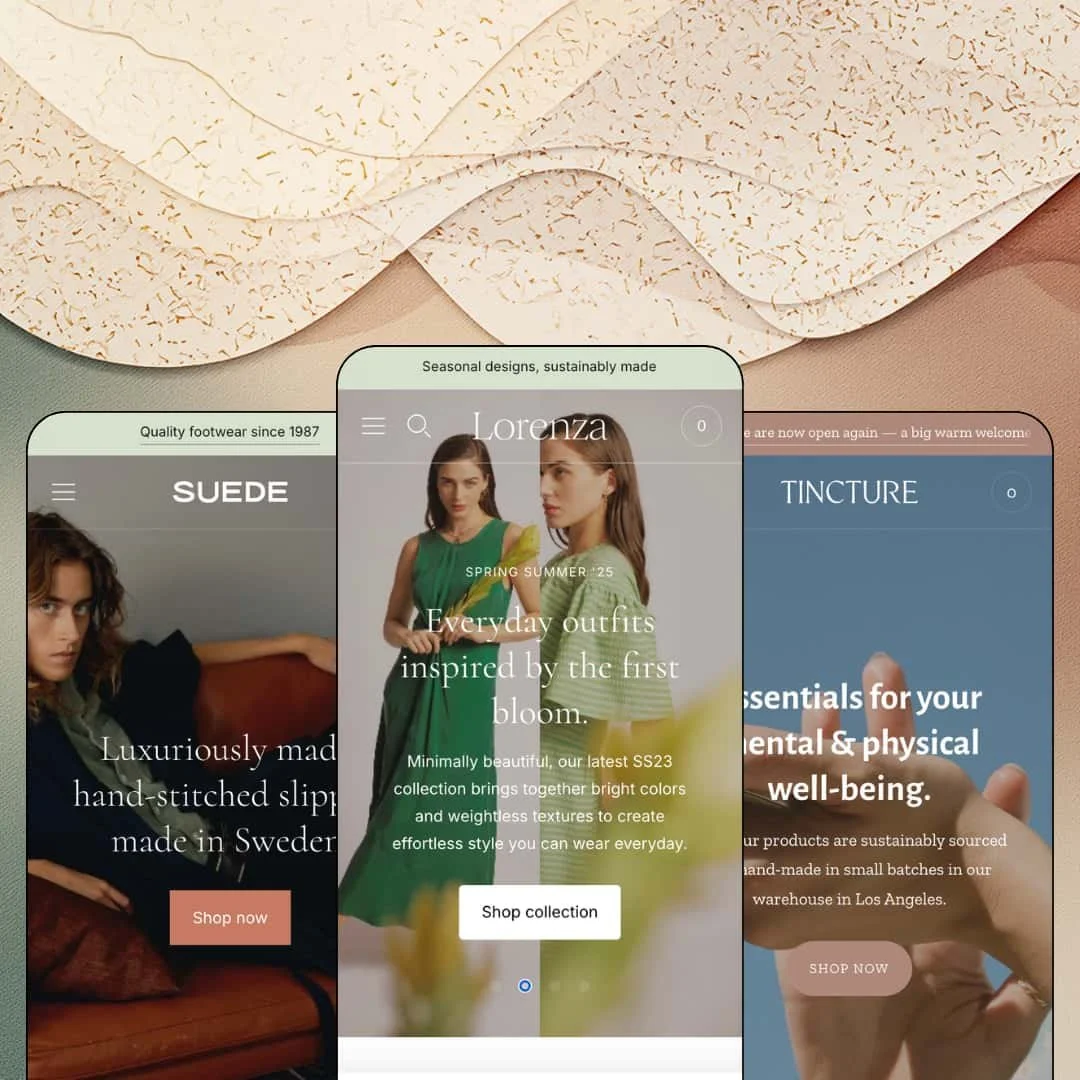
Most premium Shopify themes compete on conversion widgets; Lorenza competes on how good your brand looks mid-scroll. Fluorescent Design Inc. has kept this Online Store 2.0 theme on the Theme Store since 2017, and the current $320 build ships three presets: a fashion boutique, a Swedish slipper maker, and a small-batch herbal wellness shop. Whether the editorial bet pays off for you depends less on taste and more on the photography you can feed it.
The mega menu is a promo surface, not a sitemap
Each dropdown pairs its link columns with an image tile and a short text promo line, and all three demos deploy that slot differently. Every visitor touches the nav. Giving it a merchandising position means your current campaign travels with the buyer instead of waiting on the homepage. For single-brand boutiques running seasonal drops across a 30–100 SKU catalog, that's a permanently rented billboard.
Shipping costs answered before checkout
For cross-border sellers of considered-purchase goods such as apparel, footwear, and wellness, the estimator matters more than any hero section. Lorenza puts a full shipping calculator on the product page itself: country, province, postal code, and a Get rates button, before anything enters the cart. Surprise shipping is a classic abandonment trigger. Answering it next to the add-to-cart button is a quiet, structural conversion decision.
A real product-information kit
The size guide opens as a US/UK/Europe conversion table directly beside the size picker, and the product template supports tab sets for description, care, returns, and shipping without any page-builder gymnastics. It's simple. For apparel and footwear brands selling into multiple sizing systems to fit-sensitive, return-prone buyers, this kit converts uncertainty into a purchase and pre-empts the support ticket that would have followed it.
Collection pages that scale past a boutique
Color swatch filters, size filters, a price-range filter that states the collection's top price, nine sort orders, and a running "viewing 1–12 of 13" counter all ship in the collection template, with an Available Colors swatch row on the cards themselves. That's genuine browsing infrastructure. Catalogs in the 50–100 SKU range built on color and size variants, exactly the stores Lorenza courts, get filtering depth here that many editorial-leaning designs skip.
Social proof is display, not evidence
The testimonial sections render hand-typed quotes with first-name attributions, and I went looking for anything more: no review capture, no counts, no verification exists anywhere in the theme. The quotes are wallpaper. Beauty, wellness, and fashion merchants selling to research-heavy buyers who cross-check claims will need a review app (Judge.me, Loox, or similar) as a day-one install, plus the integration styling that comes with it.
An Online Store 2.0 foundation at a 2026 premium price
Lorenza predates the Theme Blocks generation, so its nesting and block flexibility sit at the OS 2.0 ceiling. Dawn ships free on the same section-based foundation. The $320 case therefore rests entirely on the editorial section library, the merchandised navigation, and the product-page kit, and mid-market single-brand stores comparing options should price the theme on that delta rather than on the platform features every theme inherits.
The architecture assumes a photography budget
Hotspot outfit imagery, lookbook pages, campaign video slots, caption-driven social galleries: every signature surface wants art direction. None of it is optional. Feed it supplier photos on white backgrounds and the magazine effect collapses into a sparse grid. Dropship-model sellers and first-year single-brand stores without a campaign shoot behind them will be fighting the theme's best sections instead of benefiting from them.
What it takes to launch
Expect a multi-day pass covering seasonal copy alignment across hero, lookbook, and blog surfaces, testimonial and quote population, hotspot re-pinning on your own photography, mega-menu promo restaging, and a translation review across the five bundled language files before launch.
-
What works in this preset
Scrolling this demo feels like flipping through a season catalogue that happens to have prices. A copy-led hero opens into a product carousel, an image-with-text pair, a campaign video that plays inline, and a social gallery where every image carries its own caption-length story. It's dense without feeling promotional.
Halfway down sits the piece I sat up for: an outfit module. One campaign photo, and beside it the Ponte Jacket and Brisa Pant with their prices, under a "Get the outfit" pitch that sells the set rather than the item. That's shoppable imagery doing actual merchandising work instead of decorating a homepage.
The reviewer quote cards pull the same trick. Each quote is attributed to a first name, paired with a lifestyle photo, and linked directly to the product being praised, so praise doubles as a path back into the catalog. For a brand that trades on word of mouth, that linkage is the section's whole value.
Where it stumbles
The staging voice undercuts the boutique pitch. Nearly every card in the featured "It's in bloom" grid carries an On-sale badge with a slashed price, which reads more like an outlet than the considered, editorial retailer the preset is dressed as. Merchants can restage that in an afternoon, but the demo's first impression is markdowns.
-
What works in this preset
Sole construction gets its own menu column. That's a small thing, but it shows the navigation treated as a product taxonomy: Collections, Materials, and Sole each hold a column, so a buyer can enter the same tiny catalog through gender, leather type, or stitching method depending on what they actually care about. For footwear, materials-first browsing is exactly how people shop.
Reading down the homepage, the rhythm alternates between commerce and mood: a text-only statement hero, a collection intro with its grid, a full-width feature panel, then a single press quote set in enormous type with nothing around it. The page breathes. It's the closest of the three demos to a printed catalogue.
Even the announcement bar earns its pixels here, rotating two messages that both deep-link (one into the About page, one into New Arrivals), so the top strip functions as navigation rather than filler.
Where it stumbles
With roughly a shelf's worth of slippers, the collection-intro-plus-grid pattern repeats three times in a row and the same loafers resurface in each pass. The staging exposes where the homepage grammar strains: below a few dozen products, merchants will want fewer grid sections and more feature panels, or the page starts rhyming with itself.
-
What works in this preset
This preset stages the product template for its vertical rather than against it. The elixir page I tested carries an "Our promise" text block beside the gallery and a tab set covering Use Guide, Sustainability, and Shipping, which is the theme's usage-information tooling doing real work for a category where "how do I take this" decides the purchase.
I also liked the small orientation cues. An icon row up top states returns, sourcing, and shipping terms in three tidy columns, and the collection tiles further down display live product counts, so a first-time visitor knows the store's shape within one scroll.
Where it stumbles
One staged testimonial says the customer subscribed to a delivery every two weeks, yet nothing in the theme takes a subscription. Replenishment is the natural business model for tinctures and teas, and merchants going that route should budget a subscription app (Recharge, Appstle, or similar) on top of the theme, because the staging writes a promise the section library can't cash.
The demo also lets a sold-out salve sit in two separate homepage grids. Dead inventory in a hero position is a curation choice, and it's the wrong one for a store this small.
One grammar, three convincing accents
Read back to back, the demos prove the same section library can pass as a fashion magazine, a luxury footwear catalogue, and a wellness journal without visual strain. That range is the actual product at this price: one purchase, and the aesthetic survives a pivot in vertical or tone.
Nine years old and still shipping
A 2017 launch date usually signals abandonment risk; here the changelog says otherwise, with version 7.1.1 landing in August 2026. Longevity plus an active release cadence is a maintenance profile most buyers can't verify for younger themes, and it lowers the odds of owning an orphan.
Quiet by default
The feature list includes promo popups, banners, and tiles, yet none of the three demos lean on them, and no overlay interrupts a first visit. That's a deliberate character statement: the theme trusts content over interruption, and the staging matches the pitch.
Everything is typed, nothing is data
Across all three presets, the trust layer of tabs, size charts, promise blocks, and quotes lives in hand-entered rich text with no metafield-driven structure behind it. At ten products that's charming; at a hundred it's a consistency tax, because every update is a manual edit repeated per product.
Listed verticals without a preset
The Theme Store files Lorenza under Jewelry & accessories and Food & drink, yet the demos stage fashion, footwear, and herbal wellness. Buyers in the listed verticals get no staged proof of fit and must extrapolate from adjacent categories before spending $320.
Rating
★ 7.6/10
-
Quick buy, slide-out and sticky cart, pickup, stock counter, and the on-page shipping estimator cover serious ground; no review mechanism or structured data layer.
7
-
Presets arrive content-complete and every surface edits as plain sections and rich text; the flip side is that nothing populates itself.
8
-
Collection filters re-render as a drawer with per-group Apply buttons, footer columns collapse cleanly, and the sticky cart keeps checkout reachable on long editorial pages.
8
-
Pages run lean for how image-forward they look: SVG logos, sized image assets, and restrained script weight keep the editorial layouts from turning heavy.
8
-
Three genuinely distinct looks come out of one section library; the ceiling is aesthetic, since the theme won't stop being editorial-minimal no matter the settings.
7
Frequently Asked Questions
-
Yes. Lookbook sections ship natively, and the Lorenza preset dedicates a top-level navigation item to one.
-
Both a slide-out drawer and a sticky cart are included; the drawer carries a running subtotal line and sits beside a recently-viewed rail, so buyers keep context while they browse.
-
Yes. Pickup availability is built into the product page, so merchants with Shopify locations configured can surface local collection without extra tooling.
-
Tincture. Beyond the palette, its demo organizes the catalog by need (Immune Support, Mental Wellbeing, Dietary) as well as by product type, which is the browsing logic supplement buyers actually use.
-
Yes. Every product card in the demos carries a Quick shop trigger, and quick view is a separate listed feature; both are merchant-controlled toggles.
-
The product form includes an inventory check that flags when the selected quantity exceeds stock, alongside the listed stock-counter feature for scarcity display.
This review is based on hands-on testing of the publicly available preset demos of the Lorenza Shopify theme as of August 2026. Theme features, preset availability, and performance can change with subsequent updates from the theme developer.