
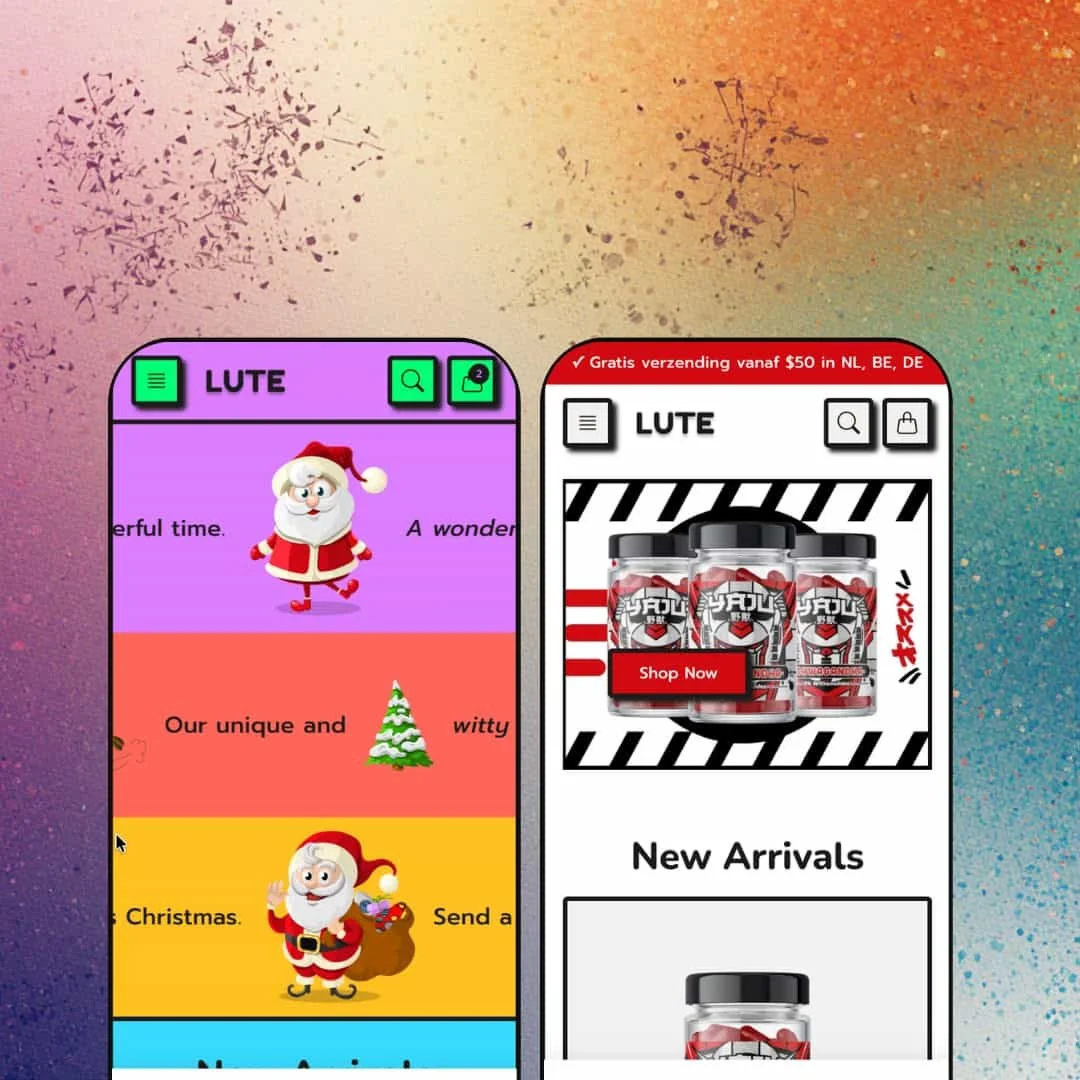
Most Shopify themes treat color as decoration. Lute, a $360 Online Store 2.0 theme from ThemeGoal, treats it as the actual message, building a neubrutalist storefront language out of hard borders, flat color fields, and type big enough to read across a room. Its two presets stage stores so different they barely look related, which is either the strongest argument for the theme or a warning sign, depending on what you're shopping for. I clicked through both to find out which.
A product page built for long-form selling
The product template runs a configurable tab row alongside dedicated spec blocks and post-gallery image-with-text slots, and the tabs relabel per context: one demo runs Description, Information, Shipping, and FAQs, while the other swaps in a Warning tab to hold compliance copy. That's real range. For supplement, beauty, or food brands whose considered-purchase buyers read ingredients and certifications before committing, this template carries the education load natively.
Interface strings arrive translated for five EU languages
Lute ships its theme interface pre-translated into English, French, Italian, German, and Spanish, with right-to-left stylesheet support on top. Product content is still on you. What the theme removes is the tedious string-by-string translation of buttons, form labels, and cart text, which matters for single-brand stores selling cross-border into neighboring European markets from day one.
A design language you can't mistake for anyone else's
When did you last see a store window and remember it a week later? Lute is built on that bet: chunky outlined blocks, unapologetic color, and oversized type turn the whole storefront into signage rather than a neutral frame quietly arranged around the products. Dawn can be recolored endlessly, but its bones stay polite. Lute is loud at the skeleton level. For gift shops and impulse-buy brands whose shoppers decide in seconds, the Theme Store tagline "use color to communicate" is a literal description of the mechanics, and that memorability is the value proposition.
The cart works as a selling surface, not a receipt
Open the slide-out cart and a Frequently Bought Together module sits inside it, pushing companion products at the exact moment purchase intent peaks, while a sticky cart keeps the buy action pinned through long product-page scrolls. Low friction, well placed. For low-price, giftable catalogs where shoppers buy on impulse and order values live or die on the second item, cross-selling inside the drawer is where the margin gets made.
The named vertical never shows up in the demos
Shopify's Theme Store files Lute alongside toy-store themes, and ThemeGoal's own description pitches kids' stores, toy shops, and baby clothes. I went looking for a toy store in these demos and never found one. Neither demo sells a toy: one preset stages seasonal greeting cards, the other a supplement label, so toy retailers and kids' brands with gift-driven, browse-heavy shoppers are the declared audience yet the one group with no staged example to evaluate or copy.
No proof at catalog depth
This kept bugging me. Both demos run tiny catalogs, sixteen products on one and single-digit core products on the other, so nothing in the available evidence shows how the grid, the collection controls, or the navigation behave once a real inventory of several hundred items lands inside them. Sixteen products is a mood board, not a stress test. Merchants running 100-plus-SKU catalogs with restock-driven traffic are betting $360 on extrapolation.
Three reviews in three years
Lute launched in June 2023 and has collected three Theme Store reviews since, all positive. That's thin. A 100% score built on three data points says little about how the theme holds up across store types, update cycles, or edge cases, and for single-brand merchants migrating an established catalog, that uncertainty weighs heavier than it would on a fresh experimental build.
What it takes to launch
Expect a multi-day pass covering full demo-copy replacement, including one preset whose copy needs rewriting out of a non-English source, plus per-product population of the tab and spec-block system, menu and promo staging built up from near-empty navigation, and brand asset swaps across announcement bars, footers, and newsletter blocks.
-
What works in this preset
Landing on the homepage feels like walking past a shop that's shouting at you, pleasantly. A ticker-style hero streams the word "Christmas" between fragments of copy in a continuous band, every piece of it clickable through to the collection, so the loudest element on the page is also the primary navigation act. I scrolled that ticker three times just to watch it loop. It's a gimmick that earns its place.
The featured-collections section runs a tab switcher: Christmas, Halloween, and Bestsellers swap product grids in place without sending you to a new page. Cards carry a second image that appears on rollover, so browsing the grid quietly previews each design's alternate artwork before you ever click into a product. It keeps a four-link storefront feeling bigger than it is.
Eight gallery images on a single sticker product. The product page stages two variant axes at once, five background artworks against three print sizes, and rounds the template out with an "About the item" spec list plus two full-width image-and-text selling sections placed after the buy box. Depth like this on a $1.99 item tells you the template was built for products that need convincing.
Where it stumbles
The demo stages a flat four-link navigation, two of those links being collections, which suits a seasonal card shop but leaves the header's deeper merchandising for merchants to architect themselves. Anyone planning promo-loaded menus or multi-level category trees starts from a nearly blank example rather than editing a built-out one.
-
What works in this preset
Same theme, opposite temperature. Fauve strips the palette back to stark blacks and clinical whites and stages a lab-tested supplement label, complete with an editorial row of three test-report features, each pairing a product photo with a heading, explainer copy, and a link deeper into the documentation pages. If the Lute preset argues that color sells, Fauve is the counter-argument that restraint does too.
Product cards here carry a direct add-to-cart button, and the grid mixes single products with discounted bundles whose compare-at prices render slashed right on the card face. Buying friction sits near zero. It's a sensible staging choice for a replenishment vertical where repeat buyers already know exactly what they want and just need the shortest path back to it.
The blog section pulls three article teasers onto the homepage with image, title, and excerpt, feeding the education-first selling this vertical runs on. For a considered purchase at supplement prices, putting the reading material one scroll away from the buy grid is the right structural call.
Where it stumbles
For a preset whose whole pitch is education-driven trust, the homepage runs lean: banner, product grid, the lab-test row, blog teasers, newsletter, done. Five sections read as a starting point rather than a finished storefront, and merchants in high-scrutiny verticals will be adding certification, comparison, and FAQ sections themselves before this layout converts skeptical first-time buyers.
One skeleton, two temperaments
Read both demos back to back and the pattern that emerges isn't a feature, it's a design system: the same sections, content slots, and template bones produce a playful seasonal boutique in one preset and a stark clinical label in the other. The mood shift comes from color tokens and typography, not from swapped architecture. That's the durable asset here, because the storefront you eventually build isn't locked to either demo's personality.
A developer still shipping
Three years after launch, the release notes read like an active roadmap rather than maintenance mode: version 3.2.0 landed in April 2026 carrying conditional settings, badge and price customization options, and a reorganized section list. For a one-time purchase with no subscription attached, ongoing development is the closest thing to an insurance policy a buyer gets.
Both demos wear the same chrome
The header and footer barely change between presets: a compact logo-and-tagline column, two short link lists, social icons, a payment row, and a flat top nav, identical in composition whether the store sells cards or capsules. Whatever depth the header and footer settings actually allow, the demos never put it on display. Buyers who weight that layer heavily are configuring blind.
The aesthetic is the product
Strip the neubrutalism out of Lute and it's hard to say what's left to justify $360. This is a theme whose identity survives even its restrained preset, and merchants who want the toolset without the attitude will spend their customization hours fighting the design rather than deploying it.
Rating
★ 7.8/10
-
Quick buy, a cross-selling cart drawer, countdown timer, stock counter, and Combined Listings support cover the conversion staples; the heavier merchandising pieces sit on the features list without a demo deployment to judge them by.
8
-
The 3.2.0 update added conditional settings, which trims editor clutter, but the product template's tab and spec-block system means real per-product content wiring before pages look like the demos.
8
-
Collection pages collapse controls into a full-screen Filter and Sort drawer, product pages keep the buy action pinned while scrolling, and the oversized type scales down without losing the theme's voice.
8
-
Homepages run restrained section counts and images load behind tiny blurred placeholders, which keeps first paint light; the marquee hero and rollover effects add motion without heavy media.
7
-
Color tokens and typography carry enough range to restyle the same sections from playful to austere, and multiple product-page layouts ship on top of that.
8
Frequently Asked Questions
-
Substantially. Lute stages a bright seasonal card shop; Fauve stages a monochrome supplement label with lab-report content, and navigation, hero style, and mood all diverge between them.
-
Yes, it's on the official features list, flagged as a Shopify Plus capability, so standard-plan merchants can't use it regardless of theme support.
-
Both appear on the features list, and quick-buy triggers are toggleable at the theme level, so a demo staging them subtly doesn't mean they're absent from your configuration options.
-
ThemeGoal maintains the theme with a dedicated documentation portal and ticket-based support, and buyer feedback on the Theme Store repeatedly credits fast response times.
-
A countdown timer, stock counter, product badges, promo banners, promo tiles, and in-menu promos are all part of the package, giving flash-drop and sale-driven stores their staging tools natively.
-
Product videos are supported per the features list; the current demos stage image-only galleries, so you'll want to test video rendering in your own theme preview before launch.
This review is based on hands-on testing of the publicly available preset demos of the Lute Shopify theme as of July 2026. Theme features, preset availability, and performance can change with subsequent updates from the theme developer.