
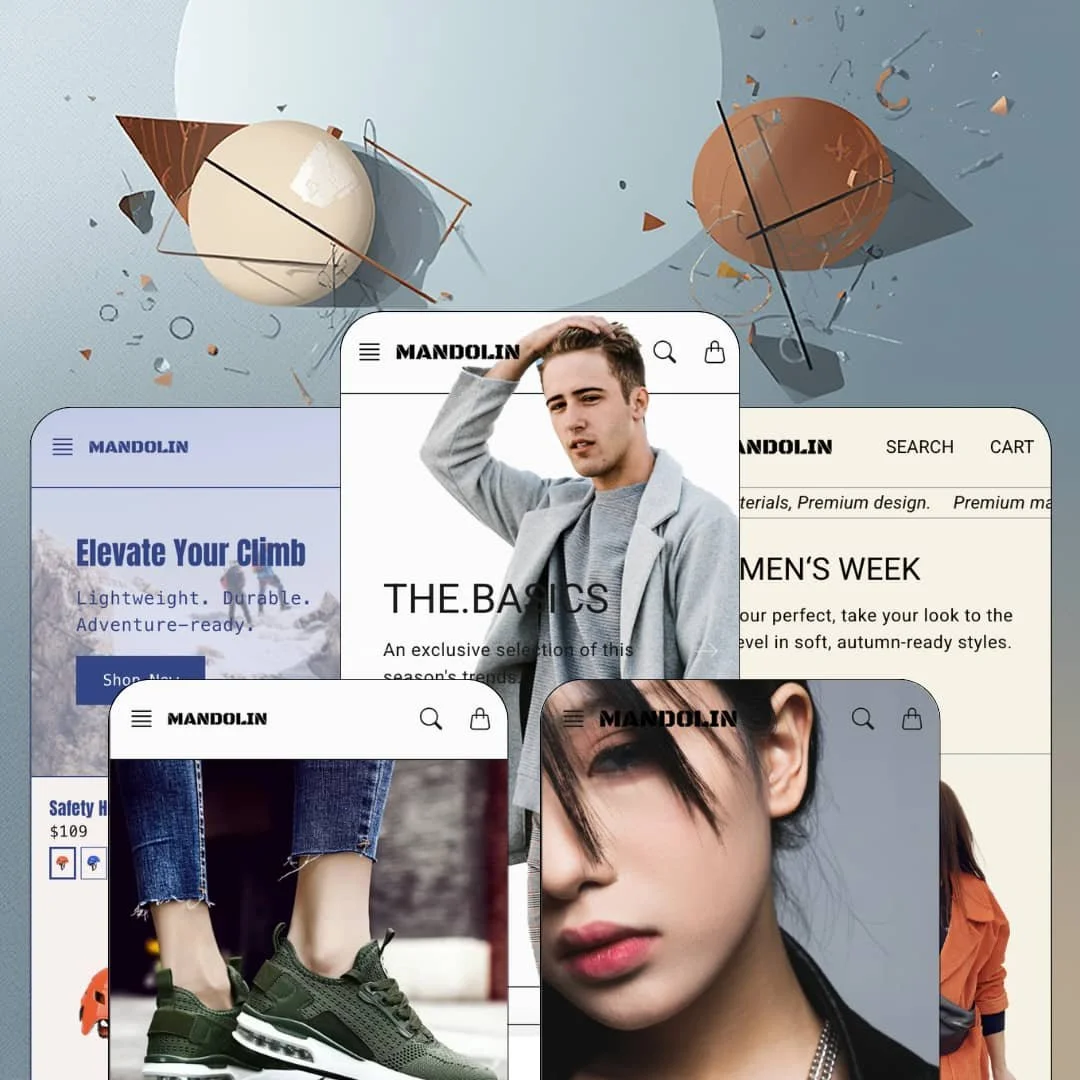
The most convincing page in Mandolin's demos isn't a homepage — it's a collection page. ThemeGoal has been shipping this Online Store 2.0 build since September 2022, and the sales pitch leads with filtering rather than with looks, which is unusual for a theme wearing fashion photography on its cover. Five presets come with the purchase: three dressed for apparel, one for footwear, one for outdoor gear. At $360, the question is whether the plumbing underneath justifies what the surface only partly shows.
Collection filtering that earns the sales pitch
Nine sort orders is a lot. The collection page backs them with a faceted filter panel showing live result counts per value — availability, color, product type, and in the footwear demo an eleven-value shoe-size facet — plus manual price-range inputs, while the mobile version wraps the whole thing in a full-screen drawer that closes with a SEE RESULTS button. Counts matter because they kill dead-end clicks: nobody filters into an empty grid. For apparel and footwear stores in the 100–500 SKU range whose buyers shop by size and color first, this is the part of the theme that will earn its keep daily.
A product page staged as one coordinated conversion kit
The product template works as a unit. A stock counter sits under the variant picker, a Buy-it-with cross-sell row pulls companion products above the fold's end, accordion tabs keep description, shipping, and size-chart content compact, and a sticky add-to-cart bar follows the scroll carrying the exact variant you picked. Each piece feeds the same goal, keeping the purchase decision and the buy button in view at the same time, so the kit compounds instead of cluttering. Impulse-buy apparel merchants at sub-$50 price points with mobile-heavy traffic are the obvious beneficiaries.
Built for stores whose traffic arrives on a phone
If most of your visitors come from Instagram or TikTok on a small screen, Mandolin's banner sections deserve a look, because they accept a separate mobile image alongside the desktop one instead of center-cropping a single wide asset. The Mandolin and Formelle demos both ship distinct portrait crops for their heroes. That's art direction, not responsiveness. For social-driven fashion stores selling to impulse buyers, it means the first screen a phone visitor sees was actually composed for a phone.
Product cards that do persuasion before the click
The card layer merchandises on its own. Badges render automatically from product state, computed save-amounts on discounted items, NEW and BEST SELLER labels, a Sold out overlay, while color swatches appear directly on the card and a second image swaps in on rollover, so a shopper standing in the collection grid already knows the price story, the colorway options, and the back view before opening anything. For restock-driven stores with 50–200 SKUs and cross-shop-heavy browsers, that shortens every session.
The default design language is discount-forward
Quiet luxury this is not. The demos stack a Hot badge on top of a save-amount label, run a Summer Sale banner promising up to 70% off, and keep urgency copy within reach of the buy button, and while every one of these is a toggle or a staging choice, together they reveal where the theme's instincts point: volume and promotion. Luxury-tier jewelry brands and premium apparel labels selling considered purchases will spend their setup phase stripping persuasion furniture out rather than adding it.
Thin storytelling sections for the tier
I went looking for a lookbook, an image-hotspot section, or any shop-the-look staging, and found none, not in the demos and not on the declared feature sheet. The sheet does carry product videos and a before/after slider. Media isn't the gap. Composed campaign storytelling is. At $360, that ceiling is fair to hold against it: this price bracket is where a theme should hand a brand its campaign tools, not just its commerce tools. Single-brand stores that sell through seasonal drops and campaign imagery will hit this wall first.
Five presets, three wardrobes
Mandolin, Formelle, and Eclat merchandise overlapping fashion catalogs, with the same relaxed-fit tees and muscle-fit shirts anchoring all three demos. That's lazy. This kept bugging me as I moved between the demos, because the preset count is a headline selling point, and in practice a buyer gets three arrangements of one apparel store plus a footwear vertical plus an outdoor vertical. Food, beauty, or home merchants with 30–300 SKUs who are comparing themes on preset breadth should count verticals here, not thumbnails.
What it takes to launch
Expect a one-to-two-day pass covering full copy replacement across hero captions, footer mission and newsletter strings, and product-description templates, plus size-chart data population per product line and mega-menu restaging against your own collection tree.
-
What works in this preset
Open the WOMEN entry in the header and a proper submenu unfolds: a Products column, direct links to New Arrivals and Bestseller, a Hoodies entry, and an all-products catch-all, so the navigation sorts browsing intent before a single collection page loads. The drawer version goes further and adds a utility tier of FAQs, refund policy, terms, and account links. Small thing. It turns the mobile menu into a service hub and saves a footer scroll on a phone.
The homepage runs two full-bleed hero slides back to back, each with its own headline and collection CTA, before the first product grid appears. Mid-scroll, a wide promo banner announcing new collections with an entry price re-engages the price-conscious shopper who skimmed past the heroes without clicking.
The blog gets unusual respect for a fashion demo. MAGAZINE sits in the top navigation as a peer of the collection links, and the homepage feeds it with three article teasers that carry real excerpt lines about color theory and clothing design rather than filler, which signals the article template is meant to be used, not tolerated.
-
What works in this preset
Lilt sells one sneaker hard. The hero's Shop Now button skips the collection layer entirely and lands on a single product page, while a secondary View more link quietly catches the browsers who aren't ready to commit to one shoe yet. Further down, a narrative banner runs the same play for a loafer, naming all four colorways in its caption before handing you off to the product.
I clicked through all three blog teasers expecting lorem-adjacent filler and found genuine footwear editorial instead: a shoe-measuring guide, an occasion guide, a style taxonomy. Paired with the deliberately slim three-link header, the preset reads like a playbook for drop-model footwear brands that want the product, not the frame, doing the talking.
-
What works in this preset
A $15 ice claw and a $399 shell jacket share one grid here. Innate is the only preset that stages hardgoods, and it mixes product-on-white renders with lifestyle photography across tents, stoves, gloves, and helmets without the card layout falling apart, which is worth seeing if your catalog spans accessories and big-ticket gear.
I spent time on the Safety Helmet page. The gallery is the story: ten images served through a thumbnail strip, covering every colorway and detail angle. Between homepage sections, a scrolling text strip repeats the preset's tagline and adds motion to the page without the weight of a video file.
Where it stumbles
Gear buyers compare numbers. Certifications, weights, and head-circumference ranges on the helmet page live inside long paragraphs of marketing prose, and the preset offers no structured spec-table treatment to lift them out, which reads against a vertical where shoppers cross-check standards before they trust a product. For an outdoor-positioned preset, that's the one piece of staging that feels borrowed from the fashion demos.
-
What works in this preset
The tabbed PREMIUM SELECTIONS section is the preset's best idea, switching between a New Arrivals feed and a Hoodies feed inside a single section slot. Two collections, one scroll position. For merchants fighting homepage length on mobile, that's a real estate win.
Before the hero even loads, an announcement bar runs a free-shipping threshold message, putting the order-value nudge at the top of every page rather than burying it in a cart drawer. The hero itself pairs a text overlay with its own campaign tagline, keeping the messaging layered instead of stacked.
-
What works in this preset
This is the preset for merchants who think in campaigns. Paired collection banner tiles sit side by side as image-led entry points into different lines, and the hero carries two CTAs at once, one pushing the sale and one inviting a slower browse.
A standalone newsletter section appears mid-page, separate from the footer form, and the footer itself links out to six social platforms including YouTube and TikTok. The staging leans acquisition-heavy. Capture the email, feed the channels, let the banners carry the visual argument.
One commerce spine under five skins
Read all five demos in a row and the pattern is the point: header behavior, cart drawer, collection machinery, and product-page structure are identical everywhere, and the presets differentiate through staging and photography sitting on top. That makes a mid-life preset switch a re-skin rather than a rebuild, and it lets an agency or holding company standardize team training on one system across very different-looking client stores.
A four-year runway, still moving
The theme launched in September 2022 and stood at version 4.3.2 as of May 2026, which is a maintenance rhythm many themes from that generation never sustained. Its Theme Store record is 100% positive across eight reviews, a small sample for a theme of this age that is better read as limited data than as proof in either direction.
The demos undersell the feature sheet
Countdown timers, before/after sliders, promo tiles, in-menu promos, and product videos all sit on the declared feature list, yet none of them is staged in any of the five demos. Buyers therefore preview a narrower theme than the one they're purchasing, and they only meet a meaningful chunk of the toolset inside the editor, after the money has moved. A theme that sells partly on being packed with features should let its demos prove it.
One homepage grammar, five times over
Footwear and outdoor included, every demo runs essentially the same sequence: hero, product grid, banner, second grid, blog teasers, newsletter. Preset personality comes from palette and photography rather than from compositional rearrangement, so a merchant who wants a homepage that doesn't feel like the demo family will be doing the recomposition work themselves in the editor.
Rating
★ 7.8/10
-
Collection and product-page machinery run deep, and the declared sheet layers marketing tooling on top. The missing piece is campaign staging, not commerce.
8
-
Because all presets share one section grammar, the editor only has to be learned once, and most demo behaviors are plain toggles.
8
-
Dedicated mobile image slots, a slide-out menu that carries service links, and a filter flow built for thumbs. Phone visitors get a composed experience, not a shrunken one.
8
-
Pages run lean: restrained section counts, responsive image sizing, and no heavy third-party embeds anywhere in the demos.
8
-
Five palettes and generous staging options inside a fixed compositional habit. You can restyle Mandolin far more easily than you can restructure it.
7
Frequently Asked Questions
-
Innate is the only demo staging hardgoods, mixing camping equipment, climbing hardware, and technical apparel in one catalog, so it's the closest reference point for anything outside fashion and footwear.
-
The feature sheet flags combined listings as a Shopify Plus capability, which matters for brands consolidating colorway variants into single listings on Plus plans.
-
Theme UI strings come pre-translated in English, French, Italian, German, and Spanish, and right-to-left layout support is declared. Product content translation itself is handled by Shopify Markets, not the theme.
-
It's a slide-out drawer with cart notes and a built-in cross-sell slot titled Frequently bought together, and the feature sheet adds a sticky cart option on top.
-
The sheet lists a mega menu with in-menu promo slots, and it's backed by breadcrumbs, collection page navigation, and enhanced search, which together keep a 500-plus SKU catalog navigable.
-
Yes, both quick view and quick buy are included, and the modal carries the full variant picker, so shoppers can pick a size and color without leaving the collection grid.
This review is based on hands-on testing of the publicly available preset demos of the Mandolin Shopify theme as of July 2026. Theme features, preset availability, and performance can change with subsequent updates from the theme developer.