
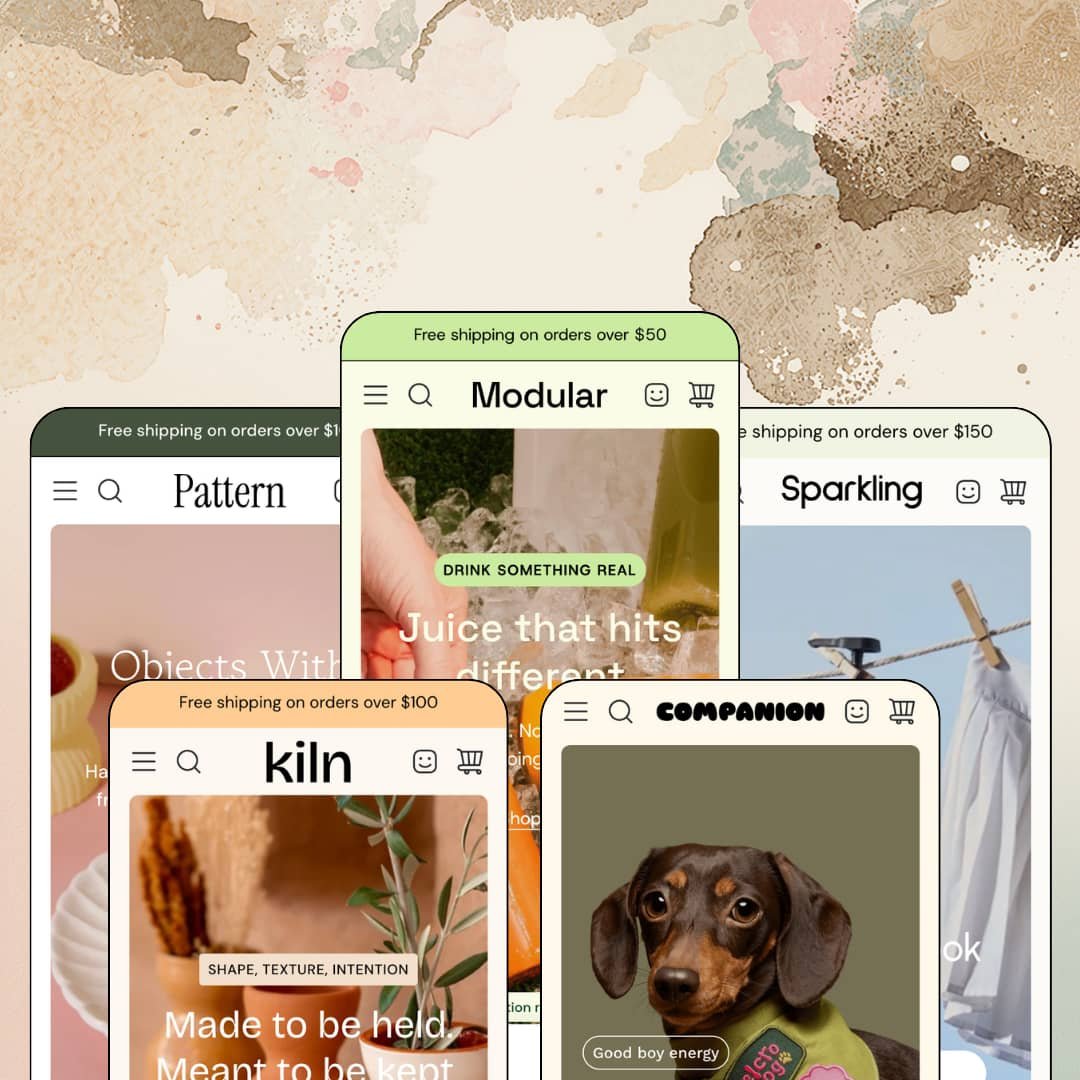
The products filling Modular's five demo stores aren't props: the dog bandanas, refill jugs, cake soaps, and studio ceramics are on loan from real brands that sell them right now. Presidio has been selling this theme since 2017, and the current version 7 build runs on Shopify's Online Store 2.0 architecture. At $300, it plays in premium territory against much younger competition. I spent time in all five presets, from juice bar to ceramics studio, to see whether borrowed authenticity translates into merchandising a merchant would actually run.
Scarcity that catches the shopper it scares
On the ceramics demo's Studio mug, "Hurry, Only 2 Left!" sits above the title; sell the piece through, and a native "Notify me when this product is available" form takes over the buy area. The counter creates urgency, the alert catches the miss, and low stock converts into a mailing list instead of a lost sale, with no app in the stack. For small-batch makers and drop-model brands cycling limited runs through catalogs under a hundred pieces, this is the core selling motion, native.
Navigation that sells, not just routes
The juice demo's Shop dropdown opens under a "Meet your daily ritual" heading and lists sixteen individual flavors across four columns, walking shoppers from navigation straight into product pages, while the cleaning demo's menu links a bulk refill bundle directly. Navigation becomes shelf space. For consumable and giftable verticals running curated ranges in the 11-to-100 product band, that shortens the path from curiosity to buy box by an entire page.
A trust stack assembled from theme sections
This is a coordinated social-proof kit rather than scattered widgets: UGC video walls pair each clip with an avatar chip and handle, press-logo rows stage Vogue and Marie Claire treatments, testimonial carousels run on home and product pages, and any product page can carry its own FAQ accordion. Stacked together, they reproduce the persuasion sequence of a full DTC landing page inside the theme editor. Social-first brands selling low-ticket impulse goods, the ones already sitting on short-form video, get the most out of it.
The cart drawer works the order value
Every demo runs the slide-out cart with a free-shipping progress bar, thresholds staged from $50 on juice to $150 on cleaning kits, flipping to "Congratulations! Your order qualified for free shipping" at the line. Quantity fields even read "(0 in cart)", keeping the storefront cart-aware while you browse. That's the cheapest order-value lever there is. For low-ticket consumables and accessories, where a $4 bottle needs company to earn its shipping, the nudge does daily work.
Replenishment stories, one-off buy buttons
Two of the five demos sell products people run out of, juice and laundry refills, and both stage their narrative around routine and reordering. The buy box stays quantity plus Add to Cart. Subscriptions, reorder shortcuts, and build-a-box mechanics sit outside the feature set, so brands whose economics depend on repeat delivery are budgeting for an app like Recharge or Appstle on top of the license. Subscription-driven consumable brands with repeat-buyer economics should price that in before falling for the staging.
Curation has a ceiling
Discovery here is hand-built. The demo collection pages stage three filter groups, availability, price, and product type, and everything beyond that is curated collections, maintained down to individual-product menu entries. Shopify's own listing files Modular under catalogs of 11 to 100-plus products, and the filing is honest. A 500-SKU electronics or parts catalog with spec-driven shoppers would spend its life fighting the theme's curatorial grain.
Every ounce of charm is hand-typed
Card taglines, benefit chips, accordion copy, menu straplines, per-product FAQ entries: all free-text fields a merchant fills in by hand. None of it writes itself. There's no product-data layer drawing on metafields to populate specs or tables, so what reads as offhand charm in the demos is, in practice, a permanent copywriting shift. Lean single-operator teams running seasonal drops will feel that load at every single launch.
2017 bones at a 2026 premium price
Modular launched in 2017 and runs Online Store 2.0, the same generation Shopify's free Dawn ships on, while the platform's newest themes have moved to the Theme Blocks generation with deeper block nesting. What $300 buys is the section library, the staging craft, and nine years of Presidio updates, not architectural headroom. Budget-watching first-time sellers benchmarking against free options, and single-brand operators planning multi-year builds, should weigh that consciously.
What it takes to launch
Expect a full copy pass across hero captions, card taglines, accordion and FAQ content, plus placeholder cleanup in several sections, mega menu re-staging, and sourcing the photography and short-form video the section library is built to display.
-
What works in this preset
You arrive to juice photography doing the talking. The category trio routes seasonal juices, new smoothies, and detox picks through oversized image tiles, and the bestseller row underneath gives every bottle a three-word personality line like "Sharp. Fresh. Awake." instead of a bare title. Those micro-taglines carry most of the demo's charm.
Between product rows, an image-with-text block argues the case for cold-pressing, followed by a three-column sourcing story that walks from growers to press to greens. It's brand education placed exactly where skimmers slow down. For a food and drink product that needs a why before a buy, the placement logic arrives already worked out.
-
What works in this preset
Here, the homepage teaches the business model. The "Style in Seconds" section walks from Step 1, Pick a Bandana, through Step 3, Swap Anytime, each step carrying its own button, so the mix-and-match logic of bandana bases and iron-on patches lands before a shopper ever opens a collection page.
Motion handles the personality work: a ticker line reading "The best-dressed dogs on the internet" scrolls between sections, and the benefit icons near the footer are small animated GIFs rather than static badges. The playfulness matches the vertical instead of decorating it.
On the Check Bandana page, sizing runs Extra Small to Extra Large as a tidy button group beneath the price. Five sizes, one glance.
Where it stumbles
The navigation wears a suit two sizes too big. Three dropdown columns serve a catalog of exactly two product types, so the Bandanas and Patches columns each repeat a "Latest drop" entry and route to the same Sale collection under different labels; the demo stages more menu than this vertical has inventory to feed. Merchants copying the preset one-to-one should plan to slim that staging down to their actual range.
-
What works in this preset
"Find the perfect gift" sits as a strapline inside the dropdown, and beneath it the demo stages three parallel shopping logics: by category, by mood (Soft & Comforting, Warm & Creamy), and by curation, including an Under $30 price shelf. Gifting behavior is anticipated inside the navigation itself. That's rare staging discipline.
A collage titled "Browse our offerings" mixes bare product links, photography tiles, and an FAQ chip into one mosaic, and further down, "Curated corners" pairs a berry scrub with a shortcake soap as ready-made gift logic. The preset sells in sets. For makers whose products photograph like desserts, and this soap catalog absolutely does, the layout keeps returning the favor with every scroll.
-
What works in this preset
Can a cleaning brand out-write its competitors? This demo bets yes: "The refill ritual" and "What you won't find" run as paragraph-length editorial blocks between product rows, and the page carries the long-form brand argument without sagging, which is worth knowing if your positioning needs more than captions.
Kit cards wear "Save up to 18%" badges. That range framing makes variant-spanning bundle discounts legible straight from the grid, before a shopper ever opens the product page, which suits a catalog built around starter kits and bulk refills at different savings depths.
-
What works in this preset
Seven colorways, right on the homepage card. The Studio mug's card lists Terracotta through Terracotta-Pink as tappable swatch links with no detour to the product page, which matters when glaze color is the entire purchase decision for a handmade object.
Scarcity is staged as studio truth rather than sales pressure: "Made in small batches... when it's gone, it's gone" frames the in-grid Sold out badges as part of the craft story instead of lost revenue. A "Studio Journal" blog row closes the page with process posts like "Why Handmade Matters". The content marketing surface has a home here.
Built for brands with a founder's voice
Across all five demos, the section mix privileges brand argument, step-by-step explainers, studio journals, refill rituals, sourcing stories, over raw catalog throughput. Modular is a storyteller that happens to sell. Businesses whose founder genuinely has a story get a theme that keeps handing them the microphone.
Pressure applied in lowercase
Urgency across the whole family stays soft-spoken and brand-colored; nowhere in five demos does the voice tip into flash-sale theatrics or red-banner melodrama. For small brands positioned adjacent to premium, that restraint is itself a conversion feature, because the pressure tools never cheapen the shelf they sit on.
Five skins, one skeleton
Every homepage runs the same narrative sequence: hero, category entry, product row, brand argument, community proof, closing benefits. The palettes and verticals change; the bones don't. A merchant wanting a structurally different landing logic, a dense catalog-first grid or a single-product long-form pitch, will be re-architecting rather than restyling.
The asset bar is set by professionals
All five presets are dressed in commissioned-grade photography and short-form video across multiple slots per page. Launching without a content pipeline means a build that visibly undershoots the demo promise, and the gap is widest exactly where the theme is most persuasive.
Jewelry is filed, not served
Shopify's listing tags Modular for jewelry and accessories alongside food and drink, yet none of the five presets stages a jewelry business. Buyers from that vertical start by adapting a neighboring preset rather than from a native fit.
★ 7.8/10
Rating
-
Inventory states, menu merchandising, and the trust sections cover the DTC playbook natively; replenishment selling and product-data automation remain app work.
8
-
Presets arrive fully staged with legible, repeatable section patterns; the sheer breadth of hand-filled text fields is the main time sink.
8
-
Menu, search, and cart all run as overlay panels built for thumb reach, and product galleries stack into swipeable columns with lightbox zoom.
8
-
Pages stay image-led with responsively sized media and moderate section counts; the video-heavy UGC rows are the heaviest passengers on every preset.
8
-
Five convincing temperaments from one library prove real visual range; variety between builds is more visual than structural.
7
Frequently Asked Questions
-
Yes. Product pages run a compact follow bar with product thumbnail, price, and an Add to Cart button once the main buy box scrolls out of view.
-
Yes; the bath-goods demo drops a "Gift sets now available" banner mid-grid inside the soap collection, styled like a native card among the products.
-
Every card across the five demos carries a Quick View trigger, so shoppers can inspect and add to cart without leaving the grid.
-
Yes. Product videos are in the official feature set, and the juice demo embeds video blocks directly on a live product page.
-
A dedicated docs site at modular.presidiocreative.com plus a support portal on the Presidio site; the theme stood at version 7.0.1 from June 2026 at review time.
-
It's in the official feature list, though none of the five demos foregrounds it, so test it against your own imagery during the try-before-you-publish period.
This review is based on hands-on testing of the publicly available preset demos of the Modular Shopify theme as of August 2026. Theme features, preset availability, and performance can change with subsequent updates from the theme developer.