
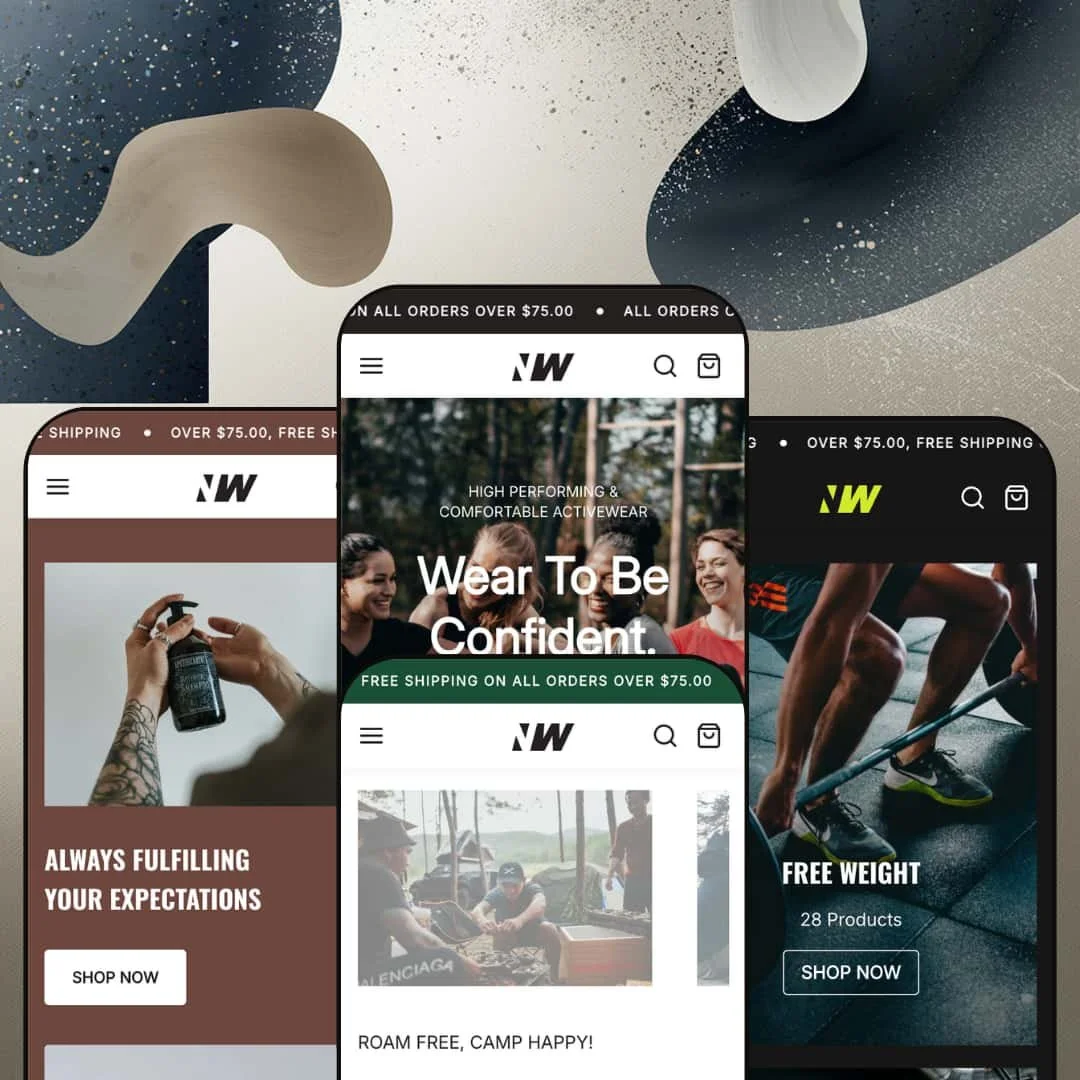
A barbershop with three Manhattan locations and a campsite outfitter selling inflatable blackout tents are, somehow, running the same theme. That's the pitch behind Neat, a $250 Online Store 2.0 theme from BoostifyThemes that ships four presets aimed at four different retail worlds. I spent time in every demo to work out whether the range is real or whether it's one store wearing four outfits. The honest answer is both, and that cuts two ways for anyone shopping at this price.
Quick-buy handles real variant complexity at the card level
Product cards resolve purchases without a page load, and not just for simple products. Razor's Beard Oil card opens a scent picker, Bath Salts offers gram sizes, and Wilderness's inflatable tent card stacks two full axes, size and color, inside the quick-add flyout. Single-variant items collapse to plain add-to-cart. For apparel and accessories stores under 100 SKUs selling impulse-priced items, this shaves a step off nearly every purchase.
Product cards that play footage
On the activewear demo, the Basic Relaxed Joggers card renders 1080p product video directly in the grid position, with rollover second images covering the stills-only products around it. Motion sells movement. Drop-model activewear and streetwear brands already shooting video for social get to reuse that footage where the buying decision starts.
A native size-guide system, tables and all
The product page ships a size-guide modal that's an actual document: a body-measurement table across eight sizes, a UK/USA/EU/IT conversion chart, and an illustrated how-to-measure section. Dawn, Shopify's free baseline, offers nothing comparable on the product page. For apparel and footwear merchants selling internationally, where sizing confusion drives returns that eat margin, having this in the theme rather than bolted on is a quiet but recurring saving.
Shoppable storytelling sections that end in a cart, not a caption
Lookbook sections pin products onto lifestyle imagery with hover cards, and the Community Stories sections go further, pairing customer-style video with a full buy box: variant selector, description, add to cart. Content stops being a detour from the funnel. Single-brand lifestyle stores with repeat buyers and an active content calendar can turn their existing photo and video output directly into purchase surfaces.
No structured surface for attribute-led buying
Neat's merchandising vocabulary is visual: galleries, hotspots, lookbooks, video. There's no spec table, comparison layout, or metafield-driven attribute grid staged anywhere in the four demos or named on the feature list. Electronics, furniture, and outdoor-gear merchants with attribute-heavy catalogs of 100+ SKUs sell on wattage, dimensions, and materials, and this theme gives them beautiful photography and no grid to argue with.
The promo machinery never switches itself off
Countdown blocks sit in the product template, hot-sale badges print discount percentages on cards, promo popups offer 20% at entry, and coupon banners anchor homepage sections. The pressure never lets up. It's exhausting. Luxury and considered-purchase brands running evergreen pricing inherit a theme whose default posture contradicts their positioning, and they'll spend their first configuration session dismantling it.
Five languages, and they're all Western European
The shipped translation set covers English, French, Italian, German, and Spanish. That's it. The selector will display whatever markets you configure, but theme UI strings outside those five arrive untranslated and become your job. Multi-market merchants selling beyond Western Europe, into Nordic, Eastern European, or Asian regions, should budget a full string-translation pass per additional language.
What it takes to launch
Expect a multi-day pass covering homepage copy across all sections, replacement of testimonial and social-proof assets, mega menu re-staging with real collection links, product-page accordion content population, footer link mapping, and translation verification for any non-shipped language. The section count per homepage makes this a checklist job, not an afternoon.
-
What works in this preset
Scroll the activewear homepage and you get a full brand pitch before the product grid ever asks for money. The announcement bar rotates three phrasings of a single free-shipping offer, a slideshow hero sets the tone, and a sustainability story unfolds in numbered blocks (01 handmade batches, 02 plant-based fibers, 03 European production) over a background video. For a category where buyers pay premiums for values, that narrative real estate earns its place.
The "Design For Any Workout Intensity" section is a small thing done well. Four category tiles map Leggings, Sport Bras, Tops, and Joggers to full-bleed product photography, so a first-time visitor can self-sort by product type in one screen. It works.
Retention wiring rounds out the preset: a magazine-style blog feed labeled Fashion Stories, a rotating customer-quote slider, and a 20%-off signup popup with its own imagery slot. None of it is exotic, but the pieces are staged as one funnel rather than scattered widgets, which is what an activewear brand chasing repeat orders actually needs.
-
What works in this preset
Barber brands live and die on foot traffic, and Razor is the only preset in this family that behaves like it knows that. A dedicated store-locations section stages three shops, each with a map snapshot, street address, phone number, and email. If you run chairs as well as checkout, that section alone justifies starting from this preset instead of restyling another one.
One detail made me sit up: the testimonial slider doesn't just quote customers, it pairs every quote with a purchasable product card, price included. Social proof becomes a shelf. A grooming store selling $16 pomades on word-of-mouth gets a direct line from praise to cart.
The header also carries the family's most complete internationalization staging, with a flag-labeled currency selector and five languages surfaced before you ever open the menu, plus a brand-logo strip and a trust-badge row further down. It reads like a shop that ships across borders. That's staging any preset can copy, but Razor shows the arrangement fully assembled.
-
What works in this preset
Seven departments deep, the navigation here is the widest in the family. The mega menu runs Tents, Navigation & Radios, Sleeping Bags, Generators & Power, Camp Accessories, Lighting, and Camp Furniture, each with four to five sub-categories nested a level below. That's a genuine three-level tree. Outdoor retail carries sprawling assortments, and this preset demonstrates the theme can actually hold one.
You feel the urgency machinery most strongly here. A 20%-coupon banner sits beside a live countdown block, a full-width background video plays under the value proposition, and hot-sale percentage badges dot the grids. It's a preset built to push seasonal campaigns hard.
The homepage even embeds a complete buy form. A featured-product section stages the Tub Chair with variant swatches, a quantity stepper, an add-to-cart button, and a social-share row, all without leaving the landing page. For flash promotions on a hero product, that's a shortcut worth having.
Where it stumbles
The staging works against the wallet, though. This demo sells $340 sleeping bags and $430 rechargeable lamps, purchases people research, yet the preset leans on the same impulse patterns as the apparel demos: quick add, sale badges, countdowns. Nothing on display helps a gear buyer weigh capacity, weight, or runtime before committing. A camping merchant with considered-purchase price points will need to build that persuasion layer themselves.
-
What works in this preset
Black background, white steel. The dark palette is more than a mood choice here; gym equipment photographed on light backdrops pops against the near-black canvas in a way the lighter presets can't replicate, and the neutral product colors (black racks, chrome bars) stop the page from turning muddy. It's the strongest argument in the family that Neat's design tokens can carry a real identity shift.
A tabbed product carousel splits Bestsellers and On Sale into switchable views inside one section, which keeps a discount-driven fitness store from stacking two more grids onto an already long page. Merchants running constant promotions get a tidy home for them.
The lower page closes with a collection trio showing per-collection product counts and a seven-post journal grid of training content. For a home-gym audience that buys on advice (pull-up bar guides, nutrition posts), pairing editorial directly above the newsletter capture is sensible sequencing rather than decoration.
One component library, four believable identities
Read all four demos back to back and the impressive part isn't any single section, it's how far color tokens, typography, and photography stretch the same parts. A warm serif-adjacent barbershop and a near-black gym-equipment store don't look like siblings at a glance. That restyling range is the actual product you're buying at $250, and it holds up.
Social proof is wired to commerce, not decoration
Across the family, trust elements consistently terminate in a transaction: quotes sit beside purchasable cards, badge rows flank product carousels, follower counts head shoppable image grids. Plenty of themes display testimonials; this one habitually puts a price next to them. That's a theme-level philosophy you only notice after reading every preset.
A homepage grammar you inherit instead of invent
Every preset follows the same sequence: announcement, hero, categories, product carousels, proof, editorial, newsletter capture. For a first-store merchant, that's a proven build path with the ordering decisions already made. You fill slots rather than architect a page.
The skeleton never changes
The flip side of that inherited grammar is that it's the only grammar on offer. Differentiation between presets comes almost entirely from palette and imagery; the structural rhythm underneath is identical every time. A merchant who wants a homepage that doesn't pace like the other Neat stores will be reordering and rebuilding sections rather than picking a genuinely different layout.
An architecture that assumes you produce content
Journals, Instagram grids, community-story video slots, testimonial engines: the section library presumes a steady stream of brand media. Stores with content operations will thrive. Stores without them will face visible holes where the demos had footage and quotes, and a stripped-down Neat homepage loses much of what distinguishes it.
★ 7.6/10
Rating
-
Variant-aware quick buy, native size-guide tooling, and shoppable content sections cover conversion well; there's no data-driven merchandising layer for spec-led catalogs.
8
-
The fixed homepage grammar makes assembly predictable, but the sheer section count per page means launch configuration is a long checklist.
7
-
The slide-out menu uses a back-button stacking pattern that keeps three-level navigation usable on small screens, and sticky cart access is built in.
8
-
Responsive image sizing is applied consistently, but demo homepages stack multiple autoplay videos and long carousels; merchants need media discipline to keep pages lean.
7
-
Four presets prove genuine visual range from bright activewear to near-black equipment retail, within one fixed structural rhythm.
8
Frequently Asked Questions
-
Match the vertical: Neat for apparel storytelling, Razor for grooming or any brand with physical locations, Wilderness for wide multi-department catalogs, Limitless if your product photography benefits from a dark canvas.
-
Yes. The Razor demo stages a store-locations section with per-shop maps, addresses, and contact details, and those sections are available to configure from any preset.
-
A slide-out cart drawer with a sticky cart trigger, paired with quick-buy on product cards, so buyers rarely leave the page they're browsing.
-
Three levels. The Wilderness demo runs seven top departments with four to five sub-categories each, alongside image-tile menu panels used in other presets.
-
Yes. Version 2.1.1 shipped in February 2026, roughly two and a half years after the theme's mid-2023 launch, with a public changelog on the Theme Store listing.
-
Yes. Neat provides no native review engine or wishlist; the theme exposes integration hooks rather than shipping either capability itself, so plan the app installs into your launch budget.
This review is based on hands-on testing of the publicly available preset demos of the Neat Shopify theme as of July 2026. Theme features, preset availability, and performance can change with subsequent updates from the theme developer.