
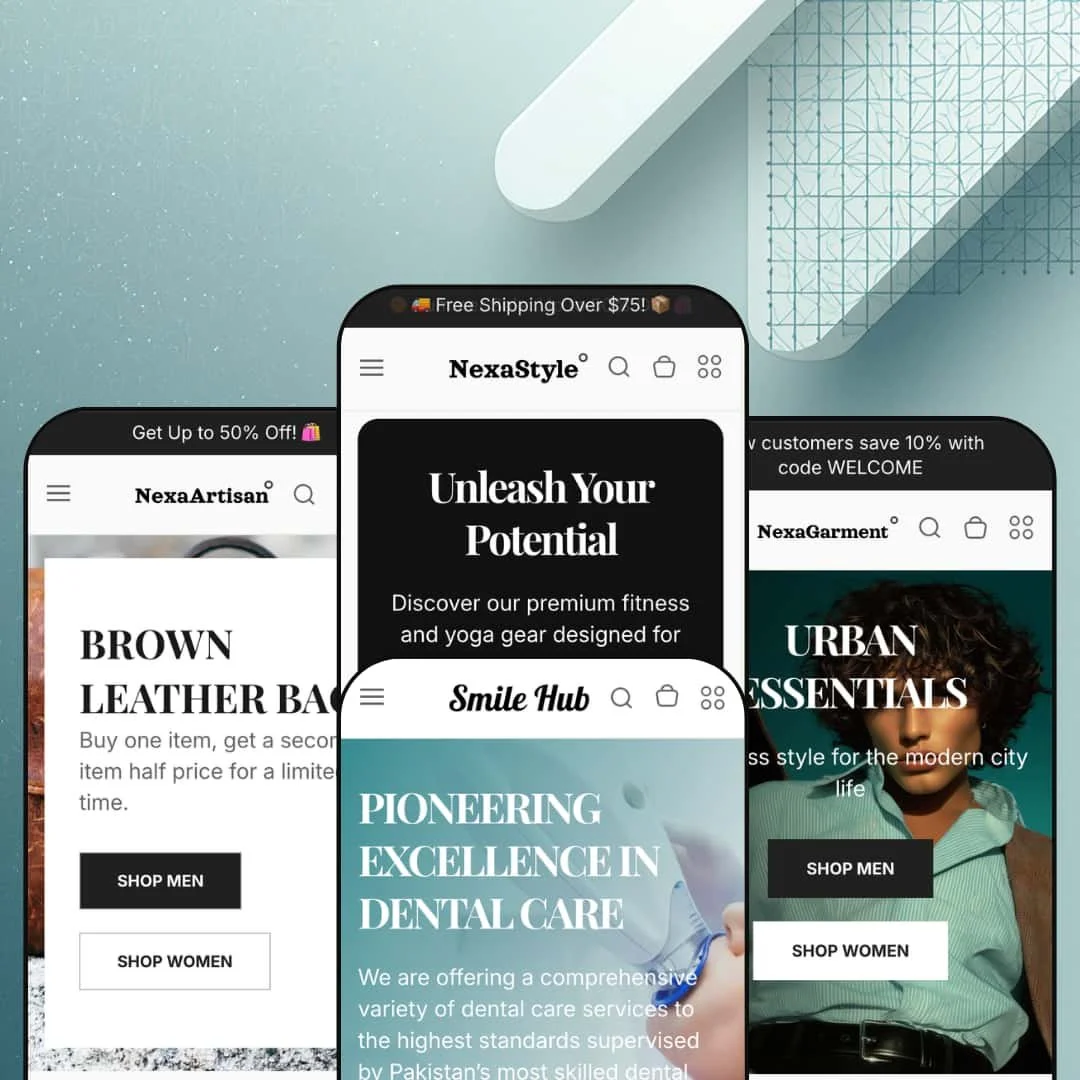
Most premium Shopify themes ship presets that vary by color and crop. Nexa ships one that's a dental clinic. Alongside the gymwear positioning the Theme Store leads with, this $290 Online Store 2.0 theme by 1o1development includes Yoga (the default), Streetwear, Leather Goods, and a service-business demo for a dental practice. The question is whether stretching one theme across four wildly different verticals delivers depth or spreads the section library thin.
Native compare-products engine
Every preset ships a working Compare Products engine. Each product card carries an "Add/remove from compare list" action, the header surfaces a "COMPARE NOW" trigger, and a dedicated comparison modal handles the side-by-side. This kind of feature typically arrives as a paid app on Shopify (most compare apps run $10-25/month), so having it native to the theme is meaningful, particularly for merchants whose buyers cross-shop two or three items before deciding. For sneaker brands, bag merchants, and tool-kit retailers where comparison is a real part of the purchase journey, the engine saves an install and a monthly fee. Single-SKU brands and pure impulse-buy verticals won't need it.
Section library bends across four verticals
The same section library handles yoga athleisure, a dental services landing page, leather goods, and streetwear: four genuinely different commercial frames from one set of building blocks. The library includes a Before/After slider, an Image Hotspot, a Featured Packets editorial lookbook, a Promo Tiles row, a Press Coverage logo strip, a Video Hero, a Countdown Timer, and the Compare engine. For merchants whose brand might pivot, expand into adjacent product lines, or run multiple sub-brands on a single Shopify install, the section breadth gives more configurability than themes that lock you into a single visual archetype. For brands with a fixed, narrow identity, much of the section variety will sit unused.
Quick View with full product rendering
The Quick View modal is the most fully built one in this price tier. Opening it from any product card produces the full product page experience inside the modal: variant picker (color or size with Sold/Available state), quantity stepper, Add to Cart, Share link, the Add-to-compare action, and a multi-image gallery. Most quick views in the $250-350 range surface a stripped-down version with image, price, and add-to-cart only. Nexa's depth means fewer clicks-to-purchase for shoppers who don't want to leave a collection page. For high-SKU stores where shoppers browse heavy and decide quickly, this is a real conversion lever.
Pre-translated UI strings for five EU languages
For EU-focused merchants, Nexa pre-populates UI strings in English, German, French, Italian, and Spanish, matching the EU Translations claim on the Theme Store. The default Nexa preset's footer surfaces all five languages alongside currency display via Shopify Markets, and the theme's button labels, navigation defaults, and form text are translated out of the box. Product descriptions, blog content, and metafield values still need merchant work or a Markets-compatible translation app: what Nexa covers is the theme-string layer.
Demo polish is uneven across all four presets
Each preset carries its own demo-content problems. The Smile dental preset has "mpactions" in the Services grid, e-commerce sizing FAQ questions left in for a dental clinic, "SHOP MEN/WOMEN" hero CTAs on a dental site, and an OUR STORY footer link pointing to /pages/about-us-about-us-about-us repeated about thirty times. Artisan and Garment both reuse identical "WOLVEN // INSTAGRAM // 07 MARCH 2024" editorial labels across all six Featured Packets cards. Garment carries a "Dr.Strange graphic t-shirt" using a copyrighted Marvel character name. The demo is the sales pitch. It should be airtight. For merchants who weigh demo proofing as a signal of overall theme quality, this is the kind of friction worth budgeting against before purchase.
Limited track record
Nexa launched in August 2024 and carries one merchant review at the time of writing: 100% positive but a sample size of one across roughly twenty months of availability. There's almost no merchant-side validation of how the theme behaves in production: real catalogs, real traffic, the edge cases the demo doesn't surface. The single review cites responsive support from 1o1development. For merchants comfortable being early adopters with active developer communication, this is workable. For merchants who treat the review count as a risk signal before committing to a $290 theme, Nexa hasn't accumulated enough public feedback to make the case yet.
The default preset carries the demo's polish weight
The most fleshed-out elements (three-slide hero, five-language footer selector, mega menu with featured products and banner image) all live in the default Nexa (Clothing) preset. The Smile, Artisan, and Garment presets each ship with simpler navigation, single-slide heroes, and reduced footer locale options. The components are theme-wide and configurable into any preset, but merchants buying for one of the three non-default presets should expect a bigger configuration lift to reach the navigation density and visual richness the Theme Store screenshots showcase from the Nexa preset.
What it takes to launch
Replace the placeholder editorial date labels across the Featured Packets lookbooks, fix the broken about-us footer link in the Smile preset, rewrite the dental-service copy if launching with Smile, swap the Dr.Strange demo product in Garment, repopulate Sweltering-branded variant inventory in the Nexa preset, and expect to reconfigure mega menu content if porting the default preset's navigation density into Smile, Artisan, or Garment.
-
What works in this preset
Opens with a 3-slide rotating hero ("Unleash Your Potential," "Join the Movement," "Enhance Your Routine"), each carrying dual CTAs. The mega menu is the deepest on display: a Collections column with seven categories (Deals, Yoga Set, Leggings, Long Sleeve, Short Sleeve, Sports Tops, Sports Shorts), a Featured column with seven product tiles complete with prices and Explore links, plus a banner image driving to /collections/deals. I clicked through the menu and counted three levels of merchandising surface before hitting a regular page. This is the only preset that ships this depth in navigation.
The yoga and athleisure mood lands through specific merchandising decisions. Sweltering appears as a vendor brand on every product card, color swatches show 4-5 variants per product, and the Lookbook section is labeled "Athleisure // Fashion // Function" with editorial restraint. The footer carries five languages (English, Deutsch, Français, Italiano, Español) plus a Country/Region switcher covering France, Germany, Italy, Spain, and the United States. The multilingual layer is the most populated of the four presets here.
Where it stumbles
The featured collection's color swatches render "Sold or unavailable" across most of the demo: Purple, White, Magenta, and the rest of the variant axes for the Cross Strap Workout Top, Slim Anti-Light Sports Skirt, High Waist Flared Yoga Leggings, and most other items in the carousel. For a theme whose Theme Store positioning leans on "Bold, Fast Shopify Theme for Gymwear Brands," watching the color picker collapse to greyed-out swatches across the headline preset is the wrong demo signal. The variant inventory needs a pass.
-
What works in this preset
Service-business adaptation, and a bold one. The hero leads with "PIONEERING EXCELLENCE IN DENTAL CARE," then drops into a clinic-information block (opening hours, address at 221B Baker Street in Marylebone, two phone numbers, email). Below that, a six-tile services grid (General Dentistry, Orthodontic Services, Implant Crown Bridge, Teeth Whitening, Restorative Dentistry, Oral & Maxillofacial Surgery), each with its own image and bullet list of sub-services. This is a Shopify theme demo that treats the homepage as a service-business landing page rather than a product grid, which is genuinely uncommon.
The Featured Collection still ships underneath the service marketing. Dental products fill the slots: a $200 Orthodontic Retainer Storage Case with size variants, a $120 Dental Cleaning Tool Kit with five color swatches (Green, Red, Navy, Orange, Yellow), a $129 Dental Impression Tray Set, a Clear Dental Aligner Tray. The merchant keeps both worlds — service marketing plus a productized retail layer for ancillary items.
Where it stumbles
The polish is the weakest of the four presets. The Services grid lists "mpactions" under Oral & Maxillofacial Surgery (should be "Impactions"). The hero CTAs read "SHOP MEN" and "SHOP WOMEN" sitting under a dental clinic banner. The FAQ block carries two leftover ecommerce-template questions ("What are the sizing specs of my order?" and "What are you sizing options?") that have nothing to do with dental care. The footer's "OUR STORY" link is broken: I clicked it and the URL extends into /pages/about-usabout-usabout-us repeated roughly thirty times in a single string. Smile is the most ambitious preset conceptually and the most loosely proofed in execution.
-
What works in this preset
Editorial restraint takes over here. The hero is single-slide, anchored on "BROWN LEATHER BAG" with a two-for-half-price subhead. Beneath it sits a Featured Packets section: six leather goods staged with the editorial label "WOLVEN // INSTAGRAM // 07 MARCH 2024" running across each card. Featured collection pricing runs from $30 (Everyday Essential Leather Wallet) up to $399 (Artisan Leather Bag), giving merchants a wide entry-to-luxury catalog range from the demo defaults.
Catalog structure shifts to category-led navigation: MEN / WOMEN / KIDS / BACK TO SCHOOL in the main menu, with a flat layout rather than a mega menu. I scrolled past the hero into OUR FAVOURITES, which runs ten products deep (wallets, sling bags, backpacks, holdalls, travel bags, crossbody). The breadth stages what a small-to-mid leather brand would actually carry. A press logo strip (Baker, Axon, Jack, Discover) sits below as the trust row.
Where it stumbles
"WOLVEN // INSTAGRAM // 07 MARCH 2024" is reused identically across all six Featured Packets cards. Six cards, one date, one source, one label. The intention is clearly an editorial-feed-styled lookbook, but the demo doesn't bother to vary the metadata per card. The Big Sale promotional banner reads "Big Sale at NextaStyle!" with an extra 'a' in the brand name. Both are merchant-fix items rather than theme bugs, but they sit visible on the homepage.
-
What works in this preset
Streetwear is where Nexa feels most at home visually. The hero "URBAN ESSENTIALS" sits over a desert-portrait staging image, and the main menu adds OUTLET and SPORTS alongside MEN/WOMEN/KIDS for a five-vertical catalog. The Popular Right Now section is a six-tile category grid (Oversized, Casuals, Denim, Graphic Tees, Tailored, Streetwear), useful for a brand whose discovery path is style-rather-than-gender-led.
OUR FAVOURITES runs eight products with a tighter $60-$189 price band, anchored by a "Heavyweight Oversized Hoodie" carrying a "Best Seller" badge. The Featured Collection underneath repeats most of the same products in a parallel layout, slightly redundant on the homepage but the editor can swap one collection for another without restructuring. The press logo strip ships with Forbes, People, Vogue, and Health as the social-proof anchors.
Where it stumbles
The same Featured Packets duplication problem: six lookbook cards all carrying "WOLVEN // INSTAGRAM // 07 MARCH 2024." One of the demo products is named "Dr.Strange graphic t-shirt," using a copyrighted Marvel character name a merchant can't ship as-is. The "Colorful Sneaker" section heading reads "Colorful Sneaker modern, athletic-style shoe," a stripped fragment that looks like the heading field was never filled in cleanly. These compound across the homepage rather than sitting in one isolated section.
The four presets are a stress test, not a colorway set
Most Shopify themes ship presets that vary by palette and crop: same theme, four mood variations. Nexa's four presets serve four completely different commerce models: athleisure retailer, dental clinic, leather goods house, streetwear brand. The implication is that the section library is built to bend rather than just look pretty in one mood. That's character, not feature.
Section library skews toward homepage merchandising
Across every preset, the homepage carries the conversion sections: testimonials, press logos, promo tiles, before/after, video hero, gallery, countdown, lookbook. The product detail page is comparatively light because the homepage is doing the persuasion work upstream. Stores whose buyers tend to convert from the homepage benefit from this design choice.
Merchandising density without app dependencies
The theme bundles native versions of features that often require apps in this price band: compare products, full quick view, lookbook, before/after slider, image hotspot, countdown timer. The cumulative effect is a storefront that runs without a stack of $10-30/month app subscriptions to deliver the same merchandising surface area.
Theme Store positioning and the demo tell different stories
The marketing tagline is "Bold, Fast Shopify Theme for Gymwear Brands." Only one of four presets actually serves gymwear. Merchants searching the Sports category for a fitness theme may not find that Nexa speaks fluently in that vertical the way the headline implies — most of the demo content lives elsewhere across leather, streetwear, and dental.
Demo-content gaps recur across all four presets
The polish issues aren't isolated to one preset. Broken about-us link in Smile, repeated editorial date stamps in Artisan and Garment, copyrighted demo product in Garment, leftover sizing FAQ on a dental site. Individually each is small. Together they signal that the demo was published before someone walked the entire site end-to-end.
★ 7.0/10
Rating
-
Compare engine, full quick view, before/after slider, lookbook, video hero, countdown; the section library is genuinely deep for the price tier
8
-
Four presets means four sets of demo content to clean up; the Smile preset adds service-business setup work that other clothing-themes wouldn't impose
6
-
Mobile menu uses a slide-out accordion pattern, sticky cart positioned for thumb reach, mobile-specific banner files present; the section count makes for heavy scroll on phone
7
-
Homepage carries a high section count across every preset (lookbook, before/after, video, countdown, gallery, testimonials, press logos), and product pages compound it with the compare engine and quick view modal
6
-
Four presets that genuinely diverge (athleisure, dental, leather, streetwear); one of the broader ranges across one section library at this price
8
Frequently Asked Questions
-
It can work, but it ships with setup work. The hero CTAs say SHOP MEN/SHOP WOMEN, the FAQ block has e-commerce sizing questions left in, and the about-us footer link is broken. The services grid, opening-hours block, and clinic-address section are genuinely useful for a service business once the demo content is cleaned up. Smile is workable for dental, salon, or similar service verticals after a content pass.
-
The default Nexa (Clothing) preset. It's the only one with the yoga/athleisure product catalog (Sweltering-branded leggings, sports bras, yoga sets), the three-slide hero, the deepest mega menu, and the five-language country selector. If you're buying Nexa for the Gymwear headline, install the Nexa preset first.
-
Theme-native. The compare modal, the per-card add/remove action, and the comparison page render are all wired into the theme's own code rather than depending on an external app subscription. This is one of the few price-band advantages Nexa carries over competing themes that punt the feature to a separate paid integration.
-
Demo inventory only. The Sweltering-branded yoga products have variant inventory set to zero in the demo store, which is why the swatches render as greyed-out and struck-through. The theme renders available variants normally: merchants populating their own catalog will see their actual stock state, not the demo's.
-
Five: English, German, French, Italian, and Spanish, matching the EU Translations claim on the Theme Store. This covers theme UI strings (button labels, form text, navigation defaults, country/language switcher copy). Product descriptions, blog content, and metafield values are not translated automatically and still need either manual entry per locale or a Markets-compatible translation app.
-
Placeholder. Every preset's Before/After section ships with the instructional text "To show before/after comparison, add more blocks in the section" visible on the live demo. The section's underlying mechanic works; the merchant just needs to add their own paired before/after image blocks and remove the placeholder text before launch.
-
King ships pre-translated UI strings for English, French, Italian, German, and Spanish (button labels, form text, navigation labels). Language selection and currency switching for the storefront are handled by Shopify Markets at the platform level; the theme contributes the country/language selector UI and RTL CSS support. Product content translations remain a merchant responsibility through Shopify's translation interface or apps like Langify.
This review is based on hands-on testing of the publicly available preset demos of the Nexa Shopify theme as of May 2026. Theme features, preset availability, and performance can change with subsequent updates from the theme developer.