
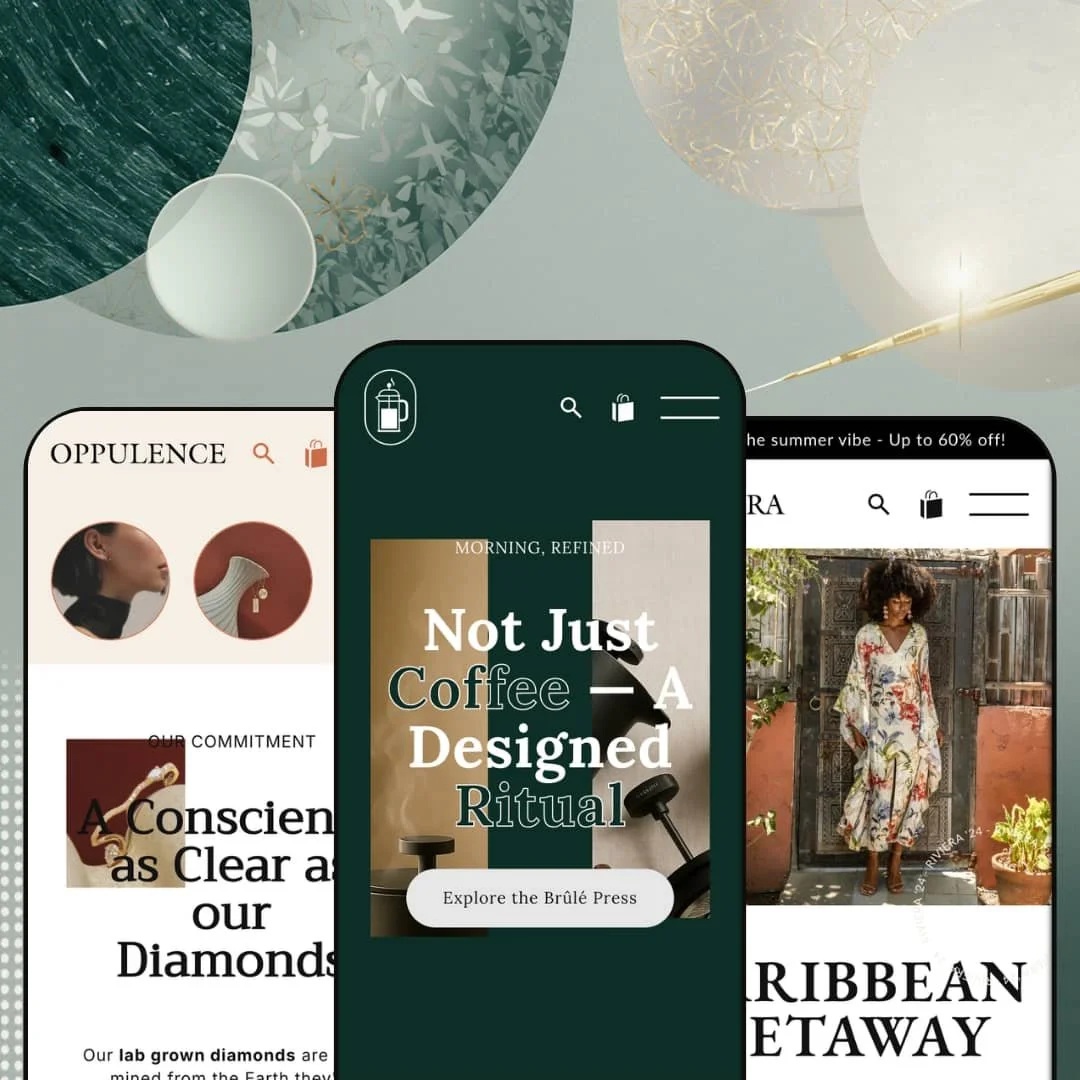
Most premium Shopify themes pick one vertical and build everything around it. Noblesse ships three finished storefronts in a single Online Store 2.0 package: a minimalist coffee-and-homeware shop, a maximal resort-wear label, and a high-ticket fine-jewelry boutique. The interesting question isn't whether any one of them looks good. It's whether the same underlying theme can wear three personalities this different without the seams showing.
A stories section that actually sells
Every preset builds its homepage around the same stories component. It’s the theme’s sharpest idea. The format mimics the reel pattern shoppers already know: tappable, full-bleed cards that can hold a product video, a collection link, a single product, or a multi-product list, each carrying its own add-to-cart inside the card. For visual-first sellers with a real photo and video library, apparel and jewelry brands chasing impulse and cross-shopping behavior, it turns the homepage into a browsable feed instead of a static grid.
Three real verticals from one license
For a multi-brand operator, or an agency standing up mid-market stores across apparel, homeware, and luxury, the math is the appeal. One $180 purchase ships three fully built directions, each with its own demo content and section staging: editorial homeware, maximal resort-wear, and high-ticket jewelry. That’s unusual reach for a single mid-tier license, and it lets a studio buyer audition three completely different storefronts before committing a line of copy.
A merchandising kit that moves as one
Cross-sell shows up in three coordinated places: a “Pairs well with” tab on the product page, a cross-sell rail inside the slide-out cart, and outfit sections like “Shop the look” and “Get the full set” on the homepage. Recently-viewed, recommended products, and quick view round out the same kit. The pieces move together. Sold as a unit, they give considered-purchase and repeat-buyer stores, mid-market jewelry and apparel especially, several honest ways to lift basket size without an upsell app.
Variant handling that scales down and up
It scales both directions. A €109 single-variant French press renders clean with populated info tabs; a bikini top offers four image-based color swatches across five sizes with a size-guide modal; a pair of diamond earrings runs a two-axis picker for gold colour and closure type with a per-variant price step. That range matters for sellers carrying mixed catalogs, apparel with color-and-size matrices alongside considered-purchase pieces that need material and finish options.
Per-product social proof needs an add-on
That gap is app-shaped. The theme gives you a polished testimonials section and trust badges, but no per-product star ratings or review counts on the product page or collection cards. Oppulence leans on a curated quote carousel instead, which reads well for brand-level reassurance and does nothing for the “what did buyers of this exact piece think” question. Stores where that matters, considered-purchase jewelry and repeat-buyer apparel, will add a review app such as Judge.me or Loox and wire it into the product template before launch.
The catalog surfaces stay plain
The design energy lands up top. Filtering and sorting are present with swatch filters, but the collection and search experiences are conventional next to the homepage’s stories, hotspots, and tabbed rows. Merchants with large, browse-driven catalogs, think 500-plus SKUs or a multi-brand storefront, will feel the drop-off between a cinematic homepage and a fairly standard grid the moment shoppers start filtering.
The theme is only as good as your content
Here’s the blunt version: this theme is a stage, and an empty stage looks worse than a plain one. Its best sections, the video stories, the hotspots, the UGC wall, the background-video bands, all assume you arrive with real photography and video. A budget or early-stage merchant launching on stock imagery and placeholder clips gets the shell of a premium brand with none of the impact, a poorer launch position than a plainer theme would have handed them.
Bespoke builds hit the Online Store 2.0 ceiling
Noblesse is an Online Store 2.0 theme, not a Theme Blocks one, so block nesting tops out around two levels. For most merchants that’s irrelevant. But brands running frequent campaign or flash-drop landing pages, and agencies assembling bespoke section stacks for clients, will find the deeply nested composition of newer themes isn’t on the table here without a page-builder app.
What it takes to launch
Plan a multi-day pass to replace demo copy and imagery across heroes, story cards, product tabs, and the events and blog entries, to populate the metafields that the product tabs and stories read from, and to re-stage the mega menu and announcement bar around your own catalog before launch.
-
What works in this preset
The hero doesn't rush. A single press shot sits beside "Not Just Coffee, A Designed Ritual," and a slow BREW · SERVE · SAVOR marquee underneath sets a deliberate pace that the sections below all keep to. For a store carrying barely a dozen items, that restraint is the entire merchandising strategy, and the preset commits to it instead of padding the page with filler blocks.
Two sections carry the catalog. A "Get the full set" block groups the brewing tools into one complementary row, and a "daily stories" carousel turns each product into a tappable, reel-style card. I clicked through the stories and the add-to-cart fires from inside the story view, so a shopper never has to leave the narrative to put something in the bag.
On the product page, the tabs do real work. The Brûlé press opens with populated Brewing Instructions, Materials & Composition, and Eco-Conscious Craft accordions rather than the usual single description blob, which is the difference between a page that reads finished and one that reads like a placeholder. It's a clean single-variant layout with related products tucked behind a tab next to recently-viewed.
Where it stumbles
This is the quietest of the three stagings. That cuts both ways. The preset leans almost entirely on lifestyle photography and whitespace, so dropping it onto a catalog without strong product imagery would expose how much of the effect is carried by the pictures and not the layout. A merchant inheriting this preset is inheriting a frame built for a small, photogenic range.
-
What works in this preset
Riviera is where the theme stops whispering. A rotating announcement bar runs two messages, the header carries a three-level mega menu that nests Swimwear into Bikini into Tops and Bottoms, and an upsell rail tucks into the navigation drawer. This is the deepest navigation the theme is capable of, staged at full extension.
The merchandising stacks up fast. A tabbed "Fresh fashion" collection switches between Swimwear, Dresses, and Tops; an image-hotspot "Shop now" section drops buyable tooltips onto a lifestyle photo; and a "Shop the look" row bundles a cover-up, top, and shorts into a single outfit. I scrolled through the whole homepage and counted close to a dozen distinct section types before reaching the footer.
Past the shopping there's a content layer. An events calendar pulls dated entries from the blog, a wellness pop-up and a design workshop with "Get tickets" calls to action, a background-video band plays under "Chase the Sun Life," and a hashtag UGC grid closes the page. For a seasonal brand that markets through lifestyle and events, those are the right sections to have wired up.
Where it stumbles
Riviera is the heaviest preset to tame. Everything that makes it impressive, the video band, the hotspots, the UGC wall, the dozen sections, is also weight a merchant has to either feed with real assets or strip back. A narrower brand starting here spends its first day editing down rather than building up.
-
What works in this preset
The numbers on the page tell you the audience. Products run from roughly €1,100 to €8,000, and the staging answers that price with the social proof a luxury buyer expects: a five-quote testimonials carousel with named customers, and an "As Seen In" press row beneath it. At this level, reassurance is the merchandising.
Motion does the talking here. The stories section leans hard on short video and GIF loops of diamonds catching the light, and a full-width background-video band runs beneath a "Stand Out, Be Bold" heading that anchors the lower half of the page. I went looking for static filler and mostly found movement instead.
Values get their own real estate. A "Conscience as Clear as our Diamonds" band makes the lab-grown, conflict-free case, and a closing trust row spells out carbon-neutral shipping, a tree planted per order, and recyclable packaging. For an ethically positioned jeweler, that messaging is built into the layout instead of bolted on.
Where it stumbles
The navigation is staged flat here: Home, Bracelets, Earrings, Necklaces, Rings, and a few pages, with no layered menu in play. That suits a tidy four-category catalog today, but a jeweler who grows into sub-categories by metal, stone, or occasion will be building out the deeper menu structure themselves rather than inheriting it staged. It's configuration work the preset leaves on the table.
Three faces from one wardrobe
The range is the point. Read all three presets back to back and the achievement isn’t any single homepage; it’s that the same type scale, spacing, and section library produce a hushed coffee brand, a loud resort label, and a luxury jeweler without ever reading like one skin recolored three times. That consistency under variety is the strongest signal of careful design-token work, and it only shows up once you’ve seen the spread.
The homepage is where the work went
The bet is consistent. Across every preset, the developer spends its energy on the homepage as a stage: stories, hotspots, video bands, tabbed collections. That’s a clear and defensible point of view about where a visual brand wins or loses a visitor, and it’s repeated steadily enough across the three demos to read as intent rather than accident.
One personality underneath the three faces
The flip side of that consistency is a single architectural temperament. Whichever preset you pick, you’re getting a visual-merchandising-first, Online Store 2.0 theme, so a brand needing a fundamentally different model, dense faceted catalogs or product configurators, meets the same ceiling no matter where it starts. The presets change the outfit, not the build.
A short public track record
Worth a neutral note: Noblesse carries eight Theme Store reviews, all positive, against a mid-2024 launch. The sentiment is uniformly good and the developer replies to feedback in the listing. Eight is a small sample. Treat the reviews as encouraging rather than conclusive while the count is still this low.
★ 7.6/10
Rating
-
A broad section library sits theme-wide: stories, image hotspots, tabbed collections, testimonials, and a coordinated cross-sell kit. The demos differ mainly in how much of it each one deploys.
8
-
Preset-driven starts and accordion product tabs lower the entry bar, though staging the stories section, mega menu, and metafield-fed info blocks is real configuration time.
7
-
The story format is natively phone-shaped, and the mobile menu uses a clean back-button stacking pattern that holds up even at three navigation levels.
8
-
The default homepage runs lean on lazy-loaded imagery; the Riviera and Oppulence stagings pull in video and GIF that merchants should weight-manage.
7
-
Three genuinely different preset directions plus the section library give wide range, with Online Store 2.0 nesting setting the ceiling on the most bespoke builds.
8
Frequently Asked Questions
-
The default Noblesse preset. It's staged around roughly a dozen products and uses whitespace and storytelling to make a short range feel deliberate instead of sparse.
-
Yes. Quick view and quick buy are in the kit, and the homepage story cards each carry their own add-to-cart, so a visitor can add items straight from the feed.
-
No, it's a theme-wide section. You can place it in any preset; Riviera and Oppulence simply lean on it harder than the coffee demo does.
-
Yes, through a blog-driven events calendar. The Riviera and Oppulence demos use it for dated workshops and pop-ups, with "Get tickets" links pulled from blog posts.
-
It's tuned for small-to-mid ranges, roughly 11 to 100 items, where visual merchandising carries the page. Very large, filter-heavy catalogs will outgrow the collection layout well before the homepage feels its limits.
-
The theme ships pre-translated UI strings for English, French, Italian, German, and Spanish, so buttons and form labels are covered out of the box. Translating your own product content is a separate step.
This review is based on hands-on testing of the publicly available preset demos of the Noblesse Shopify theme as of June 6 2026. Theme features, preset availability, and performance can change with subsequent updates from the theme developer.