
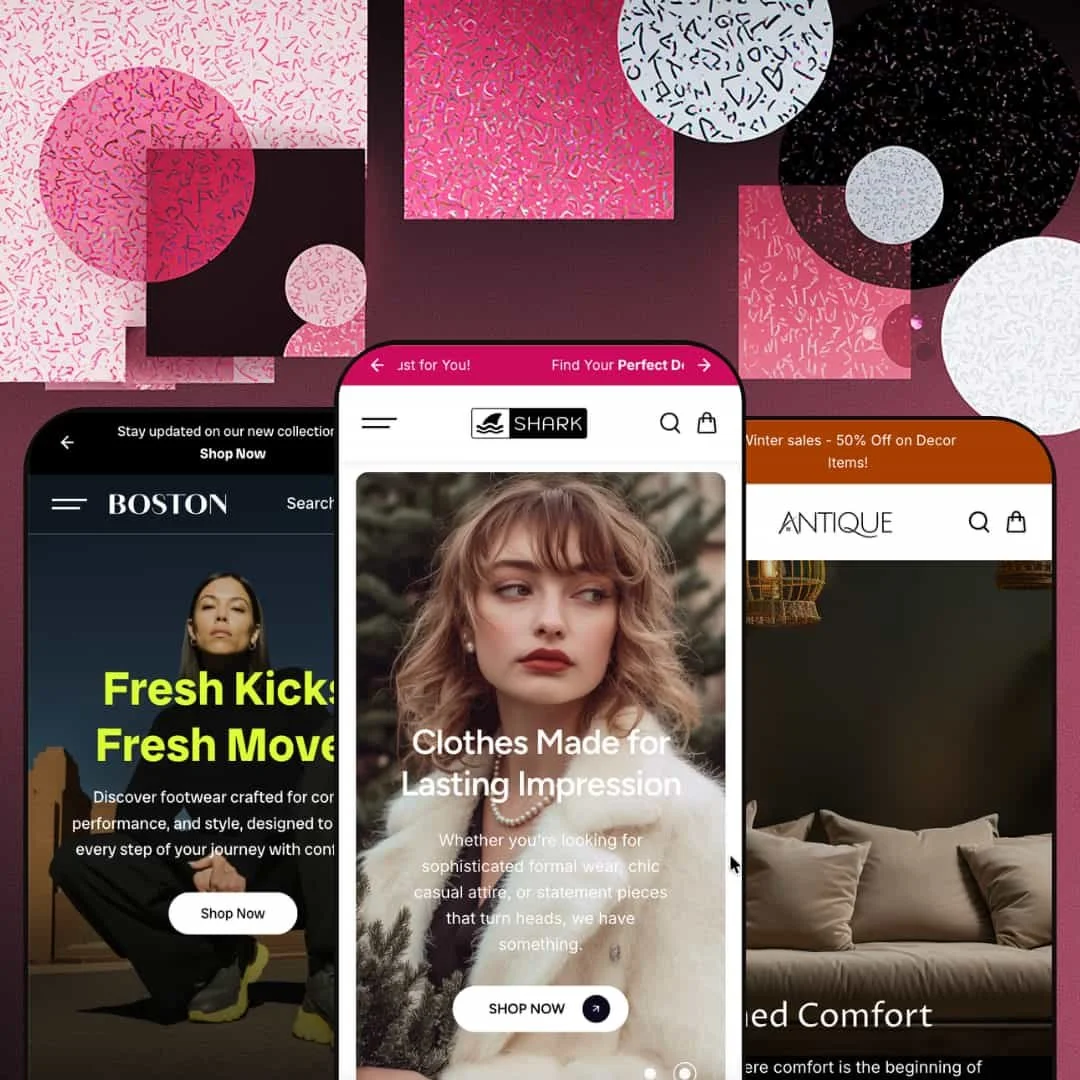
You're running a promotion most weeks, and your current theme treats discounts like an afterthought you bolt on with apps. Shark, a $200 Online Store 2.0 theme from Shine Dezign Infonet, is built on the opposite premise: ticker bars, countdowns, stock counters, and promo popups sit at the center of its identity rather than at the edges. Three presets stage that identity across apparel, home decor, and footwear, which is unusual range for a theme marketed primarily at clothing stores. Whether all that promotional energy reads as conversion fuel or as noise depends almost entirely on what you sell.
Variant rendering built for size-run retail
Shark pairs color swatches with size button groups, flags availability per combination, and keys gallery images to the selected colorway. One Boston demo sneaker runs two colorways across fifteen half-sizes, thirty live combinations, and the product page keeps every one of them individually addressable with its own stock state. That matters. Footwear and apparel merchants carrying 50 to 500 SKUs on restock-driven cycles spend their lives in exactly this kind of variant matrix, and the theme treats it as a first-class problem rather than an edge case.
Click-and-collect, presented like it matters
How many themes actually stage in-store pickup well? Shark renders pickup availability on the product page with named locations, ready-time estimates, and a store-list view; the apparel demo stages four pickup points complete with addresses and phone numbers. The presentation sells the convenience. For multi-location retailers in mid-market apparel or everyday goods, where the physical counter is half the business, this is the rare theme detail that connects the online catalog to the shop floor without an app in between.
A promotion kit for drop-driven stores
If your calendar runs on flash drops, restocks, and impulse buyers, Shark hands you a coordinated promotion bundle out of the box: countdown timers, stock counters, promo popups, in-menu promos, back-in-stock alerts, pre-order support, and an age verifier all ship as native features. They work as one system. Dawn, Shopify's free baseline, includes none of the countdown, stock-counter, or popup tooling natively, so for this specific retail style the $200 buys a genuinely different machine.
A header system with real range
The mega menu accepts plain link columns, individual product lists, and image tiles, with in-menu promo slots for pushing a hero product inside the navigation itself. Two logo slots cover light and dark header states, and the announcement bar absorbs the country and language selectors so the main bar stays uncluttered. It's flexible where headers usually aren't. Multi-category stores serving cross-shop-heavy buyers get navigation that can merchandise instead of merely list.
The volume knob starts at ten
Scrolling ticker bars, percent-off ribbons, stock counters, and badge-stacked product cards are the theme's native accent, and every demo speaks it to some degree. Everything shouts. A luxury jewelry brand or a considered-purchase furniture seller would spend their entire setup window stripping urgency cues out rather than building character in, and some of that promotional energy is woven into how the sections are designed, not just how they're configured.
Spec-driven selling needs outside help
The feature list runs deep on promotion and presentation but contains no comparison tables and no structured specification machinery. Product data beyond description prose lives in content blocks the merchant writes by hand, which is workable for a t-shirt and painful for a standing desk. The gap is real. Electronics and furniture merchants serving considered buyers who compare attributes before purchasing should budget for metafield work, custom sections, or a purpose-built app they'll need to select and integrate themselves.
These layouts are hungry
Shark's homepage patterns assume a store with a lot to say: long-form editorial blocks, tabbed brand narratives, blog feeds, testimonial walls, and image galleries all expect real content behind them. The demos fill that appetite with thousands of words. A single-founder shop with under 30 SKUs and no content pipeline faces a choice between publishing visibly thin pages or committing to a writing project that has nothing to do with selling products.
What it takes to launch
Expect a multi-day pass across long-form editorial copy, mega menu re-staging, market and currency configuration, and collection remapping before launch, plus full imagery replacement across three content-dense page templates.
-
What works in this preset
Scrolling this homepage feels like walking a flash-sale floor at a busy mall, and that's clearly the intent. The hero loads a dedicated mobile banner asset instead of cropping the desktop image, the category grid stacks ten tiles from jackets to caps, and a numbered collection index counts off featured ranges from 01 to 05 like a chart rundown. It's dense. For a discount-driven fashion store, the density works in its favor, because nearly every scroll position puts a product, a price, or an offer in front of the visitor.
I clicked through the hotspot pins in the "Fashion Frontier" section and found one of the more useful patterns in the preset. Lifestyle photos carry shoppable markers that surface product names and prices directly on the imagery, turning editorial photography into a quiet sales surface. It's lookbook merchandising without a lookbook app, and it suits outfit-led selling where the styled shot, not the product card, does the persuading.
The product page earns attention too. A gallery of seven stills runs alongside a hosted product video, color swatches map to color-keyed photography, and the content below the buy box is organized into expandable blocks for description, refunds, delivery, and support. Apparel shoppers who buy on fabric movement get the video; everyone else gets a gallery that answers the color question before they ask it.
-
What works in this preset
Furniture stores need calm, and Antique mostly delivers it. The hero swaps a single shouting banner for four editorial tiles, an eight-tile curated collections grid sits beneath, and a numbered category list runs 01 through 08 in a typeface that reads more gallery than bazaar. Same section library, much lower temperature. It proves the theme can dial itself down when the vertical demands it, which the loud apparel demo alone wouldn't tell you.
I spent time flipping the tabbed surfaces here, because Antique leans on them heavily. A tabbed bestseller grid splits the catalog into three curated views, and a separate tabbed editorial block rotates four short brand narratives behind a single image frame. Tabs are doing real work in this preset: they keep a content-rich homepage from sprawling even longer than it already is, while still giving the merchant room for storytelling.
On the product page, variant-level pricing is handled cleanly. The garden chair demo sells as a 1-, 2-, or 3-seater, with each configuration carrying its own price from Rs. 2,000 up to Rs. 5,000, and the page surfaces every price before the buyer commits to a selection. Furniture and decor sellers with size-based pricing tiers will recognize how much friction that removes.
Where it stumbles
The "Specifications" area on product pages stumbles against the vertical this preset claims. Its icon tabs hold brand storytelling about craftsmanship and eco-friendly sourcing, written as marketing prose with bullet flourishes, but a furniture buyer opening a section labeled Specifications wants dimensions, materials, and weight limits. The structure invites data and the staging fills it with copy. Merchants in this category should plan on building that information into descriptions or metafields themselves, because the preset doesn't model it.
-
What works in this preset
Boston is the youngest of the three presets, and it moves like it. The header ships two logo slots, a light and a dark version, so the bar can sit transparently over hero imagery and still hold a legible mark against the page below. Small thing, big effect. Sneaker and streetwear brands that live on full-bleed photography usually have to hack this with custom code on cheaper themes.
The merchandising surfaces lean kinetic without tipping into the apparel demo's discount-bazaar register. An icon marquee strings short slogans between custom SVG marks, the numbered category strip returns in a five-entry run, and a four-tab deals grid splits hot products into running, boots, sneakers, and terrain views so a visitor can self-sort in one click. Product cards carry Sale and Best Seller badges with color swatches inline, which keeps the grid scannable at speed.
Product pages here add a numbered benefit grid the other demos don't stage: six photographed tiles counting off cushioning, durability, breathability, and the rest, a pattern that suits feature-led footwear copy. The slide-out cart backs it up with an order-note field and running subtotal, and the checkout button stays pinned at the drawer's base, so the path from impulse to payment stays short.
Three temperaments from one section library
Read back to back, the demos make an argument single-preset themes can't: the same sections produce a loud apparel floor, a calmer decor showroom, and a kinetic sneaker shop. The range is demonstrated rather than claimed. A merchant unsure which direction their brand will grow gets evidence, not promises, that the theme can follow.
A theme still moving
The Boston preset arrived in version 2.0.3 in March 2026, nearly two years after launch, carrying new sections and settings with it. That cadence says the developer treats Shark as a living product rather than a finished one. For a one-time $200 purchase with lifetime updates, ongoing investment is part of what you're actually buying.
A skeleton that shows through
Spend an hour across all three demos and a recurring sequence emerges: hero, ticker, numbered index, tabbed grid, icon row, blog, testimonials. Differentiation between presets comes mostly from photography and palette rather than from distinct layout architecture. Two Shark stores in the same niche risk feeling like cousins, and brands that compete on visual identity will need to break the sequence deliberately.
Curation-heavy by design
Across every preset, discovery runs through hand-set surfaces: menu columns built from individual product links, hand-picked feature grids, numbered tiles pointed at specific collections. None of it updates itself. That's a maintenance tax that grows with catalog churn, and stores that rotate assortments weekly will feel it in admin hours long after launch day.
★ 7.2/10
Rating
-
Promotion, merchandising, pickup, and pre-order tooling cover a wide retail surface natively, with combined-listing support flagged for Shopify Plus.
8
-
The section library follows consistent, learnable patterns, but the sheer volume of hand-staged content stretches editor sessions well past a typical setup.
7
-
Dedicated mobile hero image slots, an accordion mobile menu, and the slide-out cart keep small-screen sessions close to the desktop experience.
8
-
The demo homepages run long, stacking media-heavy sections with repeating ticker content; product pages are noticeably leaner and load with less baggage.
6
-
Three genuinely distinct temperaments prove the range, though the promotional accent is difficult to mute entirely for quiet, premium positioning.
7
Frequently Asked Questions
-
It's marketed that way, but the Antique preset stages furniture and decor while Boston stages footwear, and the section library carries all three without strain.
-
Yes, an age verifier ships natively, which matters for merchants in alcohol-adjacent, vape-adjacent, or 18+ categories who'd otherwise reach for an app on day one.
-
Pre-order support is a native feature, sitting alongside back-in-stock alerts, so out-of-stock moments can capture demand instead of losing it.
-
A slide-out drawer with an order-note field and running totals, with gift wrapping and cart notes supported as native options.
-
Shine Dezign Infonet maintains a dedicated documentation site for Shark and runs support through a contact form linked from the Theme Store listing.
-
Combined listings is the one feature flagged Plus-only; everything else on the feature list runs on standard Shopify plans.
This review is based on hands-on testing of the publicly available preset demos of the Shark Shopify theme as of June 2026. Theme features, preset availability, and performance can change with subsequent updates from the theme developer.