
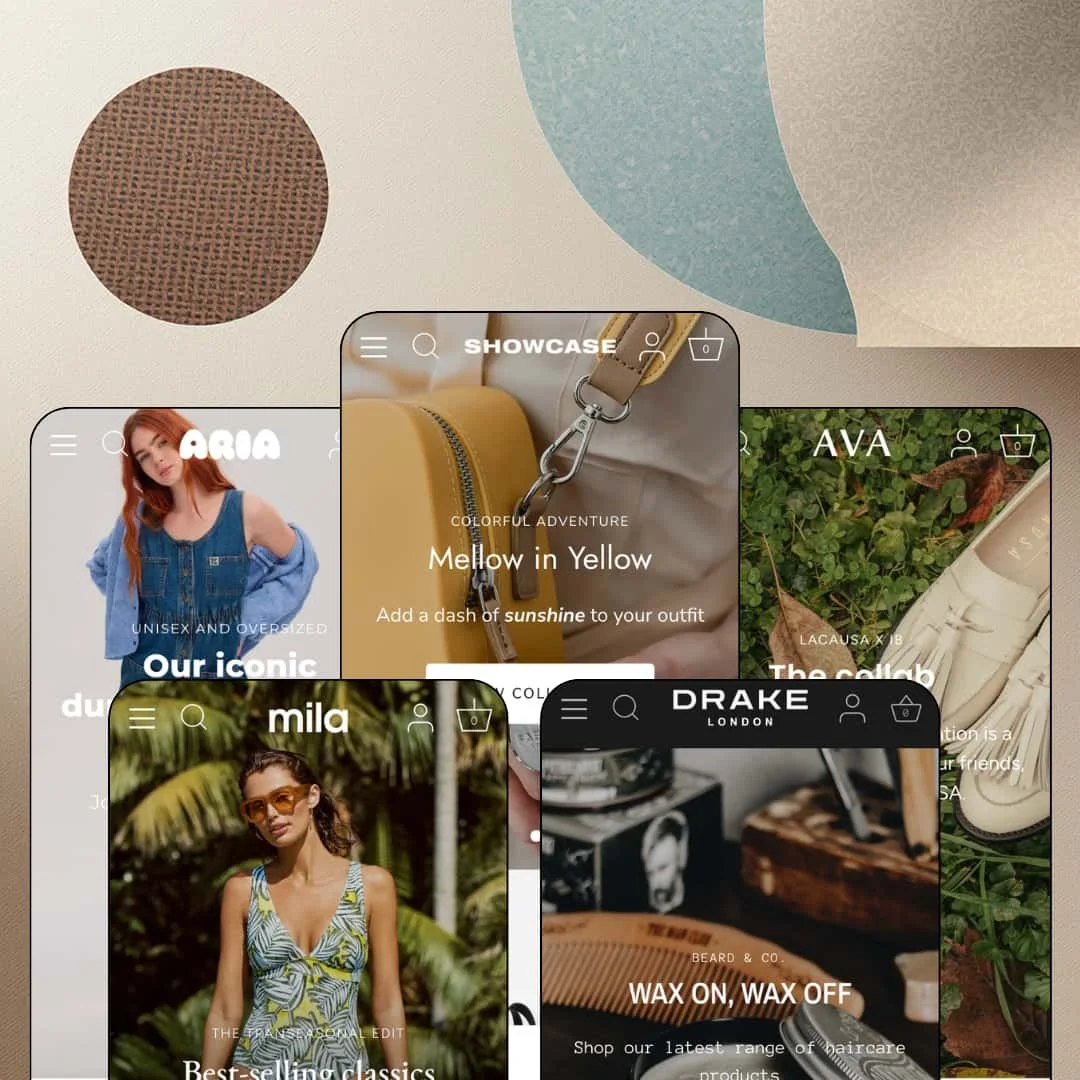
Most multi-preset themes hedge their bets by staging five flavours of the same shop. Showcase, Clean Canvas's $400 flagship, does something stranger: it stages a silicone handbag label, a swimwear brand, an organic dungaree maker, a barbershop that sells haircuts as products, and a footwear line, and lets the same twenty-section library carry all five. That breadth is the pitch and the risk, because a section library that bends this far has to hold its shape on a product page, in a mega menu, and in a cart. It's an Online Store 2.0 build on version 10.2.0, and I spent time in every preset to see where it holds and where it sags.
A mega menu that merchandises, not just lists
Showcase's mega menu pairs link columns with image promo tiles that carry a strapline and a sub-link each, and a row of secondary links sits beneath the panel. On Showcase that's New In, Gift Cards, and Like Leather; on Mila it's Classics and Holiday Shop tiles beside a seven-collection column. For a 100-to-300-SKU apparel or accessories brand running seasonal edits, the menu becomes a second homepage rather than a sitemap.
The product page stacks inventory states where the decision happens
Stock counters, pickup availability, and pre-order badges all render natively around the buy button. Showcase reads "13 in stock" next to an Ottawa pickup block, Ava reads "9 in stock" next to a Hudson one, and Drake's regime set flags Pre-order on the homepage featured block. That's a lot of signal in a small space. A multi-location retailer with 50-200 SKUs and restock-driven demand gets urgency and fulfilment options without an app layer.
Scrolling banners and marquee badges as a promo kit
What does a promo look like when it never stops moving? Here it's a scrolling-banner section that runs "Free shipping over $100" on Showcase and a four-word brand mantra on Mila, plus marquee-style card badges where SALE or NEW IN repeats across the tile. It's loud by design. Flash-drop and sale-driven brands in streetwear, swim, or footwear get a campaign voice from the section library alone.
Collection tools that carry a filtered catalogue
Aria's Dungarees page shows where the catalogue layer lands: facet counts beside every filter value, colour swatches on cards, quick-buy on the grid, and eight sort orders. The Showcase demo adds Availability, Size, and Product type filters on an all-products page. Considered-purchase shoppers in apparel or footwear with 100-500 SKUs can narrow by size and stock before opening a page.
Social proof is staged, not shipped
Every preset shows star rows on cards and a Reviews tab on the product page, and all of it is app-driven. The stars are borrowed. The testimonial section is hand-typed quotes, so a store launching from scratch gets the frames and none of the content, and has to budget a review app on top of the $400. Repeat-buyer brands in beauty or swim that lean on ratings should price that in from day one.
An Online Store 2.0 build at a 2026 premium price
Showcase runs JSON templates with sections and blocks at the two-level nesting OS 2.0 allows, and version 10.2.0 from April 2026 adds the new customer accounts but not nested theme blocks. Dawn, Shopify's free baseline, sits on the same architecture generation, so the $400 buys Showcase's section library and presets rather than a newer editor model. Agencies and multi-brand holding companies building on an eight-level nesting workflow will feel the ceiling.
Colourways are separate products by default
Three of the five demos stage each colour as its own listing. Showcase lists the City tote eight times, Ava splits Albany across product handles per hue, and the theme exposes no sibling-product mechanism on non-Plus plans, because Combined Listings is a Shopify Plus feature. It's a catalogue-maintenance decision handed to the merchant. Colour-led brands in bags, footwear, or jewellery with 30-plus styles and three-plus colourways each should expect duplicated SEO, inventory, and review work per variant.
Service verticals get the frame but not the mechanics
Drake sells treatments and the Theme Store lists Beauty and Services as a preset vertical, but nothing in the buy box handles time, location, or staff choice. The haircut goes in a cart like a comb. Single-location salons, barbers, or hospitality businesses with a handful of bookable services will need a scheduling app before the preset's positioning becomes a storefront.
What it takes to launch
Expect a multi-day pass across hero captions, testimonial content, blog or journal posts, About-page narrative, mega-menu image tiles, and collection imagery, plus inventory cleanup for sold-out and zero-priced placeholder products before launch.
-
What works in this preset
The hero doesn't stop at one slide. The Showcase demo stacks a three-message slideshow (Colorful Adventure, Back in Stock, Your Go-To) over a transparent header that sits on top of the imagery, then drops into four product sliders in a row before the first editorial break, which gives a bag brand with eight colourways per style a lot of grid real estate before the reader hits a paragraph. I noticed the header peeks back in on scroll-up rather than staying pinned, a small choice that keeps the full-bleed photography unobstructed.
Two things on the City tote page stood out. The sale price sits beside a size row of three buttons (Compact, Midi, Grande), a "13 in stock" counter, and a pickup block naming Ottawa Warehouse with "usually ready in 24 hours," and beneath that a four-icon trust strip reads Durable, 100% Vegan, Stain resistant, Cruelty-free before the accordion opens Description, What fits inside, and About the Silicone. That's a complete considered-purchase column for a bag at €77.
The collection list section does its own merchandising. Ten collections render with product counts (City 8, Leather Like 29, Clearance 11), and the Leather Like grid stages a Pre-order badge on the Steel colourway while the rest sit at full price, so the demo shows inventory states doing work on a homepage, not just a product page.
Where it stumbles
Every colour is its own product. City ships as eight separate listings (All Black, Malibu, Navy, Sol, Frapp, Blush, Berry, Steel), Chelsea as another eight, and the Leather Like City as seven more, which means a shopper comparing colours is bouncing between product pages instead of tapping a swatch. For a brand whose whole story is colour, the demo stages the catalogue the hard way.
-
What works in this preset
You land on a swimsuit, a slogan, and a ticker. Mila opens with a "Swimwear. Elevated." slideshow, then runs a scrolling banner of UPCYCLED BEAUTIFUL LUXURIOUS SUSTAINABLE straight across the page before the first product slider, and the rhythm repeats at the bottom with a second ticker above the newsletter popup. It reads like a lookbook with a cash register.
The mega menu is the most complete in the family. Shop splits into type (One Pieces, Tops, Bottoms, Tankinis, Surf Suits & Rash Vests, Sustainable Swim) and collection (Elite, Tango, Wildside, Chamarel, Messina, Eco Essentials, Multifit), and three image tiles with straplines (Classics/Best Sellers, Holiday Shop/New Arrivals) sit beside the link columns. Twenty-nine navigation entries, and none of them feel crammed.
On the Tango G Cup bra top I clicked through White and Black colour swatches and a size row from 4 to 12, saw "6 in stock," a Buy-it-now button under Add to Cart, and a pickup block for Saint Clair Avenue West. The tab set is tighter here than on Showcase (Description, Size & Fit, Reviews), which suits a swimwear buyer who mostly wants the fit answer.
Where it stumbles
Cup-sized swimwear lives or dies on sizing guidance, and the Tango page stages a Size & Fit tab but no Size Guide trigger beside the picker, where Aria and Ava both place one. For a brand selling G cups and E/F bralettes, that's the one link I went looking for first.
-
What works in this preset
Aria is the preset that stages the catalogue tools. The Dungarees collection opens with a filter rail showing counts per facet (In stock 6, XS through XL at 6 each), colour swatches on the cards, and quick-buy triggers on the grid, so a shopper filtering by size can add without leaving the list. Thirty-five swatch nodes on a six-product page tells you how much variant surface this preset exposes.
Badges do real signalling here. Pre-order runs as a marquee strip across the Timmy dungarees card, New In across the boilersuit and roll neck, and the Original Organic Cotton Dungarees show "From €41,95" against a struck €53,95, so price, state, and novelty all read from the grid without a click. The Atlas denim page continues it with XS–XL buttons, a Size Guide link, Lightwash Denim and Black swatches, and a "Pairs well with" row pulling in the bucket hat.
The brand story lands between the grids. A split image-with-text block carries the GOTS-certified, living-wage copy, a testimonial pair quotes real-sounding buyers, and the "Don't miss" promo tiles (Gear Up, Organic Cotton Accessories) give the homepage a second merchandising beat after the collection list. I sat up at how little of this needed custom work.
-
What works in this preset
A barbershop isn't an obvious Shopify demo. Drake makes it work by treating treatments as products: The First Cut sells at €40.95 with an "In stock" label, a one-review star row, and a "See more treatments" link under the buy buttons, while the homepage features The Full Monty Regime Set as a pre-order in a dedicated featured-product block with its own View-product-details link.
The page structure is the most editorial of the five. A four-collection list (Barbers Tools, Beard & Shave, VIP Treatments, Hair) sits under the slideshow, then a background video, a "What our clients are saying" testimonial trio, a VIP Treatments image-with-text overlay, a Journal feed with dated posts, and a Meet the Team section introducing Tommy The Shave and Jimmy Snips. For a single-location service brand with a small product range, that's a full About page folded into the homepage.
Testimonials follow the product. The same three client quotes that sit on the homepage reappear under the treatment description as "What our customers say," which means a reader deciding on a €40 cut sees social proof without scrolling back up.
Where it stumbles
Selling a haircut as a product means no date, no time slot, and no barber selection in the buy box. Drake stages a booking business with a cart built for objects, and a walk-in shop that wants online appointments will need a scheduling app before the preset's premise works.
-
What works in this preset
Ava stages the biggest catalogue. Seven collections (Heels 19, Boots 22, Flats 5, Socks 5, Mens 5, Sandals 15, Hats 9) feed three product sliders and two galleries, the hero announces a Lacausa collab and the Albany platform in a spread of colours, and a "Now On 30% off event" tile pushes the Clearance Edit above the brand story. The announcement bar carries a currency selector set to Germany EUR, which is the only preset that stages the selector in the header.
The Albany page is the cleanest buy box in the family. Green Tea and Pink swatches, a Size Guide link beside a 5–12 size row, "9 in stock," Buy it now, and a Hudson, New York pickup block all sit above a two-tab accordion, and the "Pairs well with" row cross-sells trousers and a button-down rather than more shoes. I tested the Clearance grid beneath it and every card showed both prices.
The ticker gets a softer job here. "A Sustainable Way of living" scrolls between the gallery and testimonials as a mood line rather than a promo, which shows the same scrolling-banner section reading as brand tone in one preset and as a shipping offer in another.
One section library, five different page rhythms
The same twenty sections produce a grid-heavy bag store, a lookbook-style swim brand, a catalogue-first dungaree shop, a magazine-shaped barbershop, and a promo-led footwear line. Reading all five shows the library is ordered by the merchant, not by the theme, and the scrolling banner alone does three different jobs.
Retail-ready fulfilment signals in every demo
Pickup blocks with location names and ready-in times appear on Showcase, Mila, and Ava, and the Theme Store lists in-store pickups as a theme feature. A brick-and-mortar brand moving online gets the local layer staged rather than implied.
Editorial depth without a page builder
Meet-the-team rows, journal feeds, background video, image-with-text overlays, and testimonial trios are all stock sections, and Drake proves you can build a whole brand narrative on a homepage with them. That's unusual restraint for a theme pitched as bold.
The same homepage skeleton under five skins
Slideshow, product slider, scrolling banner, gallery, testimonials, background video, featured blog, newsletter popup: the order shifts, the ingredients don't. A merchant who wants a homepage that doesn't feel like a Showcase demo will need to break the pattern on purpose.
Theme Store industries the presets don't serve
The listing files Showcase under Jewellery and Accessories and Food and Drink, yet no preset stages jewellery or anything edible. Buyers in those verticals are extrapolating from bags and swimwear.
A 2017 launch showing its architectural age
Nine years of updates keep the feature list current, but the underlying editor model stayed at OS 2.0 while Shopify moved on. The theme's breadth is real; its ceiling is too.
★ 7.4/10
Rating
-
Stock counters, pickup blocks, pre-order badges, mega-menu promo tiles, and faceted filters with counts are all native; reviews and bookings need apps.
8
-
Twenty sections with clear roles keep the editor legible, but colourway-as-product staging and hand-typed social proof push content work onto the merchant.
7
-
The mobile header keeps cart, search, and account reachable, and the scrolling banner compresses cleanly; sticky-scroll product details and full-bleed video are heavier on small screens.
7
-
Homepages run lean on sections but lean hard on large photography and background video in four of five demos.
7
-
Five visibly different presets from one library, with transparent and solid header modes, ticker styling, and badge marquees that read differently per brand.
8
Frequently Asked Questions
-
Yes. Aria and Ava stage a Size Guide link directly beside the size picker on the product page, and the Theme Store lists size chart as a theme feature.
-
Yes. Showcase, Mila, and Ava all render a pickup block with the location name and a "usually ready in 24 hours" line under the buy buttons, fed by Shopify locations.
-
The theme ships EU interface strings in English, French, Italian, German, and Spanish, and the Showcase demo stages a language selector in both header and footer.
-
Both exist. Mila and Ava run a static "Free Shipping On Orders Over" bar, while the scrolling-banner section handles the moving ticker lower on the page.
-
Yes. Drake stages a featured-product block for the Full Monty Regime Set with price, review stars, a Pre-order flag, and a View-product-details link.
-
The struck original price sits beside the sale price, and a SALE marquee badge runs across the tile; the Original Organic Cotton Dungarees show "From €41,95" against €53,95.
This review is based on hands-on testing of the publicly available preset demos of the Showcase Shopify theme as of August 22 2026. Theme features, preset availability, and performance can change with subsequent updates from the theme developer.