
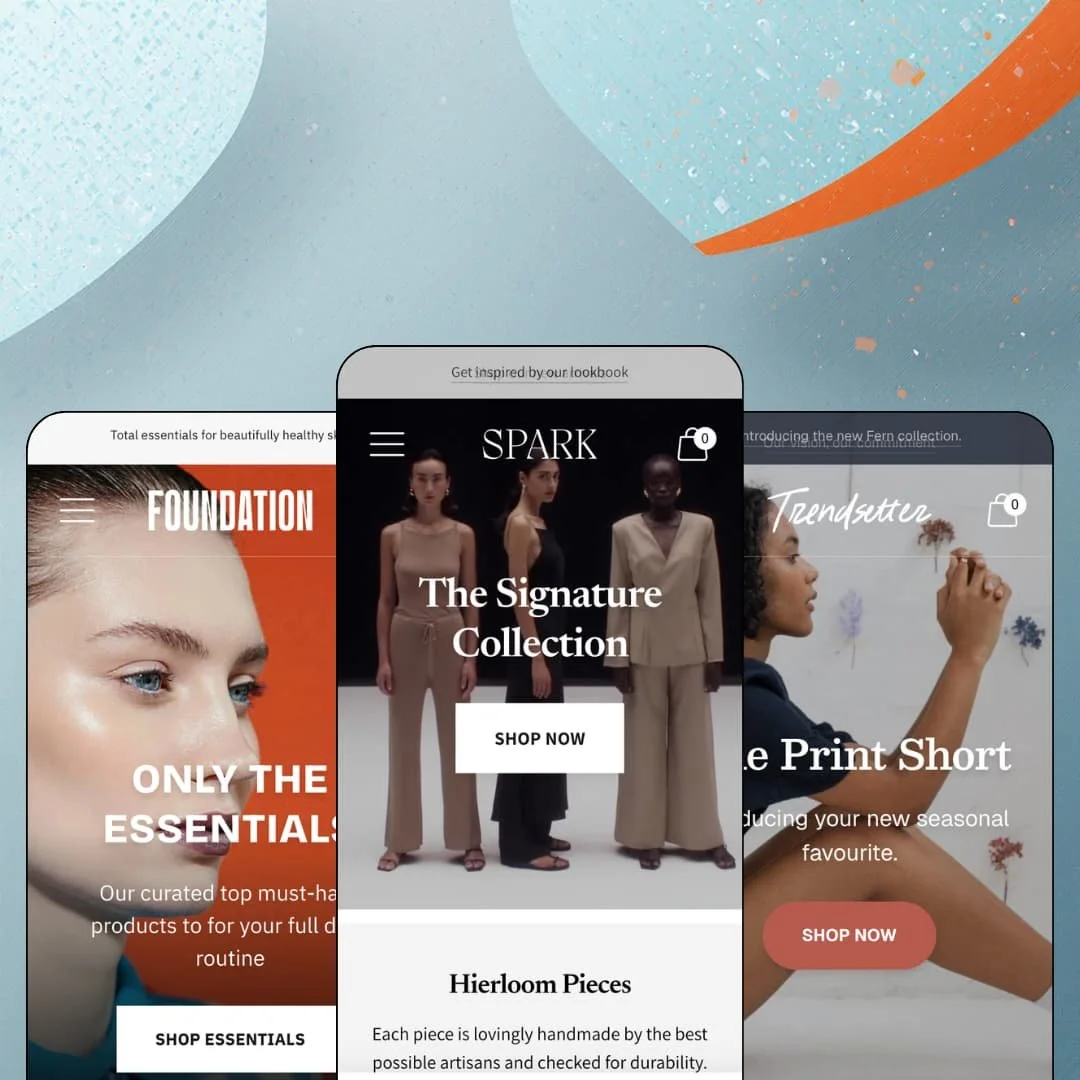
You're launching a small fashion or beauty catalog, and every theme demo you open looks like it was art-directed by a team you don't have. Spark, Fluorescent Design Inc.'s $200 theme pitched at emerging brands and first-time sellers, leans into exactly that campaign-shot aesthetic across its three presets: Spark, Foundation, and Trendsetter. It's an Online Store 2.0 build, launched in 2021 and still receiving version updates in 2026. What I wanted to find out is how much of the demo polish ships in the settings, and how much you'd have to produce yourself.
The homepage can close the sale by itself
Every preset ships a featured-product module that renders the full buy box on the homepage. No detour, no extra click. On Falconette it stages the Akabe Top with a complete size-and-color matrix, sold-out combinations flagged inline, and a working add-to-cart, so a visitor can land, pick XS in Tan, and check out without ever opening a product page. For brands built around one or two hero products, running under 30 SKUs and selling on impulse rather than comparison, that shortened funnel shows up directly in conversion math.
A product page that answers objections before they're asked
The Akabe Top page surrounds the buy box with a size-guide modal containing a full centimeter measurement table, accordion tabs for Materials, Fit, and Care, and reassurance blocks covering payment, returns, and shipping. Then it goes further: a shipping estimator with country, province, and postal-code fields pulls actual rates without leaving the page. That's checkout homework done early. For apparel merchants selling considered purchases across borders, where fit doubt and shipping-cost doubt kill carts before price ever does, this stack does quiet, cumulative work.
Quick buy that respects variants
How many taps between seeing a product and owning it? Here, two. On the Aeai demo, size chips from 0.7oz to 4oz sit directly on the collection cards, add-to-cart fires from the grid, and the slide-out cart catches the result so browsing never breaks. For beauty and consumables brands with 11 to 100 SKUs and repeat buyers who already know their size, the collection page effectively becomes the reorder page.
Five languages in the box
Spark ships its interface strings pre-translated into English, French, Italian, German, and Spanish. No string-by-string translation pass. Button labels, form text, and cart copy arrive localized, which is the part of internationalization a theme can legitimately own, while product content still flows through Shopify's own localization tooling. For mid-market apparel and beauty brands selling into France, Germany, Italy, or Spain, that's hours of translation admin already handled.
Navigation tops out at a single dropdown
Across all three demos, the menu system is a flat list with one-level dropdowns, and nothing on the theme's feature sheet points to a mega menu. Three demos, zero deep menus. For jewelry and accessories merchants running multiple lines, or any catalog pushing past roughly 100 SKUs, that ceiling arrives fast, because collection-page navigation and filters can organize a large catalog but they can't replace a browsing structure customers can see from the header.
The look is priced in assets, not dollars
Spark's presets get their effect from campaign video, editorial photography, and press-logo rows, and the sections are shaped to display that material rather than to generate interest without it. Strip the imagery down to plain product shots and the long, media-led homepage turns into empty runway. Fluorescent pitches this theme at first-time sellers. I'd flip that: solo founders launching an apparel or beauty store with phone-shot photography will feel the gap between their assets and the demo's hardest, while brands that already invest in lookbook shoots will feel at home immediately.
Online Store 2.0 pricing in a Theme Blocks era
Spark remains an Online Store 2.0 build: sections and blocks, but none of the nested theme-block flexibility Shopify's newest generation runs on. Dawn, Shopify's free default, sits on the same architectural generation at zero cost, so the $200 buys Spark's design system and section library rather than a newer foundation. That's a fair trade for the right merchant. Buyers who expect a 2026 theme purchase to carry them into deep block nesting or AI-assisted section building should know this isn't that generation.
What it takes to launch
Plan a one-to-two-day pass covering demo copy across hero captions, FAQ entries, testimonial blocks, and promo tiles, plus collection re-linking, price verification, and countdown re-staging before launch.
-
What works in this preset
Landing on Falconette, the Spark demo, feels less like entering a shop than opening a campaign film. A video slideshow runs the hero. Below it, a rotating announcement bar cycles between a new-arrivals push and a lookbook invitation, and the page settles into long editorial passes of full-bleed imagery broken up by short commerce prompts, a rhythm that flatters product photography over product density.
"— Melissa, Los Angeles." The testimonial cards each close with a first name and a city, and that small attribution choice does real trust work for a demo representing an unknown brand. The same instinct shows up in a homepage FAQ accordion and in an Instagram-styled feed complete with like counts, so the social layer reads lived-in rather than decorative. It's convincing.
A promo tile pairs an in-store event with a countdown timer, and a mosaic section mixes stills with autoplaying video tiles. Both are settings-level sections, not custom builds. What struck me is how sparingly the demo uses urgency, one countdown on the whole page, so the luxury register never tips into discount-store noise, and that restraint is a staging discipline worth copying.
-
What works in this preset
Foundation is where Spark stops whispering and starts selling. The Aeai skincare demo stacks four collection carousels down the homepage, Bestsellers, Hydrate, Colorwear, and Cleanse, each with its own header and shop link, so the page doubles as a compressed catalog for a routine-driven product line. Nothing sits further than one click from a purchase path.
"Coming soon! Buy now and we'll notify you when it's ready to ship." That line sits on the featured Essentials Kit module. It keeps the sale alive. Rather than greying out the button, the demo reframes the wait as a notification promise, which suits small-batch consumable brands where the customer relationship outlasts any single stock cycle.
The value-prop row runs all-lowercase, gender fluid, multi use, all vegan, and the footer stretches its social row to eight networks including TikTok and Snapchat. The details are small. Together they set a clinical, modern temperature that a merchant gets by picking the preset and swapping imagery, not by hiring a designer.
-
What works in this preset
"Answered by Josie." Trendsetter's FAQ section attributes each answer to a person, a tiny touch I haven't stopped thinking about, because it turns a compliance page into a customer-service signal. The rest of the demo runs the same warm register: a trust row with custom icons for sustainability, returns, and gift cards, and a section heading that casually drops an emoji.
Shopping the demo feels like handling a very small, confident assortment. A video hero titled Now Playing opens the page, and sold-out items like the Sage Culottes announce their state right in the collection grid rather than surprising you a click later. Fifteen-odd products, three collections, no filler.
Trendsetter proves the palette system has range. Chartreuse, lilac, and fern green carry the page from buttons to section backgrounds, and the demo pairs them with hand-drawn print photography credited to an Australian artist. Nothing about it reads template-default. It's the strongest argument in the family that color alone can do brand work here.
Where it stumbles
The main menu promotes three individual products to top-level items beside the collections. It's a bold arrangement for a demo. It also tells you what this preset assumes: a label built around a handful of hero pieces, staged for buyers who arrive knowing roughly what they want, and any merchant planning a broader assortment will be rethinking that menu logic before much else.
One design system, three brand temperatures
Read side by side, the presets demonstrate real visual range: hushed luxury, clinical wellness, and saturated playfulness, all produced by the same sections wearing different typography, color, and imagery. That range is the family's strongest sales argument, because it suggests a merchant's own rebrand or seasonal shift can happen inside the settings panel rather than in custom code.
Five years old, maintained like a current product
Launched in 2021, Spark reached version 4.1.0 in July 2026 and adopted Shopify's new customer Account component in that release. Long maintenance arcs beat launch-week feature lists. A theme that keeps absorbing platform changes five years in is a materially lower-risk purchase, and Spark's update history is the quietest strong line on its spec sheet.
Two of the listed verticals never get staged
Shopify's listing tags Spark for jewelry and accessories and for food and drink, yet the preset family stages two apparel stores and one beauty store. Merchants in the listed-but-undemonstrated verticals are buying on inference. The sections would likely translate, promo tiles and image hotspots aren't fabric-specific, but nobody at Fluorescent has shown you what that store looks like, and at $200 some buyers won't want to take that on faith.
Preset choice is a palette choice, not a strategy choice
Underneath the styling, all three presets run the same page grammar: media hero, value props, commerce carousel, social proof, feed. The structure never varies. That consistency is comfortable, but it means choosing between presets settles your color story rather than your merchandising approach, and anyone hoping the three demos represent three different selling strategies will find one strategy in three outfits.
Rating
★ 7.4/10
-
The promo, quick-buy, and product-page toolkits cover a boutique storefront thoroughly; the scope is deliberately small-catalog and doesn't pretend otherwise.
7
-
Presets arrive close to launch-ready with a repeating section rhythm that's quick to internalize; the settings panel does the styling work the demos show off.
8
-
The demos stage separate mobile hero crops, the cart runs as a slide-out drawer, and a sticky add-to-cart follows apparel-length product pages.
8
-
Images load small-to-large with lazy swapping, which keeps long pages moving; the media-stacked homepages with multiple autoplay videos still ask a lot of a phone connection.
7
-
Typography and color flex far enough to produce three visually unrelated demos; the fixed page grammar and Online Store 2.0 block limits set the outer wall.
7
Frequently Asked Questions
-
Within theme territory, yes: discounted products display computed badges automatically (the Aeai demo shows "Sale 33% off" and "50% off" states), and countdown timers, promo tiles, and promo popups are built-in sections.
-
Yes, in-store pickup is on the feature list and the product template carries an availability block; the pickup logic itself runs through Shopify's location settings.
-
Yes. The Falconette demo runs a dedicated Lookbook page in its main navigation, and the feature list includes lookbooks and image hotspots for shoppable imagery.
-
Heavily so: the demo product page continues with a video section, a second FAQ accordion, and a recommended-products row, so a single product URL can function as a landing page for ads.
-
A stock counter is part of the feature set, and the product template reserves a stock readout beside the variant picker, useful for small-batch brands that genuinely sell out.
-
Falconette (Spark) suits pared-back premium apparel, Aeai (Foundation) is the beauty and consumables staging, and Fern (Trendsetter) fits color-forward labels with a compact line; all three share the same feature set underneath.
This review is based on hands-on testing of the publicly available preset demos of the Spark Shopify theme as of August 2026. Theme features, preset availability, and performance can change with subsequent updates from the theme developer.