
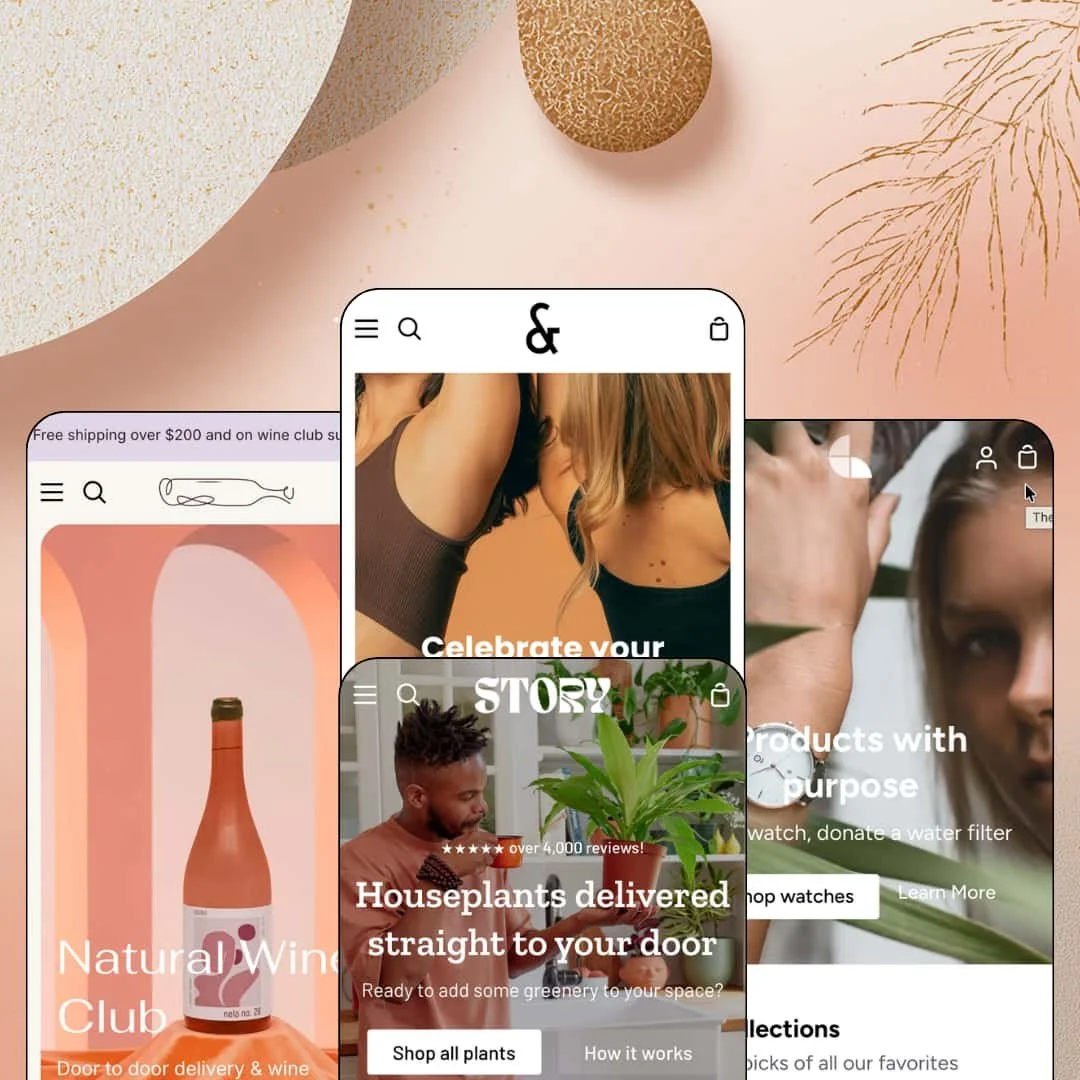
Four demo stores, four businesses with nothing in common: activewear, houseplants, Georgian natural wine, and watches that fund clean-water projects. That range is the pitch behind Story, Groupthought's $280 Online Store 2.0 theme, which has lived in the Theme Store since 2018 and treats every catalog as a brand-narrative exercise first and a product grid second. The codebase is old but not idle; version 5.1.0 arrived in October 2025 with support for high-variant products and combined listings. Whether narrative-first architecture still earns a standard-tier price in 2026 depends on how much brand you actually have to tell.
Colorway siblings give apparel per-color control
On the flagship demo's Classic Leggings, each of the five colors is its own product, and the swatch row links these siblings so shoppers hop between them with dedicated URLs, imagery, and inventory per color. A colorway can sell out, go on sale, or rank in search independently instead of hiding inside a dropdown, and the combined-listings support added in version 5.1.0 gives the pattern first-party footing on Shopify's side. Few dropdowns can claim that. For apparel and swimwear brands running 20 to 80 styles across four to eight colorways each, this system alone justifies a serious look.
The cart drawer works the order, not just the list
Threshold nudge, order notes, and a country-level shipping estimator all live inside the slide-out cart, with the flagship demo running a $100 free-shipping progress message that counts against the live subtotal. It's a checkout warm-up, not a receipt. Impulse-leaning stores with mid-range order values, especially those running a standing free-shipping threshold as their primary promotion, get the entire nudge stack in one surface without stacking apps on top of it.
What turns a $22 plant into an $85 order?
A cross-sell slot under the buy box, mostly. The plant demo offers The Ultimate Plant Care Set at $63 against a struck-through $71.95 directly below Add to Cart, one click to add, and the wine demo uses the same slot to pitch its club membership on every bottle page. The offer is native to the template rather than bolted on. For accessory-heavy catalogs across product types, plants with planters and supplies, watches with bands, that slot is quiet revenue plumbing aimed at considered buyers who are already convinced.
For founders whose product is the brand
Single-brand DTC stores selling considered purchases get a product page that argues, not just lists. Below the buy box, Story's product template accepts full editorial sections, and the plant demo puts them to work with a Pro Tips block, a virtual care-appointment pitch, and an in-page FAQ before the footer ever appears. The page carries a founder's voice. Buyers researching a purchase stay on the template that converts instead of wandering off to an About page and never coming back.
The colorway system sends the bill to catalog admin
Sibling products are separate products. A 40-style range in six colors means 240 product records, each with its own images, inventory, URL, and metadata, plus the sibling links holding the system together, and none of it maintains itself when a colorway retires or a new season lands. This kept bugging me while browsing the demo's tidy eight-color world: tidy is easy at boutique scale. Apparel merchants heading past a few hundred effective SKUs should budget ongoing catalog labor, not just a one-time setup.
Subscription staging without subscription mechanics
Solace sells a monthly wine club and Spade's FAQ promises plant subscriptions, but recurring billing is checkout territory that no theme performs; it takes a subscription app wired into the store. Story stages the pitch and stops there. Subscription-first food, beverage, and CPG brands should price in the app and its integration pass before treating the wine-club demo as a preview of their own storefront.
Feed it stock photography and it falls flat
That's the honest risk. All four demos run on borrowed real-brand libraries, credited in the footers to Paris & I, Rooted, and Tuk Watches, and the layouts assume that caliber of lifestyle imagery across heroes, menu tiles, editorial spotlights, and gallery strips. A solo operator launching with supplier photos and thin brand copy will end up owning expensive empty frames, because the theme's entire argument is the story those frames are supposed to hold.
An Online Store 2.0 theme at a 2026 price
Dawn, Shopify's free default, ships the same generational architecture: JSON templates, sections on every page, app blocks. What $280 buys here is the layer on top, meaning the merchandising, the narrative sections, the conversion furniture, rather than any architectural edge, and there's no Theme-Blocks-era nesting to point to. Know what you're paying for. Small-catalog merchants (the listing itself targets 11 to 100+ products) buying evergreen infrastructure are paying for character, and should decide deliberately that this character fits.
What it takes to launch
Expect a multi-day pass across the narrative page types (Story, Team, About, FAQ), colorway and sibling wiring for an existing catalog, attribute-collection and mega-menu re-staging, and a review of the five bundled interface translations before launch.
-
What works in this preset
Landing on the flagship demo drops you into an activewear store organized around color. The mega menu splits into a Colors column, a Type column, and two photo tiles pushing Shop New and Shop Popular, so merchandising starts before the first scroll, and the homepage follows through with a shop-by-color carousel spanning eight collections from Bubblegum to Navy. It's a retail idea, not decoration.
Reassurance lives on the homepage itself. A benefit ticker, a brand-film video block, and an FAQ accordion answering sustainability and warranty questions all sit in the scroll, which spares shoppers a trip to a policy page and lets the brand speak at the exact moment doubt shows up. Doubt gets answered where it appears.
I clicked into the leggings range and found the product template doing quiet heavy lifting: a tabbed detail area covering Product Details, Fabric & Care, Sizing & Fit, and Shipping & Returns behind a see-all expander, an icon strip for fabric blend and fit notes, and a live counter reading "Only 6 left in stock." That's a lot of reassurance surface for one template. None of it needed an app to render.
-
What works in this preset
A plant store lives or dies on findability. Spade's navigation encodes actual plant knowledge: a Lighting column running from Low Light to Full Sun, a Size column, and a Popular Categories block with Pet Friendly and Low Maintenance, so a shopper who only knows "my apartment is dark and I own a cat" still lands on the right grid. Five columns, zero guesswork.
"Loves shade." "Pet-Friendly." "Best seller." Product cards carry short custom labels like these instead of generic sale flags, which turns the collection grid into a browsable care guide long before anyone opens a product page. The badges do real selling work.
Open the Fiddle Leaf Fig and the page reads like a care sheet, with an icon strip stating watering rhythm ("Twice a month"), maintenance level, pet safety, and light preference, while the gallery carries the plant at every size from a small starter in a four-inch pot to a five-foot XL. The main buyer anxiety here is "will I kill it." This layout answers that before the description even starts.
-
What works in this preset
Two header rows greet you before the logo does: an announcement line promising free shipping over $200 and on wine-club orders, then a quick-links row for Low ABV, Staff Picks, Best Sellers, and Sale. High-intent shoppers get shortcuts. Everyone else falls through to a catalog sorted into moods like Fresh & Juicy and Weird & Wild rather than grape trivia.
The bottle pages compress tasting notes into scannable chips, with "Buttery + Creamy + Orange Blossom" stacked over "Dry, Bold, High Acid" right beside the gallery, and the wine-club offer holds its own slot in the mega menu complete with a photograph. Nobody can taste through a screen. Shorthand like this is the honest substitute.
Social proof gets a full production here rather than a footer afterthought: a testimonial carousel pairs customer quotes with lifestyle photography, and a price-band menu running from $ to $$$$ lets gift buyers shop by budget without saying so out loud. The preset consistently sells the occasion, not the SKU.
Where it stumbles
An alcohol storefront has one compliance ritual every visitor expects, and this demo skips it. I went looking for an age-confirmation step and found a cookie-consent prompt instead, so wine and spirits merchants adopting Solace should plan that layer themselves before launch, whether through the theme's popup tooling or a purpose-built solution.
-
What works in this preset
Selling a $200 watch on mission alone is a gamble. Shale commits anyway: the hero pairs "Products with purpose" with a buy-a-watch, donate-a-water-filter promise, and press quotes from Bustle, Forbes, and Esquire run as full paragraphs rather than logo wallpaper, which lends the claim third-party weight exactly where skepticism peaks.
The cart drawer moonlights as a promo channel. Alongside its shipping messaging it carries a standing reminder to use code TENOFF for ten percent off, so the discount pitch reaches shoppers at the precise moment they're weighing the total. Good placement beats loud placement.
Navigation goes product-first, and it suits a boutique range: menu columns link straight to individual watches by name, a featured tile pins The Captain in Gold with a photograph, and editorial spotlights for the Ang and the Blum treat single products the way a magazine feature would. Fifteen watches get fifteen small stages.
Where it stumbles
Menu-as-catalog has a ceiling. Every watch is a named menu entry, which is charming at fifteen products and unmanageable at fifty, so the preset's whole discovery model quietly assumes the catalog stays boutique-sized; a brand planning seasonal line expansions will
One grammar, four believable stores
Read all four demos in a row and the striking thing is that none of them feels like a re-skin; the activewear, plant, wine, and watch presets each land as an independent brand built from one section library. Range here comes from staging depth. That's rarer than preset counts suggest.
Seven years old and still shipping
A 2018 launch date usually signals drift. Story's release history points the other way, with version 5.1.0 landing in October 2025 to pick up high-variant products and combined listings, which means the theme has tracked Shopify's platform changes rather than coasted past them. Buyers get maturity and maintenance in the same purchase.
Reassurance is the house style
Across every preset the recurring move is identical: guarantees, accordion answers, third-party voices, and service promises placed at decision points on homepage and product templates alike. Seen together, the four demos reveal a theme whose real specialty is lowering purchase anxiety. Individual sections vary by vertical; the posture never does.
Narrative before commerce, everywhere
Every homepage in the family makes you meet the brand before it sells to you, with mission blocks, founder copy, and editorial imagery holding positions that conversion-first layouts hand to bestseller grids and offers. It's a deliberate trade. Shoppers arriving from a hot ad with buying intent will do more scrolling here than the click they came for strictly requires.
Menus carry what filters should
Discovery across the whole preset family is encoded as navigation: colors as collections, lighting conditions as collections, price bands as collections. That model is elegant at demo scale and increasingly manual as a catalog grows, because every new attribute value means another collection to build and another menu slot to find for it. The listing's 11-to-100-product sweet spot is written into the wayfinding itself.
★ 7.8/10
Rating
-
Colorway siblings, in-cart nudges, native cross-sell slots, and popup tooling cover the conversion basics without immediate app spend; there's no comparison or spec-table layer for technical catalogs.
8
-
Sections on every page plus starter templates keep day-to-day editing simple, but colorway wiring and attribute-collection setup front-load real work before launch.
7
-
The demos ship dedicated mobile hero assets, and the menu collapses into a stacked drill-down with per-level back navigation; "mobile first" is a claim the templates actually back.
8
-
Pages stay disciplined, with responsive image sizing throughout, restrained section counts on product templates, and no visible third-party widget bloat in the demos.
8
-
Four unrelated verticals from one section library is genuine range, though everything stays within an editorial, photography-led register.
8
Frequently Asked Questions
-
Standard option variants work exactly as usual; the plant demo sells its Fiddle Leaf Fig in four sizes as one product. Siblings are an additional pattern aimed specifically at colorways.
-
Both appear on the official feature list under cart and checkout, alongside cart notes and the slide-out cart.
-
Released October 1, 2025, it added support for high-variant products and Shopify's combined listings.
-
The theme's own labels and strings come pre-translated in English, French, Italian, German, and Spanish; translating product content remains a separate localization job.
-
Yes. The wine demo runs a cookie-consent prompt out of the box, and the feature list covers promo popups more broadly.
-
Shopify's listing tags it for catalogs of 11 to 100+ products, and all four demos run boutique-sized ranges consistent with that positioning.
This review is based on hands-on testing of the publicly available preset demos of the Story Shopify theme as of August 2026. Theme features, preset availability, and performance can change with subsequent updates from the theme developer.