
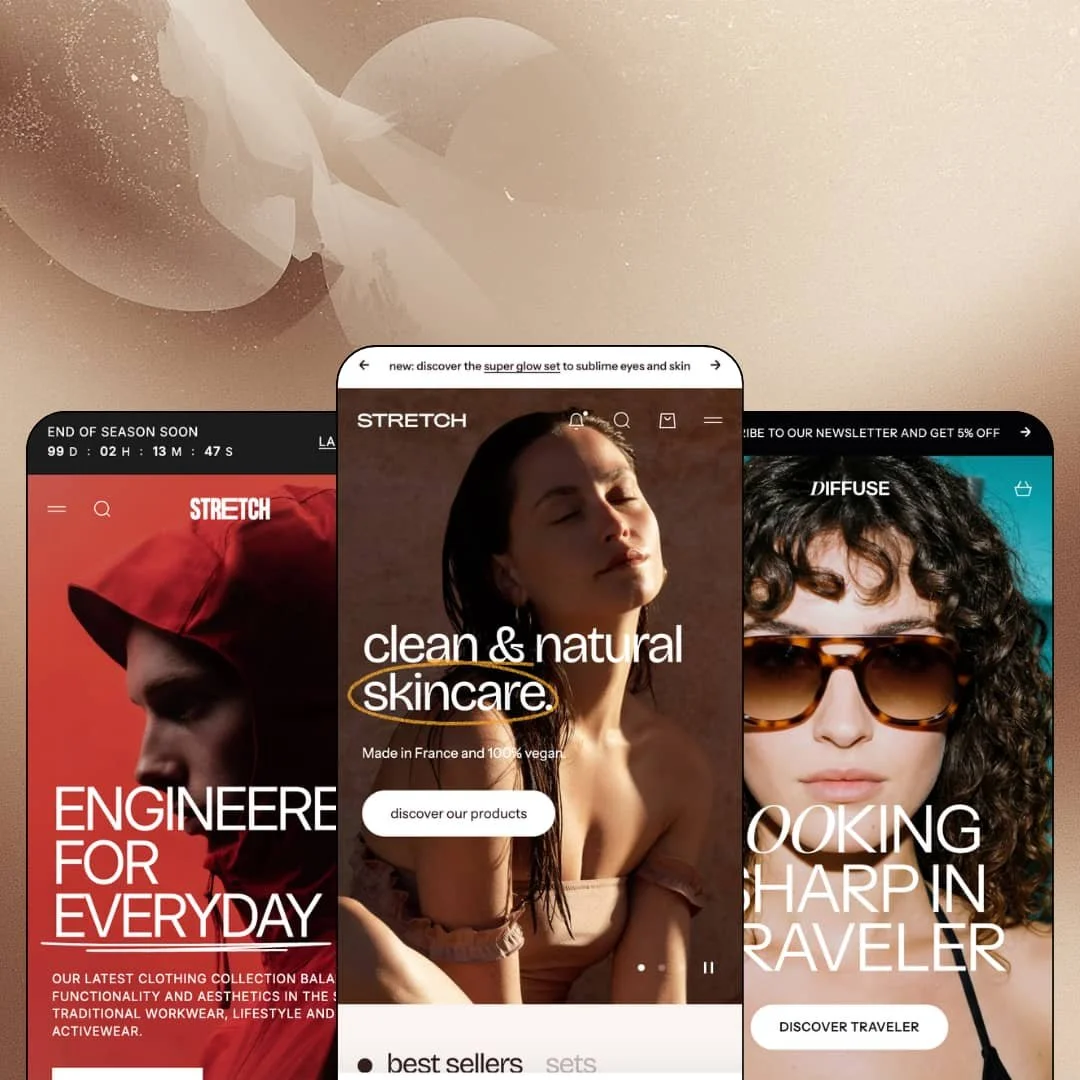
Most premium Shopify themes hand you a grid and ask you to fill it. Stretch, Maestrooo's $400 storytelling flagship, hands you a canvas instead: its layered sections let elements land wherever the design wants them, because the theme runs on the new Theme Blocks architecture, with nested blocks and AI block generation supported from day one. Three presets model that freedom as a French organic skincare brand, a Copenhagen outdoor label and a Los Angeles eyewear house. Whether the canvas becomes a signature or a liability depends entirely on what you feed it.
A freeform layout engine that earns the theme's name
The layered grid sections let images, icons, type and video sit anywhere on a shared canvas, with separate mobile positioning so the composition re-arranges deliberately instead of collapsing into a stack. It behaves like layout software. That's a custom-development look controlled entirely from the editor, which is the difference between a brand site and a template that happens to hold products. For editorial DTC brands in fashion or beauty running catalogs under 100 SKUs, this is the reason Stretch makes the shortlist.
An offers drawer that gives promotions a permanent home
A dedicated header panel collects running promotions: copyable discount codes, a newsletter incentive, image tiles pointing at a retail partnership or a store event. Codes stay one tap away. Promotions keep working on every page without commandeering the hero or stacking popups, which preserves the editorial surface the rest of the theme is busy building. Beauty and fashion brands running a steady promo cadence alongside wholesale or retail distribution get a purpose-built surface for it here.
Quick-buy that respects variants
How many taps should stand between a returning customer and their size? On product cards, Stretch answers with variant chips: shoe sizes 36 through 46 sit directly on the card and add the exact variant, while single-variant accessories get a one-tap add-to-cart button. No detour, no drop-off. For apparel and footwear stores serving repeat buyers and impulse purchases, that collapses the trip through the product page for anyone who already knows exactly what they want.
A buy box assembled like a conversion checklist
Unit-level stock counts, an optional per-product countdown block, configurable trust-icon rows, accordion tabs and a sticky add-to-cart bar all live in the product template as one coordinated kit. It ships as one kit, not five installs. Each piece is a toggle, so a merchant can run the full urgency stack on promoted items and strip everything back to price-plus-button on hero products without touching code. Mid-market brands selling considered purchases with periodic promotions, from outerwear to eyewear, can tune this per template.
The social-proof layer is display only
Testimonial sections quote Françoise, Elodie and John; a press rotator cycles Le Monde, Marie Claire and Elle logos. None of it connects to a review engine, and no demo shows a star rating, a review count or any collection mechanism anywhere in the preset family. The compliments are in-house. Beauty and eyewear brands whose buyers rely on verified reviews before committing will need a review app plus integration work before this storefront can prove anything.
Colorway depth means catalog upkeep, unless you're on Plus
Every demo stages colorways as separate products stitched together with swatch links: the Alta jacket exists three times, the Traveler sunglasses three times. It works. But the theme's Combined Listings support, which would merge those siblings into a single listing, is flagged for Shopify Plus, and Quantity Pricing carries the same flag. A standard-plan apparel or eyewear brand with ten colorways per style inherits ten products' worth of titles, imagery and metadata to maintain for every single design.
The look is only as good as your asset pipeline
The collage grammar assumes layered campaign photography, custom wordmark graphics and video, ideally staged per breakpoint. Budget for a shoot. Feed it stock packshots and the freeform canvas produces an ordinary storefront with unusually elaborate settings, because these sections amplify existing art direction rather than substitute for it. Single-founder brands and dropshipping operations without recurring photography production will struggle to make Stretch look anything like its demos.
What it takes to launch
Expect a multi-day build spanning editorial copy across long-scroll homepages, campaign imagery and graphic assets for the layered grid sections, metafield and filter wiring, colorway sibling linking, offer-panel content, countdown scheduling, and size-chart data before launch.
-
What works in this preset
Scrolling this demo feels like flipping through a brand book someone actually printed. The content is real: Nüssa is a working French organic skincare label, credited in the footer, and its products, muse interview and journal entries carry the long storytelling homepage instead of placeholder filler. An ingredient grid layers botanical icons and captioned photography over a full-bleed background, which is the freeform layout doing exactly what the sales pitch promises. It sells the theme and the brand at once.
The Super glow set page treats a two-product bundle like a small landing campaign. Hotspot markers sit on a lifestyle shot and open each component with its own usage instructions and a link to the standalone product, so the set page doubles as a routine tutorial for anyone deciding between the bundle and the singles. An FAQ accordion follows with set-specific answers. Short path, long story.
Three little cards named Face, Super glow set and Body rotate inside the shop menu itself, because the mega menu runs its own promo carousel beside every column group. I clicked the vitamin C link expecting a collection and landed directly on the cleansing gel's product page, which tells you how this navigation thinks. It's merchandising, not a sitemap.
Where it stumbles
The Unifying serum spray anchors the skin-transformation pitch, complete with a before-and-after slider, and then appears sold out in the best-sellers rail on the same page. For a preset whose entire argument is routine-building, staging the hero of the routine as unbuyable reads against the script. It's a curation choice, and an odd one.
-
What works in this preset
Somewhere between a lookbook and a zine, this homepage stacks hand-cut SVG wordmarks reading Fall, Winter and 2024 over layered campaign photography from Parel Studios. The result looks typeset, not templated. It's the freeform canvas again, staged here as graphic design rather than product merchandising, and I kept scrolling just to see what the next composition would attempt with the same toolbox.
The Alta Down Jacket page reads like a spec sheet with a photographer. Media blocks call out the DWR coating, the two-way zipper and the hand-warmer pockets with close-up imagery, a Features accordion lists fill power and fabric composition, and the size chart opens a real centimeter table with a how-to-measure silhouette beside it. The vendor byline links to an auto-built Parel collection. It earns a €675 price point.
Trying to compare the 6_01 boot's two colorways, I found the before-and-after slider doing the work: Black on one side, Sand/Black on the other, each half linking to its own product page. A section built for transformations becomes a color comparison, and it lands. Clever reuse beats new features.
Where it stumbles
Countdowns tick in three places at once: the announcement bar, the jacket's buy box, and a Special Sale banner further down the homepage. For a label whose voice is quiet Scandinavian functionality, that much clock pressure pushes the staging toward outlet energy the brand copy never asked for. The urgency tools fit drop calendars better than this positioning.
-
What works in this preset
Cat eye, Round, Square: the Optical menu's Shape column links straight into the collection with a metaobject filter already applied to the URL. That wires custom product data into navigation itself, so browsing by frame shape becomes a one-click path instead of an expedition through a filter drawer. It's the most data-driven staging in the preset family.
Halfway down the homepage I stopped expecting products at all. A booking pitch for in-store eye exams, a stores page, an offer tile promising 10€ off, and a slider relabeled before exam and after exam thread a services story through a product storefront, which is exactly what an eyewear brand with physical locations needs modeled. No booking engine sits behind it. The calls to action resolve to pages.
Nearly every heading plays the same typographic trick: double letters flip to italic, so titles render as Looking sharp and Book an eye exam. It's a tiny rich-text styling decision repeated until it becomes a recognizable brand signature, and it demonstrates how much identity this theme can carry through type treatment alone. No custom code, just discipline.
Where it stumbles
Frames are a considered purchase, and this demo sells them without a single measurement. No lens width, bridge size or temple length is staged anywhere on the product pages; the buy box carries prose, icons and a warranty accordion instead. The size-chart tooling the Snow demo deploys for jackets would translate directly to eyewear dimensions, so merchants choosing this preset will need to build that data layer themselves.
Three voices from one grammar
Read back to back, the presets barely admit they share a codebase. The apothecary calm of the skincare demo, the technical zine energy of the outdoor demo and the sun-bleached luxury of the eyewear demo come almost entirely from typography, color schemes and asset choices, not from different section sets. That is the strongest available argument that a fourth voice, yours, is achievable with the same purchase.
Demo data with receipts
Two of the three demos run licensed content from working brands, credited by name in their footers, and the coherence of the storytelling shows it. What you evaluate in the demos sits much closer to what a real launch looks like than an invented placeholder catalog would, which makes the pre-purchase read unusually trustworthy.
A maintenance rhythm you can plan around
Twenty releases in eighteen months, arriving near-monthly through 2026, with a Disclosures block for Shopify's regulatory metafields landing within weeks of the platform feature itself. Whatever else you conclude about fit, this theme is actively lived in, and roadmap risk is low.
A listed vertical with no evidence
The Theme Store files Stretch under Food & Drink alongside Jewelry & Accessories, yet nothing edible or drinkable is staged in any preset, and neither the ingredients-information nor the usage-information tooling from the feature list gets a consumables deployment anywhere. A food or beverage brand buys here on faith and translates the fashion staging alone.
Curation is the ceiling
All three demos run tight catalogs where discovery flows through menu curation, editorial rails and hand-picked collections, and the Theme Store's own catalog badge reads Some (11-100+). Nothing in the preset family models what happens when a thousand SKUs arrive, and a storytelling-first architecture gives no particular reason to assume the answer is graceful.
★ 8.6/10
Rating
-
Theme-blocks section library with card-level variant buying, an offers drawer, filter-wired navigation and a B2B quick-order list; review mechanics are absent and Combined Listings sit behind Shopify Plus.
9
-
Conditional settings, grouped section categories and editor-side error hints for countdown dates lower the learning curve, but the freeform canvas still asks for genuine design judgment.
8
-
Sections carry separate mobile media and content-position settings, and autoplay video falls back to a poster image on low-battery devices instead of leaving an empty block.
9
-
Pages run lean with lazy-loaded media, the theme dropped its old preloading library in favor of Shopify's upcoming speculation-rules support, and the optional page-transition fade is disabled by default.
8
-
Freeform placement, per-section color schemes, italic glyph styling inside headings and mobile-independent composition are the entire thesis of this theme, and it delivers on them.
9
Frequently Asked Questions
-
Yes. It launched on the nested theme-blocks generation, supports AI-generated blocks, and its freeform grid depends on that block model rather than classic section markup.
-
Interface strings in English, French, Italian, German and Spanish plus right-to-left support; the skincare demo runs a live Arabic locale alongside English.
-
A native age verifier can ask for a full birth date or a simple confirmation button, and a Disclosures block handles Shopify's regulatory safety and compliance metafields.
-
A Quick Order List section lets buyers add many variants in bulk from a single table, and quantity-based pricing display is available on Shopify Plus.
-
Yes, in both the cart drawer and the cart page, through a setting that ships turned off by default.
-
Version 2.1.1 shipped in late August 2026, and releases have landed roughly monthly since the February 2025 launch, including the Diffuse preset added in October 2025.
This review is based on hands-on testing of the publicly available preset demos of the Stretch Shopify theme as of August 2026. Theme features, preset availability, and performance can change with subsequent updates from the theme developer.