
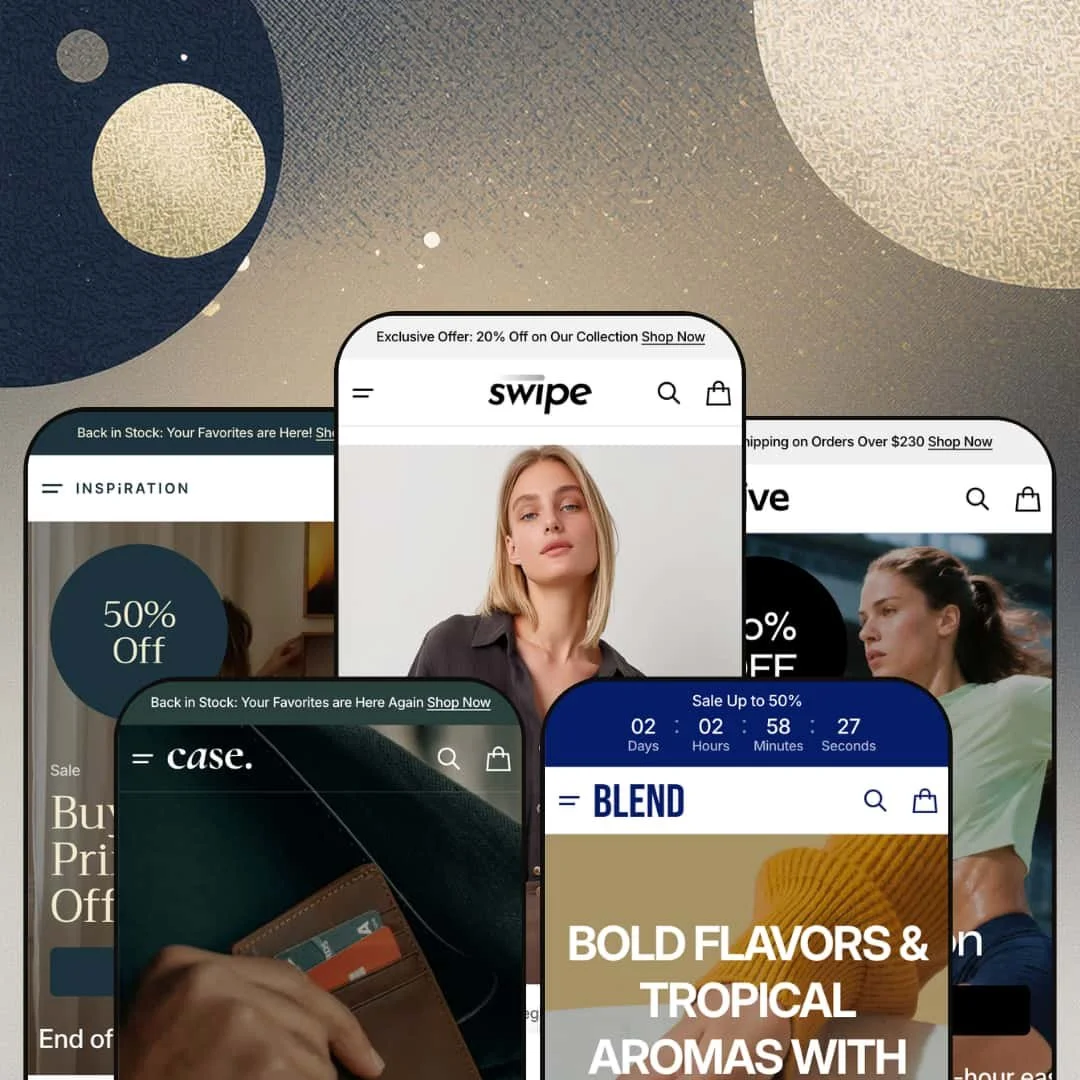
Open any of the five demos and the first thing you feel is motion: the whole thing is built to behave like a phone app, not a web page. Swipe leans hard into that idea, wiring quick view, quick buy, a slide-out cart, and a stack of urgency tools into an Online Store 2.0 architecture that spreads the same toolkit across clothing, leather goods, activewear, a bakery, and a coffee roastery. The question that kept surfacing as I clicked through was whether one feature set can really carry five different storefronts without thinning out somewhere. For a $380 theme aimed at conversion-first merchants, that breadth is the whole pitch.
A conversion toolkit that comes assembled
Quick view, quick buy, a slide-out cart, stock counters, badges, countdowns, and promo popups all ship as one coordinated merchandising kit, not scattered toggles. It comes assembled. The urgency layer is wired and styled out of the box, so the real work for a new store is editing it down to taste rather than building each piece up from nothing. For a conversion-focused merchant on a mid-market catalog of 50 to 200 SKUs, that head start saves a stack of app installs and integration time.
One license, five genuinely different storefronts
Merchants who run more than one brand, or who expect to pivot vertical, get unusual mileage here. Swipe ships five presets that aren't just recolors: a linen apparel shop, a leather-goods boutique, an activewear store, a bakery, and a coffee roaster, each with its own merchandising rhythm. The bakery preset alone, with live stock counts and allergen fields, could anchor a food store. That's broad coverage from a single $380 purchase.
Variant rendering that adapts to the product
Across the demos the variant system flexes to fit what's being sold: color swatches for apparel, a two-axis Material-and-Style picker for wallets, and ingredient-and-allergen fields for a loaf of bread. The picker bends to the catalog. Picker styles switch between button pills and dropdowns, and a size-guide modal is on hand where fit matters, which keeps options handling inside the theme instead of a separate app. For apparel and accessories sellers with multi-attribute products and fit-sensitive buyers, that coverage matters.
A section library deep enough to restage, not just recolor
The shared building blocks go well beyond the basics: before/after sliders, image-hotspot product markers, a tabbed product feed, item-of-the-week spotlights, a ticker, testimonials, and a multi-column mega menu that carries featured-product tiles and promo banners. There's a lot in the box. Header and footer both offer real structure rather than a fixed strip, with menu, image, and newsletter blocks to arrange. For a single-brand merchant on a larger catalog who wants a distinctive homepage without a separate page-builder app, that range is the difference between editing and designing.
Premium price, but not the newest architecture
At $380, Swipe sits at the top of the standard premium band. The price sits high. It's built on Online Store 2.0 rather than the newer block-based generation, which in practice means section nesting and editor flexibility stop short of what the latest architecture allows, even though the section count itself is generous. For a merchant who plans to heavily customize layouts over several years, or who specifically wants deep nested-block editing, that ceiling is worth weighing before buying.
The defaults assume a big, busy catalog
Every preset is staged dense, with full product feeds, multiple promo bands, and editorial imagery in every slot. The default is dense. A merchant launching lean will spend the first effort subtracting rather than adding, because a half-filled version of these layouts reads as empty instead of minimal. For a small-catalog or single-product brand under 30 SKUs selling considered, higher-ticket goods, the theme's instincts pull the wrong way.
Breadth means every preset still needs a point of view
Because the five demos target genuinely different verticals, none is a neutral base you can ship close to as-is. There's no shortcut preset here. Whichever one a merchant picks, the brand voice, imagery, and copy are tuned to a fictional store and need a thorough pass before they read as the merchant's own. This lands hardest on a first-time founder on a tight launch timeline running a single-brand store, who may expect a preset to be closer to turnkey than it is.
What it takes to launch
Expect a multi-day pass to replace the fictional brand voice across hero captions, the About narrative, FAQ entries, and blog content, to repopulate product imagery and any metafield-driven fields such as ingredient or stock data, and to subtract or restage the denser promo sections toward your actual catalog and sales calendar.
-
What works in this preset
Landing on the linen storefront, the homepage just keeps unfolding. A multi-image hero gives way to a banner grid of seasonal tiles, then a shop-the-look section with clickable product markers layered over an editorial photo, then a tabbed "More to Love" feed that swaps between bestsellers, sale, and category views. The page rarely sits still. It's the most maximal of the five demos.
The product pages are where the apparel focus shows. A size-guide modal sits next to the variant picker, colorways render as swatches rather than text, and the gallery options run from a stacked scroll to a slideshow. For a clothing catalog with fit-sensitive buyers, those are the right defaults.
What stood out was the restraint hiding inside all that density. Below the product feeds, a tidy FAQ accordion, a four-up trust row, and a clean "Style Edit" journal grid give the eye somewhere to rest. The structure carries a big catalog without feeling like a wall.
Where it stumbles
The maximalism cuts both ways. A merchant with a tight capsule line of under 30 SKUs will spend real effort deciding which sections to switch off, because the demo's rhythm depends on having enough product and editorial imagery to fill every band. Staged lean, the same layout can read half-empty rather than curated.
-
What works in this preset
Case dials the energy down and lets the product carry the page. The hero stacks four quiet category statements, and an "Item of the Day" block pairs a single wallet with a full gallery, the kind of single-product spotlight that suits a considered purchase. Restraint is the whole personality. Card holders and document covers carry color swatches, while a flagship wallet runs a two-axis Material-and-Style picker rendered as button groups rather than dropdowns.
I went looking for the seams and found mostly polish. An "In High Demand" promo trio, a testimonial row, and an About band carrying the full-grain and RFID story round things out, so the page lands like a brand rather than a sample. For accessories sold on material and finish, the native variant picker does the heavy lifting cleanly.
Where it stumbles
The quietness has a flip side. Case is staged for a small, premium catalog, so a merchant bringing hundreds of SKUs across many categories will find the single-spotlight rhythm working against them, and will lean on the collection and filter templates the theme also ships rather than the homepage's boutique pacing.
-
What works in this preset
Strive is the loudest of the family, and it owns it. A full-bleed sale hero rolls straight into a scrolling ticker that repeats the brand promise, a six-tile lifestyle category grid, and a 50%-off countdown band that frames the whole storefront as a running promotion. The demo is tuned for momentum. A "Most Sought-After Sports Sets" block even pairs leggings with matching bras as a shop-the-set unit.
So what keeps it from tipping into chaos? Mostly type and spacing: the clean sans headings and generous gaps hold the energy steady even with a ticker, a countdown, and three sale bands stacked on one page. For a flash-drop, impulse-buy activewear shop, the relentlessness is a feature, not a bug.
Where it stumbles
All that urgency assumes a sale is always on. For an evergreen activewear brand that rarely discounts, the countdown band and the 50%-off framing will feel off-brand, and re-staging the demo toward full-price, repeat-buyer merchandising is a deliberate editing pass rather than a quick swap.
-
What works in this preset
Inspiration is the outlier, and the most interesting demo of the set. It dresses the same engine as a neighborhood bakery: a soft three-slide story hero, a "Freshly Baked Favorites" feed, and product cards that show live stock levels like "In stock (38)" and "Low Stock (14)". It feels hand-built.
The product page leans into something the bakery framing demands. It uses the theme's ingredient and nutrition fields to surface allergen and grain details on a loaf listing, while a store-pickup notice and a free-shipping progress bar sit alongside. The other demos stage their product pages without these blocks; here they're the point. For a bakery, grocer, or supplement seller working with dietary attributes, that's useful staging.
This is the demo that made me reconsider the theme's range. A bakery storefront with stock counters and pickup logic is a long way from a linen lookbook, and the fact that one section library stretches to both says something about how configurable the underlying kit is.
Where it stumbles
It's a double-edged demo. Because Inspiration is staged so differently from its siblings, a merchant who buys Swipe expecting this exact bakery layout will be rebuilding toward it rather than recoloring, since the food merchandising here is as much a configuration achievement as a starting point.
-
What works in this preset
Blend organizes everything around origin. The navigation and collection structure both split the catalog by country, so the storefront reads like a roaster's menu of single origins rather than a generic shop with everything in one bin. It's a clean fit for category depth. A top-of-page countdown and an "Item of the Week" spotlight keep one origin in focus at a time.
I kept scrolling expecting the coffee theme to thin out, and it didn't. A three-slide editorial hero near the foot of the page, a "Popular Brands" logo strip, a sustainability trust row, and a roastery "About" band carry the storytelling well past the product grids. For a single-origin roaster or a subscription-leaning coffee brand, the depth holds up.
The same engine genuinely changes shape
Clicking through all five in a row, the strongest impression isn't any single feature; it's how far one section library bends. The chassis is genuinely flexible. The food preset's stock counters and pickup logic sit on the same foundation as the apparel lookbook and the coffee roaster's origin menu, and that elasticity is hard to fake with cosmetic theming alone.
The mobile-app instinct shows in the structure
The "native app" pitch isn't only marketing copy. It feels built for thumbs. Sticky elements, the slide-out cart, and a back-stacking mobile menu show up consistently across every preset, which gives the whole family a coherent handheld feel rather than a desktop layout squeezed down to fit a phone.
The breadth carries an editing tax
Read together, the demos prioritize showroom impact over launch-readiness. The demos sell hard. Every preset is dressed to impress in a screenshot, which is exactly what moves a theme off the shelf, but it means the gap between "looks like the demo" and "ready for my catalog" is genuinely wide, and that distance is the buyer's to close.
A short public track record
One practical note rather than a knock: the theme carries only a handful of Theme Store reviews so far, all of them positive but few in number. There's less of a long public history to lean on than with long-established themes, so early buyers are weighing the demos and the developer's around-the-clock support promise more than a deep review record.
★ 8.2/10
Rating
-
The merchandising and conversion toolkit is unusually complete out of the box, from quick buy and stock counters to image hotspots and ingredient fields.
9
-
The section library is approachable, but the dense default staging means most merchants start by subtracting, which takes time to judge well.
7
-
The app-like intent is consistent: sticky cart, slide-out drawer, and a back-stacking mobile menu across every preset.
9
-
Homepages lean on heavy imagery and many sections, so trimming unused bands matters for keeping the long demo pages quick.
7
-
Five distinct presets plus a broad section, header, and footer toolkit give real room to restage rather than just recolor.
9
Frequently Asked Questions
-
Inspiration. It's the only demo staged with live stock counters, store-pickup messaging, and ingredient or allergen fields wired into the product page.
-
No. Those ship with the theme and appear staged in the demos, though live behaviors like the countdown only animate on a working storefront rather than in a static preview.
-
A fair amount. The demos are built dense, so plan on enough lifestyle imagery and catalog depth to fill the homepage bands, or switch some of them off.
-
Yes. The Case demo runs a Material-and-Style two-axis picker as button groups, and other presets show color swatches and dropdown variants.
-
Mid-to-larger catalogs. The layouts assume enough products to populate feeds, tabs, and category grids without looking sparse.
-
It includes right-to-left support and pre-translated EU theme strings (EN, FR, IT, DE, ES). Product translation and currency conversion themselves are handled by Shopify's market settings, not the theme.
This review is based on hands-on testing of the publicly available preset demos of the Swipe Shopify theme as of May 2026. Theme features, preset availability, and performance can change with subsequent updates from the theme developer.