
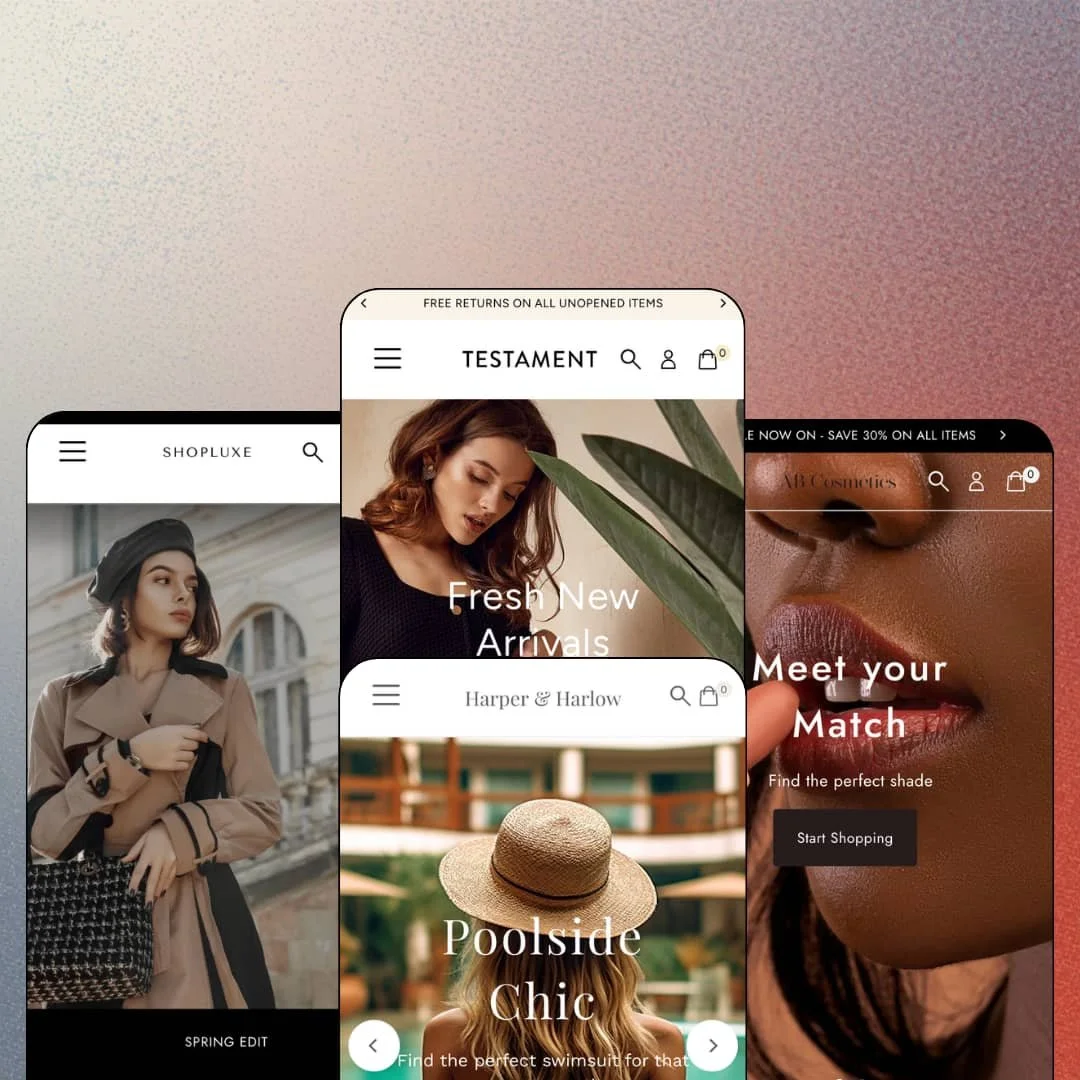
Some themes decorate a catalog; Testament merchandises it. We Are Underground's $250 theme puts size buttons, color swatches, countdowns, and stock warnings everywhere a shopper might hesitate, and it does so on Shopify's Online Store 2.0 section architecture, so every one of those mechanics is drag-and-drop rather than code. I spent time in all four preset demos, from a womenswear boutique to a handbag showroom, and the same conviction runs through each: the storefront's job is to close. Whether that conviction fits your brand is the real question this review needs to answer.
Variant selection lives on the product card
Collection cards expose the actual purchase decision in the grid: dress size runs in the fashion preset, full boot sizes from 2 to 8 in the accessories preset, shade swatches in the beauty preset. That removes the load-a-product-page step that costs conversions on sized goods, with no app involved. Apparel, swimwear and beauty brands selling size- or shade-driven catalogs get the most out of it.
The product page answers objections in place
The buy area carries a slim-to-oversized fit scale, a live low-stock line, a quantity stepper and a color module that gathers sibling shades behind one control. Tabs below hold care notes, a size guide with real measurement conversion tables, shipping and returns, and an embedded contact form. A hesitant shopper never has to leave the page to resolve the doubt that would have stopped the order, which matters most for fit-sensitive apparel and footwear.
Native promotion toolkit deep enough to retire apps
Rotating announcement bars, scrolling tickers, countdown sections that run on the homepage and the product page, discount tile carousels and newsletter popups are all built in. A merchant running monthly offers can stage an entire campaign from the theme editor instead of stacking paid app subscriptions. Stores with a sale on the calendar every month recover real budget here.
Four presets that are separate builds, not recolors
This is rarer than it sounds. The beauty preset rearranges the header and runs multi-currency, the swimwear preset leads with campaign video and pre-order states, the accessories preset is tab-driven with an ethics-forward video block, and the flagship plays the classic boutique. Anyone comparing multi-preset families gets four genuinely different structural starting points from one section library.
The review layer is presentation, not machinery
Star ratings appear on demo product cards and product pages, yet nothing in the theme's own feature set collects or manages reviews. The stars are scenery. The moment you want a customer to actually leave one, you are installing and paying for a review app, so budget for it from day one rather than discovering the gap after launch.
Colorway siblings create catalog homework
The color module on the product page is built around colorways living as separate listings, and the fashion demo stages several styles exactly that way. It works beautifully for the shopper. For the merchant, every new color means a full product entry to create, describe, photograph and keep in sync, so a twenty-style catalog with four colors each quietly becomes eighty listings to maintain in parallel.
Online Store 2.0 architecture at a 2026 price
The foundation is proven, not new. Testament's section model is the same generational architecture that Shopify's free Dawn theme ships with, and newer releases built on nested theme blocks allow finer-grained editing. What the $250 buys is the merchandising layer and the four staged builds on top of it, which is worth naming plainly before committing.
What it takes to launch
Plan a full staging pass before publishing. The demos preview the checklist: product titles that drift from their listings, boilerplate placeholders left in policy tabs, countdown timers still running past their end dates, near-duplicate demo products, one demo introducing itself under an older internal preset name, and the beauty demo built on a real cosmetics brand's naming that no merchant could ship. Your own work runs to structuring colorway listings, populating size chart tables, configuring the fit scale per product, writing the tabbed product content, and either scheduling or switching off each promotion surface.
-
What works in this preset
The flagship demo stages a womenswear boutique that opens with a two-slide hero and a rotating announcement bar carrying shipping, returns, and cutoff messages alongside social icons. It reads like a store that has an operations team behind it, not just a lookbook.
Further down, a product-focus hero gives a single playsuit the full-width treatment with its own headline and buy link, and a testimonial section ties each quote to the product it praises. That linkage is smarter than the usual anonymous quote wall because a skeptical shopper can jump straight from praise to purchase.
A press logo carousel with names like Vogue and Elle, a blog feed, and an Instagram gallery that plays video round out the lower page. The result is a homepage that layers authority signals between selling moments instead of stacking them all at the top.
Where it stumbles
The staging leads with urgency before it establishes identity. A countdown block and a carousel of discount tiles sit high on the page, so a first-time visitor meets the sale before they meet the brand, which is a defensible choice for an outlet store but an odd one for a boutique positioning itself around polished lifestyle photography.
The product grid also mixes two variant grammars: some dresses expose size runs, while neighboring styles present color links that lead to sibling listings. Shoppers adapt, but the grid never quite settles into one consistent interaction pattern.
-
What works in this preset
Exodus restyles the system as a cosmetics counter, and it is the demo where variants shine brightest. Lipstick shades sit on the cards as proper swatches of a single product, so the catalog feels dense with choice without ballooning into dozens of near-duplicate listings.
The header moves the logo left and the demo runs a three-currency setup, which quietly proves the layout is not locked to the flagship's arrangement. A scrolling ticker pushes a discount code across the page, and tabbed featured collections split the assortment into duos, glosses, and lipsticks without leaving the homepage.
A values banner about planet-positive sourcing breaks up the promotion with a brand note. It is a small thing, but it keeps the page from reading as one continuous discount.
Where it stumbles
The discount voice saturates everything. Between the announcement bar, the ticker, and the code repeated in section copy, the same offer appears three or four times before the fold, and a beauty brand trading on desirability may find that rhythm works against the shelf appeal the photography is trying to build.
The homepage tabs also mirror the navigation menu almost one-to-one, so the tabbed section restates choices the header already offers rather than surfacing a different cut of the catalog.
-
What works in this preset
Revelation is the campaign preset. A three-slide hero flows into a full-width video section built around a branded hashtag, and focus blocks on fabrics and prints give the page an editorial spine that the other demos mostly lack.
The commerce layer stays sharp underneath the styling. Tabbed collections carry a native pre-order badge on an upcoming one-piece and a sale badge with struck-through pricing on a bottom, while bralettes display from-pricing that acknowledges their size-based price spread honestly.
A brand-story block positions the store as a multi-label swimwear destination, and the announcement bar picks up a TikTok icon, a nice nod to where swimwear discovery actually happens in 2026.
Where it stumbles
Urgency mechanics stack thickly here: a ticker, a countdown, and sale badges all compete on one page, and for a category where shoppers browse across sessions before committing, the pressure can feel misjudged rather than motivating.
-
What works in this preset
Genesis stages handbags, wallets, and boots, and its opening move is the strongest tab implementation of the four: three product categories in one section, each tab loading its own grid, which compresses an entire storefront's breadth into a single scroll position.
What struck me most was the video block pairing craft footage with an ethical-production message, followed by a product-focus hero that gives one structured tote a proper introduction with three finishes called out in the copy. The page sells a point of view about the products, not just the products.
Split banners route visitors into a lookbook and a style guide, and the collection list publishes item counts per category. Counts are an underrated honesty feature, since they set expectations before the click.
Where it stumbles
The catalog is thin for the architecture wrapped around it. Roughly twenty items feed three category tabs plus a favorites row, so the same totes and wallets reappear several times on one homepage, and the repetition becomes noticeable within two scrolls.
One conviction carried through four storefronts
Read the presets side by side and the same belief surfaces in each: the storefront exists to close, and every screen should hand the shopper a decision they can act on. Fashion does it with size buttons, beauty with shade swatches, swimwear with pre-order and sale states, accessories with category tabs. That coherence is what separates a theme family from a folder of layouts.
The section library flexes further than most demos reveal
The same components produce a left-aligned multi-currency header in one demo and a centred boutique header in another, a campaign video spine here and a three-tab catalog compression there. Nothing needed a different architecture to get there. For a merchant, that means the preset you start from is a starting point rather than a ceiling.
Nine years of continuous refinement, still shipping
Testament launched in February 2017 and received its most recent feature update in August 2026. A record that long tells you the merchandising depth was accumulated rather than designed in one pass, and it answers the question every buyer of an older theme should ask about whether support will still be there next year.
One page grammar underneath four looks
Every homepage walks the same sequence: announcement, hero, tabbed or featured collections, focus hero, social proof, newsletter. The styling differentiates convincingly, but the rhythm a returning visitor experiences is identical across the family. Merchants wanting a structurally unusual storefront will be rebuilding the section order themselves.
Listed for food and drink, built for fashion
The Theme Store names Food & Drink alongside Jewelry & Accessories as target industries, yet no preset addresses consumables and none of the sections handle the things food sellers need, such as nutrition data or subscription-style replenishment. A grocery or pantry brand would be starting from a fashion foundation and adapting.
Campaign sections presume campaign assets
Full-width video, editorial focus blocks, lookbook banners and press logo rows all expect material a brand has commissioned. Without that library, the layouts either sit empty or get filled with stock imagery that undercuts the polish. First-time sellers should count the photography and video budget as part of the theme's real cost.
★ 7.6/10
Rating
-
A deep native toolkit for the price: card-level variant selection, pre-order, stock counters, countdowns, promo tiles, popups, mega menu, age verifier, size charts, and lookbooks all ship built in. Reviews and subscriptions are the two notable app dependencies.
8
-
Online Store 2.0 sections keep everything drag-and-drop, and the tabbed product content is straightforward to populate. The sheer number of promotion surfaces means launch involves deliberately switching things off, and the colorway-sibling structure asks for catalog planning before you import products.
7
-
All four demos present cleanly at phone width, with the announcement rotation, tabbed collections, and card-level size buttons all remaining usable on small screens. The swimwear demo's video section and the accessories demo's category tabs translate to mobile without layout compromises.
8
-
The staged homepages carry slideshows, video sections, carousels, and long section stacks, so there is a meaningful amount of content to load. Pages felt responsive once rendered, but merchants replicating the demo density should expect to curate section count with load times in mind.
7
-
Four presets with genuinely different structures (boutique, cosmetics counter, campaign-led swimwear, tab-driven accessories) plus rearrangeable headers and 30+ sections demonstrate real range. The shared underlying page rhythm is the main constraint on how unusual a layout can get without manual restructuring.
8
Frequently Asked Questions
-
Testament is a one-time $250 purchase on the Shopify Theme Store, which includes all four presets (Testament, Exodus, Revelation, Genesis), free updates, and developer support. You can try it free on an unpublished store before paying.
-
Yes. The theme launched in February 2017 and received its most recent update in August 2026 (version 15.4.0, adding color palette options), which is an unusually long and consistent maintenance record.
-
The developer positions it for catalogs from around a dozen up to a hundred-plus products. The curated homepage sections reward mid-sized catalogs; very small catalogs will feel repetitive in the tabbed layouts, as the accessories demo shows.
-
Yes, all three are built in, alongside promo popups, promo tiles, a mega menu, an age verifier, size charts, lookbooks, and in-store pickup support. Combined Listings support is included for Shopify Plus stores.
-
For product reviews, yes: the theme displays ratings but has no review-collection engine of its own. Subscriptions would also require an app. Most promotion and urgency features that other stores buy apps for are already native here.
-
The interface ships with English, French, Italian, German, and Spanish translations, and the demos run live language selectors alongside multi-currency configurations.
This review is based on hands-on testing of the publicly available preset demos of the Testament Shopify theme as of August 2026. Theme features, preset availability, and performance can change with subsequent updates from the theme developer.